Pensacola man charged with aggravated child abuse after 3-year-old injured
A Pensacola man has been charged with aggravated child abuse after authorities say he punched a 3-year-old boy in the mouth, leaving the child injured.
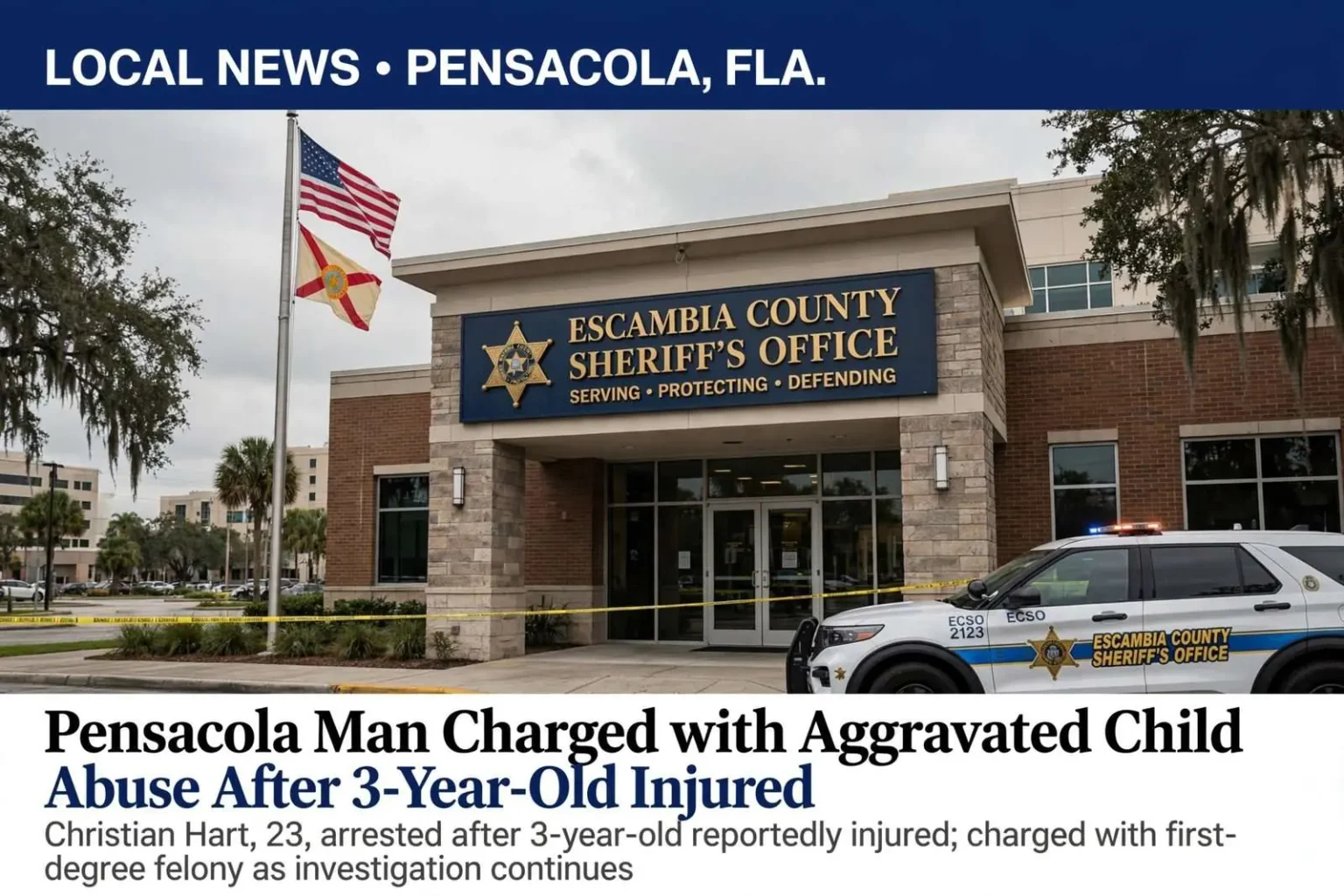
PENSACOLA, Fla. — A Pensacola man has been charged with aggravated child abuse after police say he punched a 3-year-old boy in the mouth, leaving the child injured. Christian Hart, 23, was identified by the Escambia County Sheriff’s Office as the suspect.
According to investigators, the boy’s mother found him bleeding from the mouth and, when she confronted Hart, saw him strike the child before leaving the home. A witness told deputies the boy was found with swelling and redness on his upper lip after Hart reportedly hopped a fence and got into a vehicle. The case remains under investigation.
The charge at the center of the case, aggravated child abuse, is among the most serious offenses in Florida’s criminal code. Under state law, a person commits the crime by willfully torturing, maliciously punishing or caging a child, or by willfully and unlawfully causing great bodily harm, permanent disability or permanent disfigurement to a child. It is classified as a first-degree felony, a category that carries the possibility of up to 30 years in prison upon conviction, reflecting the state’s determination to treat violence against young children as a crime of the highest gravity short of homicide.
How the system responds to these cases
Reports involving injuries to children as young as this one typically move on an accelerated track, and for good reason. A 3-year-old cannot explain what happened in words an investigator can rely on, so the case is built from the physical evidence, the medical findings and the accounts of the adults present. Injuries inside a home are also documented with particular care because the account a caregiver offers must be consistent with the nature of the injury — a standard forensic principle that has guided child-abuse medicine since its development in the 1960s. Discrepancies between what witnesses describe and what the medical examination shows are often what elevate an investigation from a report to a prosecution.
When a report of harm to a young child reaches law enforcement in Florida, the response quickly becomes a coordinated one. Deputies or officers secure the scene and make certain the child is safe; the Florida Department of Children and Families is contacted, and its child protective investigators assess the home, interview the parties involved and determine what protections the child needs going forward. Medical evaluation is a central piece of the process — injuries to a child this young are documented not only for treatment but for evidentiary purposes, with findings recorded in detail by emergency physicians or specialized child-protection medical teams.
Escambia County’s courts handle these prosecutions through the State Attorney’s Office for the First Judicial Circuit, which covers Escambia, Santa Rosa, Okaloosa and Walton counties. Prosecutors review the sheriff’s investigation, witness statements and medical documentation before deciding how to proceed with charges, and cases involving child victims frequently include testimony from medical experts, forensic interviewers and family members. Florida law provides protections for young victims in the courtroom, including provisions that can limit a child’s direct testimony and allow alternative means of presentation where appropriate.
Children’s Advocacy Center resources in the Pensacola area play a role in cases like this as well. The community’s child-protection infrastructure — built over decades by prosecutors, deputies, medical providers and social workers — is designed so that a child is interviewed once, by a trained specialist, in a setting that minimizes additional trauma. That model, now standard across Florida and the country, exists because repeated interviews by multiple agencies were found to compound harm and degrade the reliability of young children’s accounts.
The Escambia County Sheriff’s Office
The Escambia County Sheriff’s Office, the primary law enforcement agency for Florida’s westernmost county, investigates thousands of incidents a year across a jurisdiction that stretches from the Alabama line to Perdido Key and includes the unincorporated areas surrounding the city of Pensacola. The agency’s patrol and investigative divisions work cases ranging from property crimes to major violence, and its deputies are often the first adults a child in crisis encounters after a report is made. Cases involving child victims are handled with protocols intended to move quickly: identifying the person responsible, documenting evidence while it is fresh, and connecting the family with the state agencies that determine long-term protective arrangements.
Pensacola itself is the county seat and the largest city in the Florida Panhandle, a community of roughly 54,000 residents within a metro area of about half a million people that includes the naval air station, a heavy military presence and a tourism economy built on some of the country’s most visited beaches. Behind the postcard image, Escambia County faces social challenges familiar to communities across the South, and its child-welfare caseload reflects them. Local agencies have repeatedly urged residents to report suspected child abuse promptly, noting that early intervention — by law enforcement, pediatricians, teachers or neighbors — is the single most effective protection a vulnerable child has.
What happens next
With the suspect charged, the case moves into the standard sequence of the criminal process. An arrest on a first-degree felony charge is followed by a first appearance before a judge, where bond conditions are addressed, and then by the prosecutors’ review of the complete investigation. If the case proceeds, it moves through arraignment, pretrial motions and either a plea or trial, a process that can take many months. Separate from the criminal case, the dependency process run by the Department of Children and Families and the courts determines where the child will live and what services the family will receive, decisions made on a different track and timeline from the prosecution itself.
Investigators continued to develop the case in the days after the initial report, a reminder that charging documents represent an early snapshot rather than a complete account. Details contained in an initial release — what witnesses saw, the sequence of events inside the home, the circumstances of the departure described in the report — are typically tested and expanded as detectives complete interviews and review medical and physical evidence. Where the investigation leads beyond the initial charge, prosecutors in Florida have latitude to present the full set of facts to a grand jury, and additional counts can be added as evidence warrants.
The presence of multiple witnesses, including the mother and the person who described the child’s injuries, gives investigators a foundation most such cases lack. Witness availability and consistency over time will be factors in how the prosecution proceeds, which is why deputies work to secure formal interviews early rather than relying on the statements taken at the scene on the day of the report.
The toll of child abuse and where help exists
Child welfare advocates emphasize that cases like this one, however shocking, fit a pattern that communities confront continuously. National child-protection data consistently show that children under the age of 4 are at the greatest risk of serious harm from abuse, with perpetrators most often caregivers or adults close to the household — a reality that makes vigilance by everyone in a child’s orbit essential. Toddler-age victims cannot report abuse themselves in any reliable way, so the adults around them — parents, relatives, neighbors, child care providers — are effectively their only reporters, and delayed disclosure is one of the factors that allows abuse of the youngest children to continue.
Florida’s child abuse reporting framework gives every resident a role. State law requires certain professionals — teachers, medical providers, social workers and others in frequent contact with children — to report suspected abuse or neglect, and the state’s toll-free abuse hotline accepts calls from any member of the public who has reason to believe a child is being harmed. Reports can be made anonymously, and the law shields good-faith reporters from liability. Authorities stress that residents should never hesitate to call out of uncertainty — screening the report is the system’s job, not the caller’s. In Escambia County, reports are routed to the protective investigators who assess the child’s safety and, where necessary, involve law enforcement — as happened in this case.
The region’s support resources extend beyond crisis response. Local organizations offer parenting programs, respite care and family-strengthening services aimed at preventing the conditions under which abuse occurs, and pediatric practices across the Pensacola area screen for developmental and safety concerns at well-child visits. Community leaders in the Panhandle have long argued that the most effective child protection happens before law enforcement is ever called, through connected families, accessible mental health care and adults willing to intervene when a child shows signs of injury or fear.
For now, the 3-year-old at the center of this case is in the care of those responsible for his protection, and the criminal case against the 23-year-old charged in his injury rests with the courts. The investigation remains open, and additional information will be released as it becomes appropriate.