Pensacola man sentenced to 17+ years for attacking girlfriend inside Family Dollar
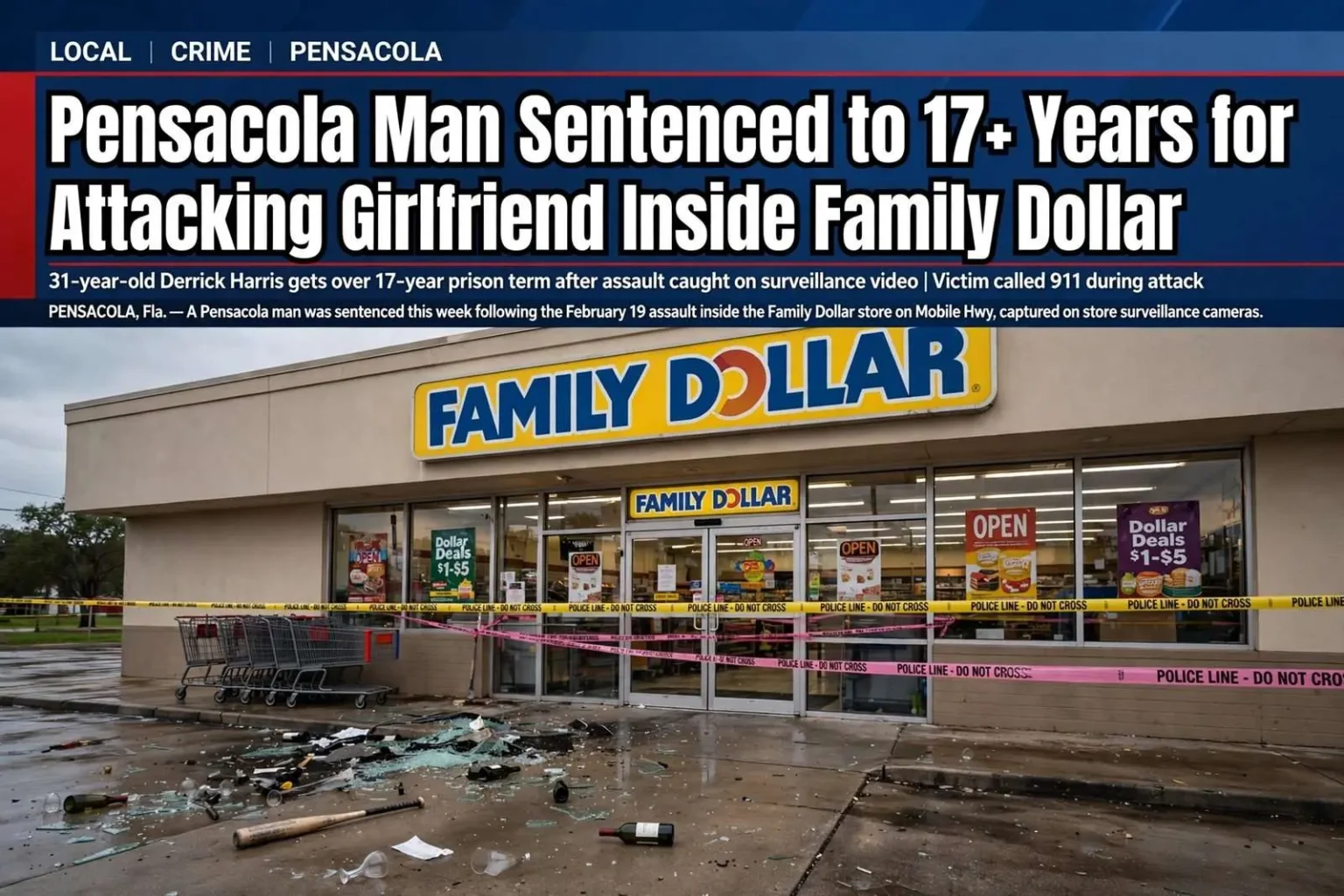
A Pensacola man has been sentenced to more than 17 years in prison for attacking his girlfriend inside a Family Dollar store, according to court records. Prosecutors said 31-year-old Derrick Harris got into an argument with the victim inside the Pensacola store on Feb. 19, and what began as a dispute escalated into a series of assaults that unfolded in front of employees and customers, much of it captured on the store’s surveillance cameras.
After leaving the store following the initial argument, Harris returned as the victim was checking out and punched her in the face when store employees told him to leave. The attack did not end there. While the victim was on the phone with 911, Harris came back again, knocked her to the floor and struck her several times, according to prosecutors. Store employees tried to intervene, and a manager grabbed a baseball bat and ordered everyone behind her before Harris took the bat from her, swung it at the victim’s head, missed, and struck bottles of wine and other items before leaving the store.
An attack caught on camera
Surveillance footage has become a decisive form of evidence in retail store prosecutions, and this case illustrates why. Cameras inside a discount store record continuously, with fixed angles covering the registers and aisles, and they capture not only the defendant’s actions but the sequence of events that led to them. When a case goes before a judge, that footage removes the arguments that often cloud assault prosecutions, because the attack is no longer a matter of competing accounts but a recorded series of acts.
The recording also documented the conduct of everyone else in the store. Employees who tried to intervene and a manager who armed herself with a baseball bat and moved customers out of the way were acting under genuinely dangerous conditions, and the footage preserved exactly what they did and when. Courts and prosecutors take that kind of testimony seriously, and the fact that workers put themselves between an attacker and his victim is part of the record of what happened inside the store that day.
How the case moved through court
Prosecutions like this one proceed through the Escambia County court system, where the State Attorney’s office reviews the evidence, files charges, and negotiates or tries the case to a conclusion. A sentence of more than 17 years reflects the severity with which the justice system treats repeated, sustained attacks on an intimate partner, particularly one committed in a public place, in front of witnesses, against a victim who was calling 911 when the blows landed. Sentencing in Florida also accounts for a defendant’s prior record, and a term of that length generally reflects a scoring range that went beyond the incident itself.
Domestic violence cases carry particular weight in sentencing because of the relationship between the parties. Florida law treats violence against a person the defendant lives with or has a family or dating relationship with as an aggravating circumstance, and judges are required to consider the history between the parties when deciding on a sentence. A victim who is attacked by a partner faces risks that strangers do not, including continued contact after the incident and retaliation, and the courts weigh that dynamic when setting conditions for release and, eventually, the length of the term.
The role of the 911 call
The victim’s call to 911 during the attack became part of the evidence in the case. Emergency calls are recorded from the moment they connect, and the audio captures what the caller is experiencing in real time, including sounds in the background and the operator’s responses. In prosecutions, that recording can corroborate the timeline of events minute by minute, and dispatch records establish exactly when the call came in and when officers were sent.
For the victim, making that call while being beaten required the presence of mind that domestic violence advocates say is one of the most important survival tools in these situations. A phone in hand connects a victim to help even when she cannot leave the location, and dispatchers are trained to keep callers talking, gather the address and description, and update responding officers while the assault is ongoing. In a retail store, that call also alerts employees to what is happening, which is a large part of why the staff at this store reacted as quickly as they did.
What employees faced that day
Retail workers are rarely trained for anything like the situation that developed in this store, and the decisions they made in seconds had lasting consequences. A manager who grabs a weapon and orders customers to get behind her is making a judgment that the threat to the victim outweighs the risk to herself, and taking a bat away from her left her exposed while it put the weapon in the attacker’s hands. That the swing missed the victim’s head and shattered bottles instead was a matter of inches, and the outcome of this case would read very differently had it connected.
Employment experts and victim advocates note that store policies on confronting violent customers vary widely, and many chains instruct employees to prioritize their own safety and call 911 rather than physically intervene. Workers who step in anyway are protected by Florida’s use-of-force laws when defending others, but the moment remains a dangerous one, as this incident showed when the weapon changed hands. The employees here acted on instinct to protect a woman being beaten in their workplace, and the sentence the attacker received reflects the gravity of what they witnessed and tried to stop.
Domestic violence in the Pensacola area
Escambia County has long wrestled with rates of domestic violence that exceed state averages, and the local court system, law enforcement and advocacy organizations have built dedicated infrastructure around the problem. The area hosts a certified domestic violence center that provides emergency shelter, a 24-hour hotline, safety planning and court advocacy for survivors, and the county’s courts handle domestic violence injunctions through a dedicated process designed to get protective orders in front of a judge quickly. Advocates stress that the most dangerous moments in an abusive relationship often come during and after a breakup or a public confrontation, which is why safety planning matters so much once violence has occurred.
Public attacks like this one also put the issue in front of people who might otherwise think of domestic violence as a private matter. Advocates point out that these incidents spill into workplaces, stores, schools and streets constantly, and that bystanders who see an assault in progress can help by calling 911, documenting what they safely can, and staying with the victim until help arrives. The employees in this store did those things, and the footage of their response has become part of the public record of how a community reacts when violence happens in its midst.
What happens after sentencing
A prison sentence of more than 17 years means the victim and everyone who worked in that store can plan their lives around a long period without the defendant on the street. Florida requires those sentenced to prison to serve a substantial minimum portion of their terms, and victims receive notification at key points in an inmate’s status through the state’s victim notification system. Restitution orders in cases like this can also cover the victim’s medical expenses and the store’s losses from broken merchandise and damaged property.
For the victim, the end of the court case is a milestone but not a finish line. Survivors of this kind of assault often carry physical injuries, medical appointments and counseling needs long after sentencing, along with the practical work of rebuilding a sense of safety in daily routines like shopping or working. Advocacy organizations in the Pensacola area continue to offer services long after cases close, and prosecutors’ offices employ victim advocates whose job is to walk survivors through each stage of the process, from the first interview through sentencing and beyond.
The outcome of this case sends a message that prosecutors hope deters similar violence: an attack on an intimate partner in a public store, carried out in front of employees and customers and captured on camera, is treated with the full severity of the law. The surveillance video, the 911 recording, the testimony of employees and the sentence that followed all became part of the record, and the community that watched it happen in a neighborhood store will remember both the attack and the price the attacker ultimately paid for it.
A sentence with a wider purpose
Long sentences in public, recorded cases serve a function beyond the individual defendant. They give judges and prosecutors a reference point for the next case, they show victims of domestic violence that the system takes these attacks seriously, and they document for the community what a sustained assault costs the person who commits it. Every element of this incident, from the argument that started it to the baseball bat that ended up swinging at a woman’s head, unfolded in a matter of minutes inside a store where people were doing nothing more dangerous than shopping, and the penalty that followed reflects how far that behavior falls outside what a community will accept.