Pensacola protest organizer tells mayor ‘we are here to stay until we get change’
Pensacola Mayor Grover Robinson asked peaceful protesters to leave Graffiti Bridge as organizer Kyle Cole said they will stay until they see change.
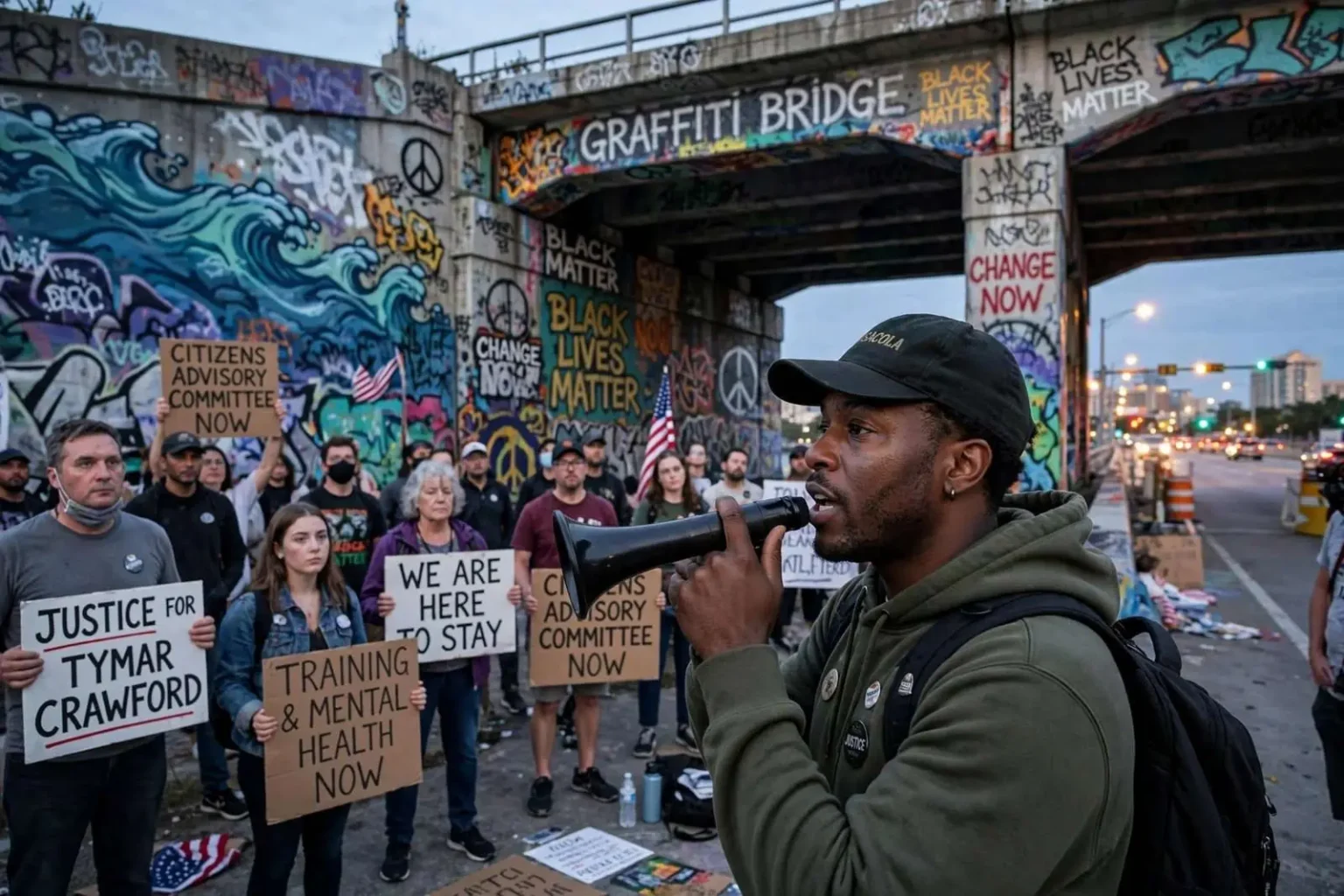
Pensacola Mayor Grover Robinson is asking peaceful protesters to leave Graffiti Bridge after some demonstrators stepped into the street at the Three Mile Bridge over the weekend. The appeal came as nightly demonstrations at the long-standing waterfront landmark entered another week, and after video surfaced that raised the stakes for everyone involved.
“We are here to stay until we get changes,” protest organizer Kyle Cole told demonstrators Monday as they rallied around him.
Cole and others are demanding changes within the Pensacola Police Department, beginning with more training and mental health services for officers. “We’re asking for things that you as a mayor can change right now today by the stroke of your pen, by the clicks of your keyboard. If we cannot get that, don’t even ask for us to move,” Cole said.
The standoff crystallized the tension between two legitimate concerns: demonstrators determined to keep pressure on city government, and a city administration responsible for keeping one of Pensacola’s busiest corridors safe for the drivers and pedestrians on it.
Robinson has asked peaceful protesters to relocate, suggesting a spot such as city hall. The request came after some people entered the roadway and video appeared to show someone struck by a car and carried on the hood across the Three Mile Bridge — the segment of Bayou Parkway where the Graffiti Bridge railroad underpass crosses, and where the evening gatherings had spilled out of the structure and into the roadway.
“I said if they wanted to stay there through Wednesday that that was fine and certainly understandable; however, after that we need to be working on a different location that perhaps does not create so much traffic confusion, congestion or potential risk of impact, someone getting hit,” Robinson said, recounting his conversation with Cole.
The Bridge That Became a Movement
Graffiti Bridge occupies a singular place in Pensacola’s public life. The century-old CSX railroad underpass on Tarragona Street, legally a sanctioned graffiti wall, has long served as the city’s open-air canvas — a place where residents paint memorials, birthday messages and tributes, and where the artwork shifts week to week. When protests erupted across the country in the summer of 2020, the bridge became the natural gathering point, its surface repainted daily with the names and demands of the moment.
That visibility is what made it powerful. Drivers crossing the Three Mile Bridge into downtown passed the crowds directly, which meant every evening demonstration doubled as a message to thousands of commuters. But the same geometry created the danger the mayor described: a protest standing at the mouth of a bridge approach is a protest standing in traffic, with the risk that a distracted or confused driver produces the kind of incident the video appeared to capture.
Cole’s response to the relocation request drew a line between the movement’s means and its ends. The demand — policy changes within the police department, deliverable by executive action — framed the continued occupation of the bridge as leverage rather than habit. In his telling, the demonstrators would trade their location for results, but not for assurances.
Tymar Crawford and the Citizens Advisory Committee
Robinson said the city is now working to create a Citizens Advisory Committee that the community demanded after a Pensacola police officer shot and killed Tymar Crawford last year. The 2019 shooting — which occurred during a struggle after officers confronted Crawford, who was wanted on a warrant — became a flashpoint in Pensacola, with residents demanding transparency and a formal channel through which the community could review and influence police practices.
Citizens advisory boards of this kind vary widely in power, and the design questions matter more than the name. A committee with access to complaint data, use-of-force reviews and input into policy can change how a department operates; one that meets, listens and files reports can become a pressure valve. Protest organizers’ insistence on “things that a mayor can change right now” reflected skepticism that advisory structures alone satisfy the demand — which is why training and mental health services, concrete and fundable, sat at the center of the list.
The mental health component has become standard in reform conversations nationwide. Departments that pair officers with mental health professionals, or train them in crisis intervention, report fewer escalations in the encounters that most often turn fatal. For a department the size of Pensacola’s, those changes are administrative decisions — precisely the “stroke of a pen” category Cole described, though each carries budget implications the mayor must manage.
Two Weeks of Pressure
By the time of Robinson’s appeal, the Graffiti Bridge demonstrations had become a fixture of Pensacola’s evenings — a rhythm of gathering, marching and speechifying that persisted through heat, rain and the risk that always attends crowds standing near traffic. The mayor’s framework was deliberate: a grace period through Wednesday, then movement. His recounting of the conversation with Cole made clear that the city’s concern was not the message but the map — where the message was delivered, and what stood next to it.
The weekend’s incident at the Three Mile Bridge approach changed the calculus. A pedestrian struck by a car, even a survivable one, converts a protest into a public safety story and gives officials grounds to insist on relocation that they would have hesitated to assert otherwise. Demonstrators understood the risk of appearing to be pushed off their ground; the mayor understood that a death on the bridge approach would be worse for everyone.
Whether the movement accepted the city hall alternative or held the bridge, the underlying negotiation remained the same: what, specifically, would the city change, and how quickly. Cole’s formulation made the trade explicit — relocation for action. Robinson’s committee plan was the first installment of the city’s answer, with the harder questions about departmental policy still ahead of it.
What Change Actually Looks Like
The demands at the center of the Pensacola demonstrations — officer training and mental health services — belong to a family of reforms that cities across the country were adopting that summer. Crisis intervention training teaches officers to recognize and de-escalate encounters involving mental illness; co-responder models pair officers with clinicians; revised use-of-force policies emphasize de-escalation and prohibit the techniques most likely to kill. Each is a policy document and a budget line, not a statute — which is why demonstrators aimed their demands at the mayor’s desk rather than the statehouse.
The Citizens Advisory Committee would supply the accountability structure that keeps those changes honest: a body empowered to receive complaints, review data and report publicly on whether the department is doing what it said it would. The committee’s composition — who appoints its members, what records it can see — would determine whether it earns the community’s trust, and organizers made clear they intended to watch that design closely.
For now, the immediate question was simpler and more physical: where Pensacola’s nightly crowds would stand. The bridge had given the movement its platform and the city its dilemma, and the negotiation between Kyle Cole and Grover Robinson would decide whether the platform moved — or whether the city’s answers moved first.
The Geometry of a Protest Site
Understanding the standoff requires understanding the ground it stood on. Graffiti Bridge carries the CSX rail line over Bayou Parkway at the northern approach to the Three Mile Bridge, one of the two principal crossings between downtown Pensacola and the growing neighborhoods to the north. The roadway beneath the span narrows to the bridge lanes, meaning crowds that assemble at the underpass are never more than a few feet from live traffic moving at bridge-approach speed.
For years that juxtaposition was the bridge’s charm — mural-covered walls beside a commuter corridor, a daily gallery for thousands of drivers. For a protest, the same spot functions as both billboard and hazard. Demonstrators at the underpass are visible to every car entering the bridge from either direction, which is precisely why the location amplified the movement’s message, and precisely why a single driver’s mistake could turn a demonstration into a casualty.
The weekend incident — video appearing to show a person struck by a car and carried on the hood across the bridge — illustrated the risk in the starkest available terms. No protest strategy survives a death at its site, and both sides of the negotiation knew it. The mayor’s appeal through Wednesday and the organizer’s insistence on staying were both positions taken with that same calculation in view.
City Hall as an Alternative
Robinson’s suggestion of city hall as a relocation site was more practical than symbolic. The plaza at the corner of Palafox and Garden streets sits in the heart of downtown, steps from Pensacola’s seat of government, with none of the traffic exposure of the bridge approach. Demonstrations there remain visible to the officials they target — the mayor’s office looks out on the same downtown the crowds would occupy — while removing the risk of bridge traffic.
The proposal also fits a pattern American cities used that summer, in which protest sites shifted from highways and bridges to civic spaces once public safety concerns mounted. The moves are always contested: organizers argue that inconvenience is the point, that a message delivered where commuters cannot avoid it carries more force than one delivered to the already-converted across from city hall. City officials counter that the first death on a bridge approach would erase any sympathy the movement had earned.
In Pensacola’s case, the protest’s demands were directed at the city itself — police training, mental health services, the advisory committee — so the argument that city hall would dilute the message had a counterweight: the audience that mattered was across the plaza, not in the passing cars. Whether the crowds moved by Wednesday, and what the city offered in return, would show how that balance resolved.
The Stakes for Pensacola
Pensacola entered this negotiation with a history that shaped both sides. The Crawford shooting the year before had left a residue of distrust between the community and the police department, and the nationwide demonstrations of 2020 gave local grievances a larger stage and a louder voice. The city’s movement toward a Citizens Advisory Committee was the visible product of that pressure, and the bridge crowds were the reason the committee was moving.
For the mayor, the task was to separate the message from the method without appearing to suppress either. For the organizers, the task was to keep the pressure on without handing the city a safety incident that justified clearing them out. Both men said versions of the same thing in those August days: nobody wanted anyone hurt, and nobody wanted the movement’s momentum lost. The bridge between those goals — in this case literally — was the negotiation itself, and it was still underway as the Wednesday deadline Robinson described approached.