Pensacola to ease COVID-19 restrictions as vaccinations expand, hospitalizations fall
Pensacola will ease COVID-19 restrictions as vaccine eligibility expands to age 60-plus and hospitalizations fall from a January peak near 300 to 68.
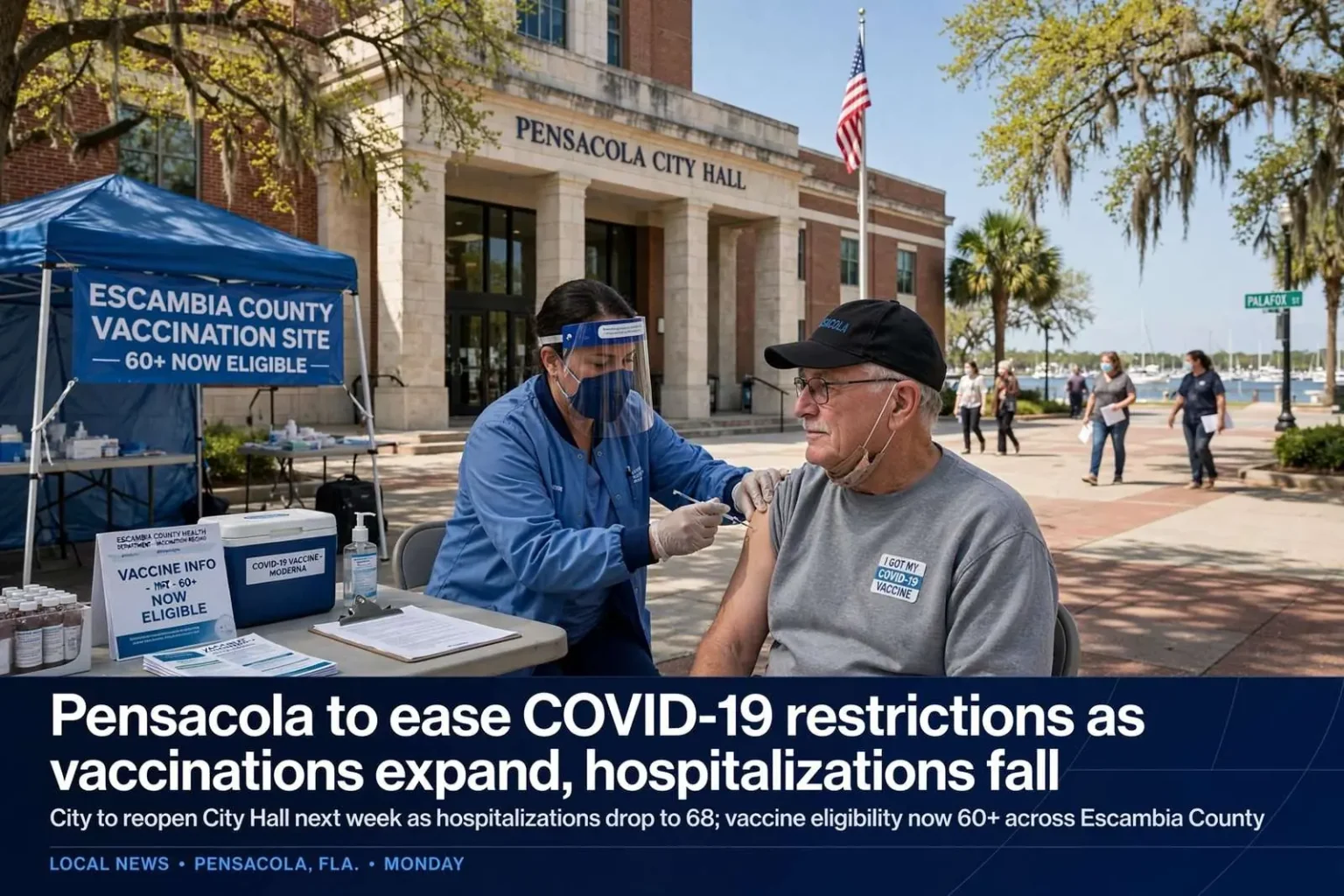
PENSACOLA, Fla. — Pensacola is preparing to loosen some of its COVID-19 restrictions as vaccination numbers climb and hospitalizations continue a steady decline, a pivot that would mark the most significant return toward normal city operations since the pandemic began. Starting Monday, eligibility for the coronavirus vaccine expands to residents age 60 and older across Escambia County, widening the pool of people who can seek appointments after months in which the doses went first to health-care workers, long-term care residents, and seniors 65 and up.
More than 47,000 people in the county had already received a shot as of this week, a figure that local officials view as the foundation for whatever reopening steps follow. Vaccination is not a condition for the city’s easing, but Mayor Grover Robinson has tied the city’s decisions to the two indicators that have governed Florida’s pandemic response from the start: the capacity of the hospital system and the trajectory of the outbreak.
The Numbers Driving the Reopening
Speaking Monday, Robinson said city hall will reopen to the public next week, ending a long stretch in which most municipal business moved online, by phone, or through drop boxes. He pointed to hospitalization figures as the city’s guidepost for reopening. The count of hospitalized COVID-19 patients had peaked near 300 in January, at the height of the winter surge, and stood at 68 on Monday, a decline of roughly three-quarters from the peak over the course of about two months.
“We feel like we’re getting to almost 50 hospitalizations,” Robinson said. “That’s why you certainly see us looking to open some things up.”
The 50-hospitalization threshold matters because it functions as the city’s tripwire. Robinson indicated that once the number drops below 50, the city could lift additional limits, restoring activities and access points that have been curtailed since the pandemic’s early waves. The metric has the advantage of being hard to game and easy to understand: it reflects not how many cases are reported, which varies with testing volume, but how sick the community actually is at any given moment.
Local health officials have watched the same curve. Hospitalizations lag infections by several weeks, so a sustained decline in the count means transmission was falling weeks earlier, and the continued slide from the January peak has given city leaders confidence that the winter surge is genuinely behind them rather than pausing between waves.
The Vaccination Push
The expansion of eligibility to residents 60 and older is the latest step in a vaccination campaign that has moved in phases across Escambia County since the end of last year. Front-line medical workers, residents and staff of long-term care facilities, and seniors were the first groups in line under the state’s priority framework, and each expansion has pushed more of the population into eligibility as supply allows.
The county’s rollout has relied on a mix of distribution points: hospital-system sites, county health department operations, and partnerships with pharmacies and community organizations, with appointments and walk-up options shifting as supply fluctuates. The 47,000-plus residents who have received at least a first dose represent a meaningful fraction of the county’s population, though officials continue to urge residents who remain hesitant to seek information from medical providers rather than social media.
Public health leaders in the Panhandle have emphasized that the campaign’s success will determine whether the reopening lasts. Every vaccination reduces the pool of people vulnerable to severe illness, which is the pool that drives hospitalizations, which in turn is the number that governs the city’s restrictions. In that sense, the path back to normal in Pensacola runs directly through the appointment lines at vaccination sites across Escambia County.
City Hall and Municipal Services Return
The reopening of city hall next week will be the most visible change for residents. Over the past year, transactions that once required a trip downtown — permit applications, utility business, meetings with city departments, and public records requests — moved to online portals, phone lines, and modified drop-off arrangements. The shift kept staff and the public separated during the worst of the outbreak but also created backlogs and frustration for residents who could not complete their business remotely.
Restoring public access does not mean a return to the pre-pandemic playbook in every detail. Cities across Florida that have reopened municipal buildings have generally kept virtual meeting options, enhanced sanitizing routines, and flexibility for staff, and Pensacola is expected to follow that pattern, pairing the reopened doors with the operational lessons of the past year. Still, for residents who have spent months unable to walk into a city office, the reopening is the clearest signal yet that the emergency posture is ending.
City departments have spent the transition period preparing, and Robinson’s framing of the decision as data-driven rather than calendar-driven reflects the approach the city has taken throughout: rules tighten when hospitals fill and ease when they empty, with the hospitalization count serving as the single number to watch.
Events Could Return This Spring
Depending on how the numbers trend, the city may permit indoor and outdoor permitted events this spring, a change that would matter enormously to the organizations, vendors, and nonprofits that have watched a year of festivals, races, markets, and gatherings disappear from the calendar. Pensacola’s spring season is normally among its busiest, drawing visitors for waterfront events and downtown programming that fuel the hospitality economy along Palafox Street and the waterfront district.
Permitted events carry specific requirements under the city’s framework — capacity management, security, and coordination with police and fire services — and organizers would need to work within whatever conditions the city attaches as it restarts approvals. Rising vaccination rates are expected to make the resumption possible, officials said, because a more protected population lowers the risk that gatherings translate into another surge.
The distinction between indoor and outdoor settings has shaped event policy since the pandemic’s first months, with outdoor gatherings consistently viewed as lower risk, and the city’s approach this spring is expected to reflect that hierarchy. Organizers who have spent the past year canceling are watching the hospitalization number as closely as city hall does, since it now functions as the community’s shared signal for when the calendar can fill again.
The Year Behind, the Season Ahead
The turnaround arrives after a punishing year for the city. The January peak, with hospitalizations near 300, strained the region’s medical system and came on the heels of a pandemic year that claimed lives, closed businesses, upended schools, and reshaped daily life along the Gulf Coast. The decline since then has been steady rather than sudden, but its direction has held long enough for officials to move from caution to planning.
For the businesses and workers who bore the brunt of the restrictions, the easing comes later than anyone hoped but earlier than the darkest weeks suggested. Restaurants, venues, tour operators, and downtown shops built their plans around the same uncertainty the city has managed, and the prospect of a spring with permitted events offers the first real season to plan for since the pandemic began. The city’s tourism base — anchored by its beaches, naval aviation heritage, and historic downtown — depends on exactly the gatherings that were curtailed, and each step back toward normal operations ripples through the local economy.
Public health officials continue to pair the good news with reminders: vaccinations remain the surest protection, residents who feel sick are urged to stay home and test, and the progress that allows city hall to reopen its doors can be reversed if another wave takes hold. The virus that filled hospitals to near 300 beds in January has not disappeared; the community’s defenses against it have simply grown, one appointment at a time.
For now, the city’s trajectory and its caution are pointing the same direction. Hospitalizations at 68 and falling, eligibility expanding to residents 60 and older, more than 47,000 residents already vaccinated, and a mayor watching a single number that stands within reach of the threshold for further reopening — those are the facts as Pensacola enters spring, and they describe a community preparing, carefully, to open up.
Naval Air Station Pensacola, home of the Blue Angels and one of the region’s largest employers, has moved through its own cycle of restrictions over the past year, and the city’s reopening posture has been coordinated with the military and county partners who share the community’s pandemic response. The interlocking nature of the region — a major naval base, a county health system, and a tourist economy that spans the beaches of Pensacola Beach and Perdido Key — means no single reopening decision happens in isolation, and residents have grown accustomed to watching the same dashboards that officials watch.
Residents can expect the next announcements — the exact conditions for permitted events and any further lifting of limits once the count drops below 50 — to follow the same pattern as this one: tied to the data, announced with the numbers in hand, and aimed at restoring the parts of civic life that have been on hold the longest.