Pensacola woman pleads no contest in deadly DUI crash after Mardi Gras parade
Cherri Baker pleaded no contest to DUI manslaughter in a three-vehicle crash on Cervantes Street after Pensacola's 2019 Grand Mardi Gras Parade.
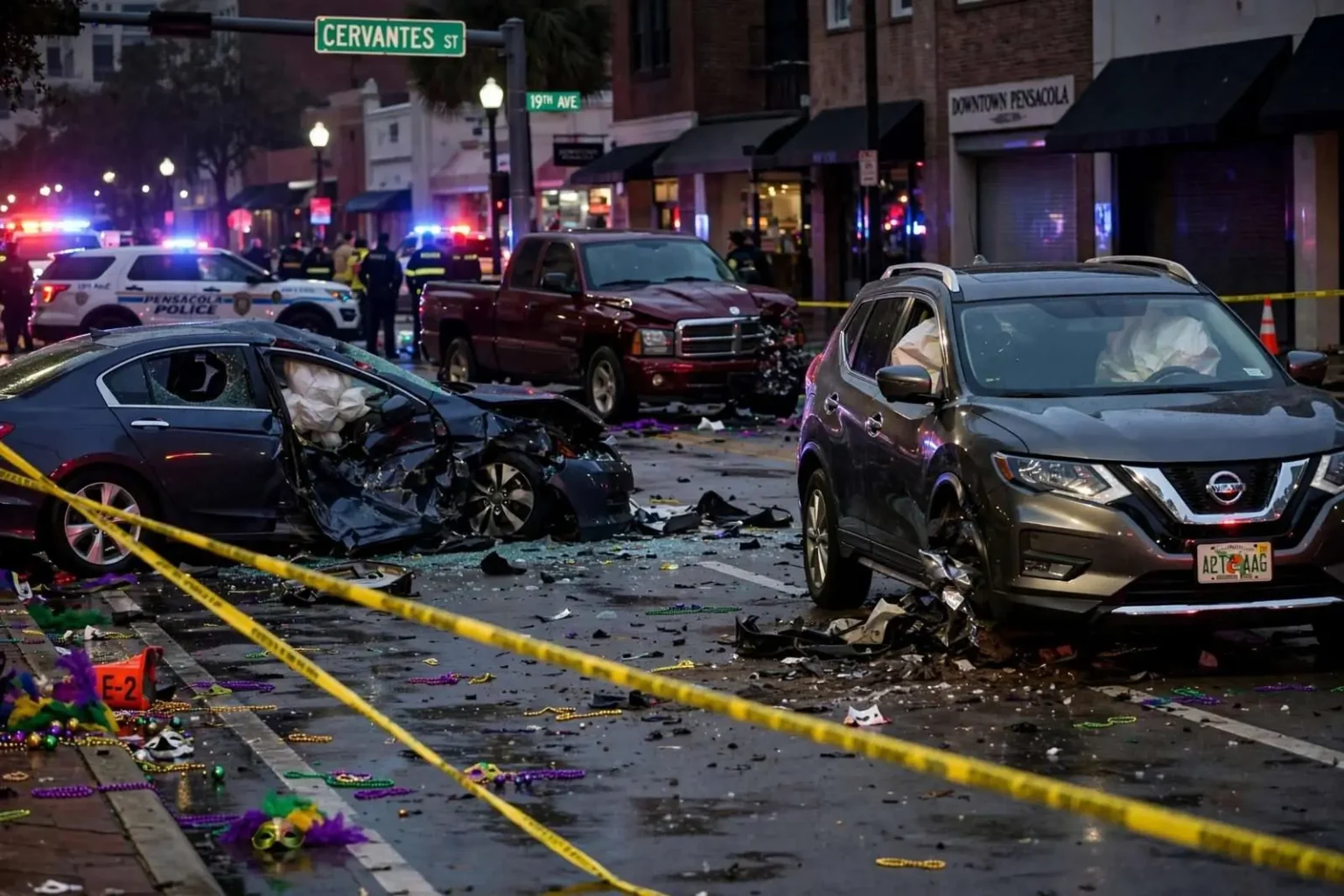
PENSACOLA, Fla. — A Pensacola woman has pleaded no contest to criminal charges stemming from a three-vehicle crash on Cervantes Street after the 2019 Grand Mardi Gras Parade in downtown Pensacola, a collision that killed one person and injured another.
Cherri Baker pleaded no contest to leaving the scene of a crash involving death, DUI manslaughter, leaving the scene of a crash involving injury and DUI causing injury, according to the State Attorney’s Office. The plea resolves the criminal charges arising from the February 2019 crash, which occurred on Cervantes Street in the hours after one of Pensacola’s signature downtown celebrations.
After leaving the parade, Baker was driving her 2017 Nissan Rogue eastbound on Cervantes and tried to merge into the outside lane to avoid a vehicle stopped waiting to turn onto 19th Avenue, prosecutors said. Her SUV struck the back of a Honda Accord in the outside lane, causing it to lose control and cross into oncoming traffic. A westbound 2004 Dodge Dakota could not avoid the collision and hit the passenger side of the Accord. The Accord’s passenger died and its driver was injured.
Prosecutors said Baker’s Rogue then struck the Dakota and left the scene. Police later located her. A blood sample showed a blood alcohol content of .184 — more than twice Florida’s legal limit.
The charges and what they carry
The four counts to which Baker pleaded no contest span Florida’s felony and misdemeanor statutes governing impaired driving and hit-and-run offenses. DUI manslaughter is the most serious of them, a first-degree felony under Florida law when a driver’s operation of a vehicle while impaired causes a death. Leaving the scene of a crash involving death and leaving the scene of a crash involving injury are separate offenses with their own penalties, reflecting the state’s treatment of flight from a fatal collision as a distinct crime from the crash itself.
A no contest plea — the legal term is nolo contendere — does not admit guilt but accepts conviction as though a plea of guilty had been entered, and it exposes the defendant to the full range of sentencing the charges allow. A sentencing hearing is scheduled for March 4 at 1:30 p.m. Baker faces up to 20 years in state prison, and state law requires a four-year mandatory minimum sentence.
The mandatory minimum reflects changes Florida legislators made to the state’s driving-under-the-influence statutes over the past two decades, raising penalties for DUI offenses involving death and injury and tightening the sentencing floors judges must impose. Victims’ family members are typically afforded the opportunity to address the court at sentencing under Florida’s crime victim provisions, and the March hearing is expected to include impact statements before the judge imposes sentence.
Each of the four counts carries its own sentencing weight, and courts structure sentences across multiple counts to reflect the full range of conduct — the death, the injury, and the two instances of leaving the scene. In practice, that means the March 4 hearing will address not one offense but the sequence of decisions prosecutors laid out: the impaired driving, the chain-reaction collision that followed, and the decision to drive away from a scene where one person was dead and another was hurt. The judge’s task at sentencing will be to weigh that sequence as a whole within the limits the statutes impose.
Under Florida law, a conviction for DUI manslaughter also carries a driver’s license revocation measured in years, along with fines and other conditions the court may impose, and the leaving-the-scene counts add revocation exposure of their own. Those administrative consequences follow the criminal sentence automatically, meaning the resolution of the case will extend well beyond whatever prison term is imposed on March 4.
The crash’s connection to Mardi Gras season
Pensacola’s Mardi Gras celebration is among the oldest on the Gulf Coast, and the Grand Mardi Gras Parade that rolls through downtown Pensacola each year draws large crowds to the city center. Parade nights fill downtown streets with pedestrians, families and parked cars, and the celebrations routinely run into the late evening hours. Law enforcement agencies in Escambia County traditionally increase patrols and DUI enforcement around parade nights for exactly the reason the statute books anticipate: the combination of celebrations, crowds and late-night driving produces a predictable rise in impaired-driving arrests and crashes.
Cervantes Street, where the crash occurred, is a heavily traveled east-west corridor through Pensacola that carries both local traffic and through commuters, intersecting 19th Avenue near some of the city’s busiest commercial stretches. The road’s volume makes the kind of lane-change collision described by prosecutors — a merge into an occupied lane at speed — especially dangerous, with little margin for error for vehicles traveling close behind.
The crash unfolded in seconds but touched three vehicles and five people: the Rogue’s driver, the Accord’s driver and passenger, and the Dakota’s occupants. The chain-reaction pattern — a rear-end strike that pushed the Accord across the center line into the path of oncoming traffic — is among the most lethal collision configurations on multi-lane roads, because the struck vehicle’s occupants absorb a side impact that offers them little protection and no chance to react. That physics is why prosecutors and crash investigators treat impaired lane-changing as seriously as they do, and why the counts in this case reached beyond the initial contact between the Rogue and the Accord.
The crash that followed the parade became one of the cases cited by Escambia County prosecutors in discussions of impaired driving enforcement during festival season. Local officials have long paired the celebrations with public reminders about designated drivers, ride services and the consequences of impaired driving, and fatal crashes tied to parade nights tend to renew those campaigns each year.
How a DUI manslaughter case moves through the courts
Cases of this kind typically take years to move from arrest to resolution, and the timeline here — from a February 2019 crash to a plea entered well afterward — reflects the pace of serious felony litigation in the First Judicial Circuit. Prosecutors must assemble crash reconstruction evidence, toxicology results, witness accounts and the circumstances of the defendant’s flight from the scene, and defense counsel reviews that evidence while plea negotiations proceed. Many DUI manslaughter cases resolve by plea rather than trial, as this one did, with the sentencing hearing becoming the forum where the full circumstances are laid out in court.
The blood alcohol result in the case — .184, more than double Florida’s legal limit of .08 — will be among the facts before the judge at sentencing. Florida’s sentencing structure for DUI manslaughter allows judges substantial discretion above the mandatory minimum, weighing the circumstances of the crash, the defendant’s record, and the statements of victims’ families. With the plea entered, the March 4 hearing stands as the final step in the criminal case, closing out a prosecution that began with a parade night three years of legal proceedings ago.
The wider toll of hit-and-run crashes
The flight from the scene is a recurring aggravating factor in crashes of this kind, and Florida law treats it accordingly. When a driver leaves the scene of a fatal collision, the injured party loses the immediate medical response that might follow, investigators lose critical minutes, and families are left waiting for answers about how their loved one died. Prosecutors across Florida — and along the Gulf Coast in particular, where Mardi Gras season, spring break and summer tourism keep roads busy late into the night — have made refusal to stop after a serious crash a charging priority, which is why the two leaving-the-scene counts stood alongside the DUI counts in this case.
For the family of the passenger killed in the Accord, and for the Accord’s driver who survived with injuries, the plea marks the point where the criminal process turns entirely to the question of punishment. Civil remedies remain available separately, as they do in most serious crash cases, but the March 4 sentencing hearing is the proceeding where the state’s response is set — and where the up-to-20-years exposure and the four-year mandatory minimum converge into an actual sentence.
Impaired driving enforcement in the Pensacola area continues each parade season, with the Escambia County Sheriff’s Office, Pensacola Police Department and Florida Highway Patrol all participating in saturation patrols during the celebrations. Traffic safety advocates in the region use cases like this one in outreach each year, pairing the statistics on impaired driving with the human cost that a single night of decisions can impose on two families and a community.
The case also stands as a reminder of the range of consequences that follow a DUI arrest along the Gulf Coast — criminal exposure measured in years, the mandatory minimums the Legislature has attached to injury and death cases, and the separate and lasting harm of leaving a crash scene. The sentencing hearing set for March 4 at 1:30 p.m. will conclude the criminal file; the consequences of the crash itself will last considerably longer.