Perdido Key Songwriter’s ‘Ol’ Red’ Honored During Nashville’s Ole Red Week
Perdido Key songwriter Mark Sherrill, co-writer of the classic country song 'Ol' Red,' is being honored in Nashville as WSM Radio declares Ole Red Week.
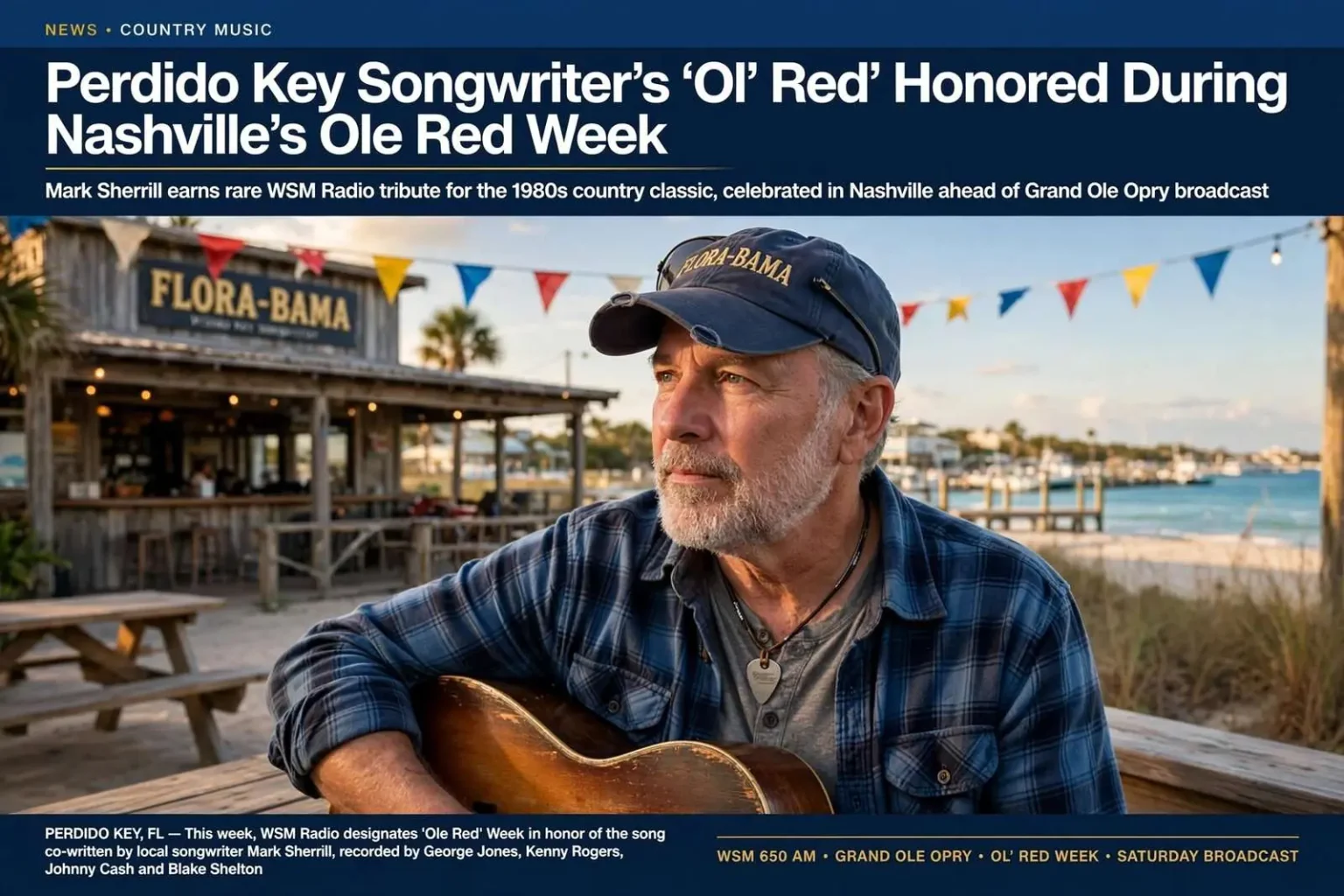
A Perdido Key songwriter is earning a rare Nashville honor this week for a country classic with deep Gulf Coast roots. Mark Sherrill, who lives on Perdido Key, co-wrote “Ol’ Red” in the late 1980s. The song tells the story of a Georgia prisoner who uses a prison bloodhound’s attraction to a blue tick hound to engineer his escape.
Over the years it has been recorded by some of country music’s biggest names, including George Jones, Kenny Rogers, Johnny Cash and Hoyt Axton. For a songwriter, that kind of roster is extraordinary. Most Nashville songs are cut once, maybe twice; a tune that draws George Jones, Kenny Rogers and Johnny Cash to the same material has crossed from catalog to canon, and each new recording introduces it to another generation of listeners.
WSM Radio in Nashville has declared this week “Ole Red” Week, a nod to the spelling change from “Ol’ Red” to “Ole Red” adopted to reflect the Grand Ole Opry. The recognition comes ahead of Saturday night’s Grand Ole Opry broadcast featuring Blake Shelton and Gwen Stefani, Stefani’s debut appearance on the storied stage. Shelton is the most recent artist to record the tune, and his version turned it into one of the signature hits of his career.
The Song and Its Story
“Ol’ Red” works because it is a complete short story set to a shuffle. The narrator lands in a Georgia prison, falls under the watch of the warden’s prized tracking bloodhound, and discovers that the dog cannot resist a romance with a neighbor’s blue tick hound. The prisoner trains the pairing deliberately, and on the night of his escape, the bloodhound follows its heart instead of its nose, buying the narrator his freedom.
That narrative construction, a twist that arrives because of a detail planted early, comes straight from the country songwriting tradition of storytellers like Axton, whose own “Joy to the World” and writing career made him a natural fit for the song. Sherrill wrote it during the years he lived in Nashville and owned a bait shop, far from the row of publishing houses but close enough to the music business to get his songs heard.
The bait shop detail is more than color. Songwriters outside the Nashville machine often work day jobs that keep them rooted in the everyday world their songs describe, and the years behind a bait shop counter put Sherrill among the fishermen, hunters and rural characters whose lives fill country music’s best verses. The song’s authenticity, its easy command of dogs, tracking and country geography, suggests exactly that grounding.
A Rare Nashville Honor
WSM Radio, the station whose call letters are intertwined with country music history, has declared the week “Ole Red” Week, formally adopting the spelling Shelton’s hit uses and tying the song’s story to the Opry’s own. WSM launched the Grand Ole Opry broadcast in 1925, and the station’s flagship status means a themed week is a meaningful salute rather than a passing mention.
For Sherrill, the tribute carries real weight. “It choked me up and kind of brought tears to my eyes. It’s not an honor everybody gets,” Sherrill said. Songwriters rarely receive the public recognition that performers enjoy, even when their songs outlast the careers of everyone who sang them. A week on the airwaves of the station that made country music a broadcast institution is the exception.
The timing connects the song to a weekend of Opry history. Saturday night’s broadcast featured Blake Shelton alongside Gwen Stefani, marking Stefani’s debut appearance on the storied stage, and Shelton’s presence ensured that the song bearing the week’s name would be sung in the building where its many lives in country music began.
From Nashville to Perdido Key
Today Sherrill performs “Ol’ Red” regularly at the Flora-Bama, the beach bar straddling the Alabama-Florida line, where fans travel from across the country to hear him sing it. The venue is one of the most famous roadside music institutions in America, a sprawling complex on Perdido Key that has hosted everyone from Jimmy Buffett’s circle of Gulf Coast songwriters to Nashville stars dropping in unannounced.
The Flora-Bama’s songwriting culture makes it a fitting home for a writer with a catalog like Sherrill’s. The bar’s annual songwriting festival and its decades of showcase nights have made the straddle-the-line lounge a proving ground where songs are tested on audiences who have heard everything. When Sherrill takes the stage there and reaches the song’s opening lines, he is performing for crowds that include visitors who planned their trips around hearing it.
The journey from a Nashville bait shop to a Perdido Key stage traces the path of many Gulf Coast songwriters. The region between Pensacola and Mobile has produced and attracted working writers for generations, drawn by a culture where beach bars, fishing camps and honky-tonks keep live country and gulf-and-western music in steady demand. Sherrill’s story adds a Nashville chapter to that map without ever leaving the coast behind.
The Song’s Recording History
The list of artists who have recorded “Ol’ Red” reads like a walk through the Country Music Hall of Fame. George Jones, the Possum himself, brought the song’s story ballad structure into the tradition he defined. Kenny Rogers recorded it during his crossover era, when his narrative instincts were at their peak. Johnny Cash’s version placed the prison-escape tale in the repertoire of the artist whose prison performances defined an entire branch of country music.
Hoyt Axton’s recording carries special resonance, since Axton was himself one of America’s great story-song writers. When a writer of that caliber records your song, it functions as a peer review from the best possible source. Each of these recordings predates the version most fans know today, and together they demonstrate how a strong song can be reshaped by every voice that takes it on.
Blake Shelton’s recording, the most recent and by far the most commercially successful, arrived as his career was ascending and became a signature hit, eventually lending its name to the bar and entertainment brand he built with the Opry’s parent company. The spelling shift from “Ol’ Red” to “Ole Red,” echoing the Grand Ole Opry’s own name, is the kind of detail that only matters when a song has become a franchise, which is exactly what happened.
What the Week Means
An entire week on WSM devoted to a single song is unusual, and the gesture lands at the intersection of several anniversaries in the song’s life: the late-1980s writing session, the parade of classic recordings that followed, Shelton’s hit and now the song’s own branded week in the town where it was born. For a songwriter living on Perdido Key, it means the phone rings and the credits roll a little differently for a while.
Sherrill’s emotional response to the news reflects how songwriters experience these moments. The song left his hands decades ago and lived lives he never directed, recorded by legends he never met and sung by crowds who learned it from the radio. Seeing Nashville stop and name a week after it brings the whole journey home at once, from the bait shop to the Opry’s stage to the beach bar where he still sings it like it’s the first time.
Fans who want to hear the song from its co-writer can find him where the Gulf Coast has always found him, on a stage at the Flora-Bama with the water just across the street, playing the story of a bloodhound, a blue tick hound and a prisoner who understood both.
The Perdido Key Songwriting Community
Perdido Key and the surrounding Gulf Coast corridor hold a particular place in American songwriting. The stretch from Pensacola through Orange Beach to Mobile has supported working musicians for generations, its bars and beach venues booking live acts year-round in a tourist economy that rewards performers who can hold a room with an original song. Writers who settle here tend to be lifers, musicians who traded the industry’s centers for the coast and built careers on constant performance.
Sherrill fits that profile precisely. Rather than remaining in Nashville among the publishing offices, he came back to the coast, where a songwriter can play several nights a week, own his connection to his audience and live within sight of the water that shapes the region’s whole musical identity. The trade-off is distance from the industry’s machinery; the reward is a durable local career anchored by songs the tourists carry home with them.
The Flora-Bama anchors that scene. Its stages run long hours, its audience is a rotating mix of locals and visitors from every state, and its history includes impromptu appearances by major stars alongside the regulars who hold down the room week after week. For a writer whose most famous song is about a prison escape, there is a fitting irony in performing it nightly in a place nobody ever wants to leave.
Why Story Songs Endure
“Ol’ Red” belongs to the story-song lineage that runs through country music’s history, from the recitation ballads of the early Opry era to the narrative hits that still chart today. Story songs endure because they reward relistening: once the twist is known, the early verses reveal the setup, and each hearing uncovers new detail in the craft.
The song’s premise, a prisoner outsmarting a tracking dog through the dog’s own heart, compresses everything the genre does best into three minutes. It has animals, stakes, wit and a clean resolution, delivered at a tempo that lets the audience hang on every line. Those qualities explain why artists as different as George Jones and Blake Shelton heard the same possibilities in it, and why radio audiences adopted it across different decades.
For aspiring writers on the Gulf Coast circuit, the song’s path is a working lesson. It was written far from Music Row, recorded repeatedly across decades and finally became a franchise. The lesson is that songs outlive arrangements, careers and even the writers’ proximity to Nashville, and that a great story told plainly will find its singers eventually.
As “Ole Red” Week plays out on WSM and the Opry’s Saturday broadcast brings Shelton and Stefani to the stage together for her Opry debut, the song at the center of it all remains what it has always been: a Gulf Coast writer’s story, recorded by legends, sung on beaches and now celebrated in the town that made country music a broadcast institution.