
Phillips Preparatory School in Mobile earns International Baccalaureate designation
Phillips Preparatory School in Mobile has been designated an International Baccalaureate school, becoming only the eighth IB middle school in Alabama.
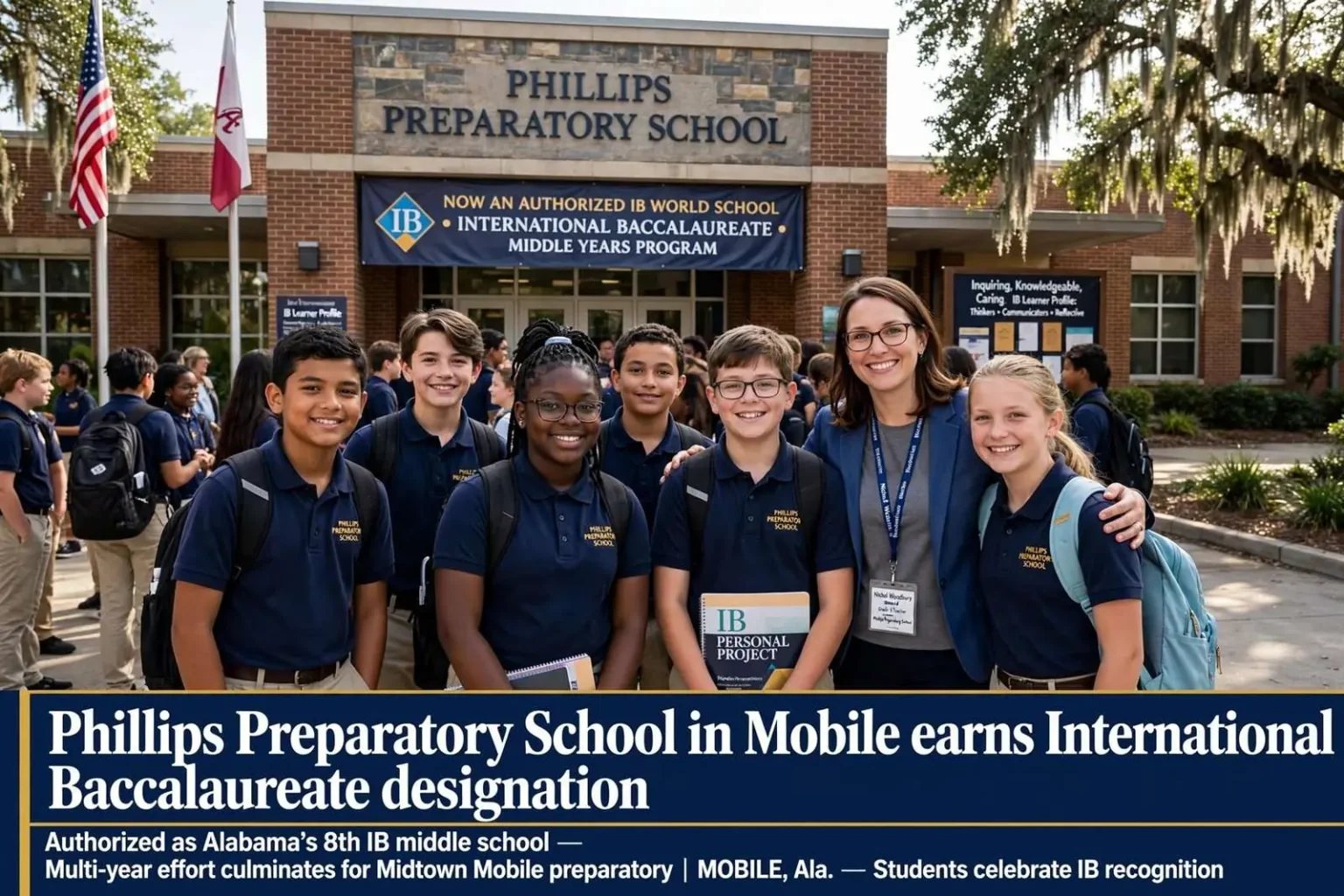
MOBILE, Ala. — Students at Phillips Preparatory School in Mobile learned this week that their school has been designated an International Baccalaureate school. The designation places the Midtown Mobile school in a select group, capping a multi-year effort to align its longstanding advanced curriculum with one of the world’s most recognized academic frameworks. For a public preparatory school, the milestone is both a validation of how it already teaches and a new credential that follows its students outward.
“Because we have always been an advanced program and have taught this way, we knew this was a perfect fit for us,” said eighth-grade teacher Nichol Woodbury. Her point captures why the transition proved natural: Phillips has operated for years as a preparatory school with entrance standards and an accelerated curriculum, so the IB framework, rather than demanding an overhaul, gave formal structure and international recognition to practices the faculty had long embraced.
The IB program is a global one that emphasizes personal and academic achievement. Founded as an international educational foundation, the International Baccalaureate organization designs coursework intended to develop inquiring, knowledgeable, and caring young people, with an emphasis on critical thinking, global awareness, and cross-disciplinary learning. Its middle-years program asks students to connect subjects to one another and to the world outside the classroom, an approach that differs from rote test preparation even as it demands rigor.
Students say they are embracing the broad, balanced curriculum. “We go above and beyond and we take the step that some people don’t,” said eighth-grader Braeden Dye. “It really changes your work ethic and the way you handle issues,” said student Kylie McCool. Those reflections from the students themselves are the kind of evidence IB evaluators look for: not just coursework completed, but learners who can describe how their habits of mind have changed.
The advanced curriculum may give these students an edge in high school and college. “Colleges are starting now to look at their IB scores, look at their IB background to give them admittance into their schools,” Woodbury said. Universities across the country recognize IB coursework in admissions and, at the diploma level, award college credit for higher-level exams, and even at the middle-years stage the credential signals to selective high school programs and admissions offices that a student has operated within a demanding, internationally benchmarked curriculum.
Phillips began teaching the International Baccalaureate program two and a half years ago, when this group of eighth graders were sixth graders. That timeline matters: the current eighth-grade class is the first to move through the program nearly from start to finish, experiencing the full arc from the foundational middle-years work through the culminating projects and assessments that IB authorization evaluates. Becoming an authorized IB school is not a quick application; it requires teacher training, curriculum alignment, site visits, and a review of how the school’s practices measure up to the organization’s standards.
With the designation, Phillips becomes only the eighth IB middle school in the state. Alabama’s IB landscape has grown over the past two decades but remains thin at the middle-school level, where authorization demands sustained commitment from administrators and faculty. For Mobile County Public Schools, the designation adds a distinguishing program to a system that has built several magnet and specialty offerings, and it gives Phillips a recruiting identity that extends beyond its longstanding preparatory reputation.
“The students are taking what they learn in class and applying it to real-world situations and I’m amazed at what they’ve been able to do with it,” said Principal Brenda Hartzog. Her observation points to the program’s central promise: that learning organized around inquiry and application produces students who can use what they know, not just recall it.
What the IB Framework Asks of Students and Teachers
The middle-years program spans a broad set of subject groups, language and literature, language acquisition, individuals and societies, sciences, mathematics, arts, physical and health education, and design, and ties them together with a core of approaches to learning that teach students how to research, collaborate, communicate, and reflect. Community service and a culminating personal project push students to carry learning beyond the school building. For teachers, the framework requires collaboration across departments so that a science unit and a humanities unit can reinforce one another, a shift from the subject-by-subject rhythm of a traditional junior high.
Assessment under IB looks different as well. Rather than relying solely on multiple-choice testing, the program uses criterion-referenced evaluation of projects, essays, presentations, and performances, asking students to demonstrate reasoning rather than recall. That approach is one reason colleges respect the credential: it certifies not just content knowledge but the capacity to organize and defend an argument, skills that translate directly to advanced coursework.
For Phillips Preparatory’s faculty, achieving authorization meant years of professional development, including IB-specific training workshops and the documentation of how classroom practice meets the organization’s standards. Teachers describe the process as demanding but clarifying, since the framework’s published criteria gave them a shared vocabulary for what rigorous instruction should look like across every subject, from a sixth-grade math class to an eighth-grade design project.
What It Means for Midtown Mobile
The designation also lands in a neighborhood context. Phillips Preparatory serves families across Midtown Mobile and the surrounding districts, and its advanced-program reputation has made it one of the school system’s sought-after options. An IB credential gives parents considering the school a recognizable benchmark, the same name they might encounter on applications to selective high schools and universities, and it aligns the middle school with the growing number of IB and advanced-study pathways available in Alabama’s public schools.
For the students, the immediate payoff shows up in daily habits. The program’s emphasis on reflection means students are asked to explain how they learn, not just what they learned, and its projects require planning, revision, and presentation over weeks rather than a single night’s studying. Teachers report that those habits carry into other settings, from athletics to student government, because the framework treats organization, communication, and perseverance as learnable skills rather than fixed traits.
The personal project that anchors the culminating years of the middle-years program gives each student a chance to pursue an independent inquiry, with a faculty supervisor, a defined process, and a public presentation of the outcome. Topics chosen by students typically range from community service initiatives to creative works to technical builds, and the discipline of carrying a self-directed project from proposal to finished product is one of the experiences students most often describe as transformative.
The Road to Authorization
Schools pursuing IB authorization move through defined phases, from application and candidacy through authorization visits, and the process at Phillips unfolded alongside its regular academic calendar. Faculty attended category-specific training, administrators mapped the school’s policies on assessment, language, and special educational needs to IB requirements, and evaluators visited to observe classrooms and interview students and staff. Reaching the finish line two and a half years after the first classes began reflects an unusually smooth pace, aided by the school’s existing advanced-program culture.
The distinction also places Phillips among a small national cohort. IB middle schools remain uncommon across the Southeast, and the eighth-in-Alabama milestone means most of the state’s students will never encounter the framework before high school, if at all. Educators hope the visibility of Phillips’s success will encourage other Mobile County schools to explore candidacy, a pattern seen in other states where an early adopter’s experience lowers the barrier for schools that follow.
The designation also carries meaning for how the school tells its story going forward. Phillips Preparatory has long attracted families through its selective reputation and academic results, but the IB name travels further: it is recognized by educators in other states and countries, it appears in admissions literature, and it gives transferring students a framework their new schools will understand. In a district where school choice has expanded and families weigh options carefully, that kind of portable credential is a meaningful advantage.
The school’s teachers say the real measure will show up over the coming years, as cohorts that complete the full middle-years program move into the city’s high schools. If the program’s habits stick, students who ask better questions, manage long projects well, and connect their coursework to the community, the designation will have accomplished what it set out to do. Woodbury’s assessment of the fit, that Phillips had always taught this way, suggests the school expects the answer to be yes.
For now, the celebration belongs to the students who built it. The eighth graders who entered as sixth graders and grew up inside the framework watched their school join a group that includes only seven other middle schools in Alabama, and they did it while producing the projects, essays, and presentations that made the case. Phillips Preparatory’s name now carries a designation that few schools in the state hold, and the students who earned it have a credential they can take anywhere.