
Photographer Jerrid Jones Unveils Faces Portrait Exhibition at Mobile Arts Council
Photographer Jerrid Jones debuts his portrait series Faces at the Mobile Arts Council during ArtWalk, featuring textured overlays on portraits.
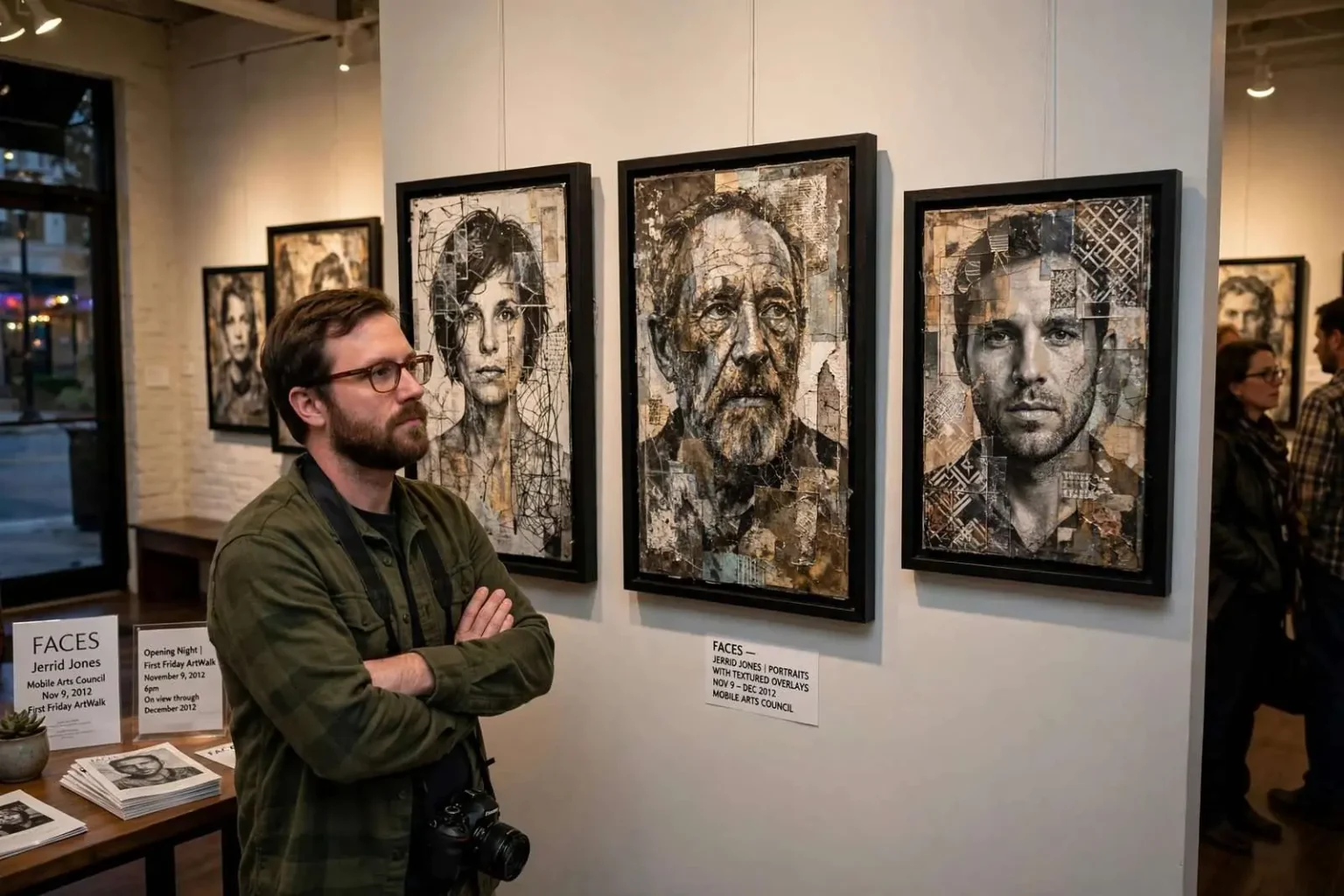
Mobile photographer Jerrid Jones is bringing a unique and compelling collection of portrait photography to the Mobile Arts Council with his exhibition titled Faces, which opens during the First Friday ArtWalk on November 9, 2012, at 6 p.m. The exhibition features a striking series of portraits that challenge traditional approaches to photographing the human face. Rather than conventional glamour or beauty shots, Jones has crafted images that strip away pretense, capturing his subjects with raw, unguarded expressions before layering them with carefully selected textures and overlays.
The Mobile Arts Council, a longtime anchor of the city’s downtown arts scene, opens its gallery doors each First Friday as part of the ArtWalk, a monthly evening when galleries, studios and shops across downtown Mobile stay open late and visitors stroll between venues. Openings held in connection with the ArtWalk typically give the public a chance to meet the artist, and the November edition puts Jones’s work in front of one of the largest art audiences Mobile draws each month. The Faces exhibition is on display at the Mobile Arts Council gallery through December 2012.
The timing of the opening also places the exhibition in front of holiday crowds, since December gallery visits often include shoppers looking for original work by local artists. A portrait series offers an accessible entry point for viewers who might not consider themselves regular museumgoers, because everyone arrives with a lifetime of experience reading faces. Jones’s textured overlays give even familiar-looking portraits a layer of distance and interpretation that invites closer inspection.
A Creative Process Born from Experimentation
Jones described the project as an evolving creative journey rather than a carefully pre-planned concept. Each portrait session taught him something new and opened doors to fresh ideas. That willingness to let the work develop on its own terms is part of what gives the series its distinctive character, since the approach changed and matured as the collection grew one face at a time.
The photographer, who typically works alone, deliberately pushed himself outside his comfort zone by collaborating closely with his subjects. He sought blank, emotionless expressions from his subjects, only to discover that each person still carried an emotion or expression they could not fully conceal. What began as an attempt to photograph neutral faces became, instead, a study in the small involuntary signals that every person gives away, whether they intend to or not.
That observation led to the distinctive textured overlay technique that defines the series, with Jones carefully matching each overlay to the individual face. Rather than treating every portrait the same way, he studied what each photograph revealed and chose a texture that reinforced or complicated what the viewer was seeing. The result is a body of work that rewards a second and third look, as the layered images shift depending on how closely the eye moves across them.
The decision to work with overlays also reflects the era in which the series was made. Digital editing tools had put techniques within reach that once required elaborate darkroom work, and photographers of Jones’s generation learned to treat the computer as part of the creative toolkit rather than a threat to traditional craft. In Faces, the technology serves the concept rather than the other way around: the textures are not decoration but part of the conversation between the subject and the viewer.
Portraiture has always occupied a special place in photography, from the formal studio portraits of the early twentieth century to the candid environmental portraits favored by documentary shooters. Jones’s series sits deliberately between those traditions. The faces are captured with documentary honesty, but the layered finishes push the finished images toward something more personal and interpretive, closer to mixed-media art than to a standard studio print.
From Film to Digital
Jones first picked up a camera years ago while working on a local film production in Mobile. Watching the crew operate their equipment sparked a passion that led him to grab his father’s camera and begin shooting roll after roll of film. The path from film sets to still photography is a familiar one, since motion picture crews and still photographers share an obsession with light, composition and timing, but few who catch the bug on a film set expect to build a body of work around the human face.
Shooting film taught early habits that stuck: limited exposures encourage photographers to think before they press the shutter, and waiting for a roll to come back from processing builds patience and intentionality. Jones’s father’s camera became the gateway to a practice that would survive a long interruption.
After stepping away from the craft for roughly a decade, the rise of digital photography reignited his interest, and he taught himself modern techniques through online resources and by studying other photographers’ work. The timing of his return mattered. The digital revolution of the 2000s lowered the cost of experimentation dramatically, removed the per-shot price of film and processing, and opened vast online communities where photographers shared tutorials, critiques and inspiration. For a self-taught artist returning to the field, those resources functioned as a replacement for formal schooling.
That self-directed education shows in the Faces series, which blends fundamentals learned on film with digital-era layering techniques. Jones’s route into photography, through curiosity and persistence rather than a degree program, is a common one among working photographers on the Gulf Coast, where a small but active community of shooters supports galleries, festivals and commercial work across Mobile and Baldwin counties.
Advice for Aspiring Photographers
For young photographers looking to develop their skills, Jones offered straightforward guidance: focus on finding the right camera for your needs rather than getting caught up in brand competitions, study other photographers’ images to identify what works and what does not, and be open to constructive criticism.
Not every photograph will be a masterpiece, he noted, and learning to accept and grow from feedback is essential to improving as an artist. The advice echoes what working photographers across the industry repeat: gear matters far less than seeing, and the fastest way to develop an eye is to look deliberately at work that has stood the test of time. Volume matters too, since photographers improve by shooting consistently and by being willing to discard the majority of what they produce.
His point about criticism carries particular weight for artists showing work publicly for the first time. A gallery opening invites reactions of every kind, and an artist who can separate useful critique from noise tends to keep growing. For Jones, whose series was built by experimenting and adjusting after every session, that openness to revision is not just advice but the method that produced the exhibition itself.
The Local Arts Context
An exhibition like Faces depends on infrastructure that Mobile has spent decades building. The Mobile Arts Council has long served as a hub for visual artists in the region, staging rotating exhibitions, supporting local creatives and connecting artists to audiences through events like the First Friday ArtWalk. Downtown Mobile’s gallery scene gives photographers, painters and sculptors a venue without requiring a trip to New Orleans or Atlanta, and it has helped a generation of Gulf Coast artists show and sell work close to home.
First Friday events do more than fill a single evening. They create a rhythm for the local art calendar, giving collectors and casual viewers alike a predictable night to see new work and giving artists a hard deadline that keeps them producing. For photographers especially, gallery exposure matters because so much of the medium now lives on screens; seeing a layered portrait printed large, under gallery light, is a different experience from scrolling past it, and Jones’s textured work in particular benefits from being viewed in person.
Portrait photography in particular resonates with gallery audiences because every viewer brings a face of their own to the conversation. Jones’s insistence on photographing people as they actually are, emotion and all, aligns with a broader shift in contemporary portraiture away from polish and toward authenticity, a trend visible from editorial photography to the way families now choose their own commissioned portraits.
What Comes Next
Looking ahead, Jones said he plans to continue expanding the Faces series while exploring deeper and more experimental approaches to his signature texture and overlay techniques, as well as new ways to display his finished work. Growing a series rather than abandoning it for something new is a discipline that many artists struggle to maintain, and it suggests that Faces will keep evolving as Jones finds new subjects and new treatments.
New display methods could take the work beyond framed prints on a wall, something layered photographic work lends itself to, since textures and scale can change how an image reads in a room. For now, area residents have through December 2012 to see the series at the Mobile Arts Council gallery, with the November 9 opening during First Friday ArtWalk offering the best chance to view the portraits and meet the photographer behind them.