
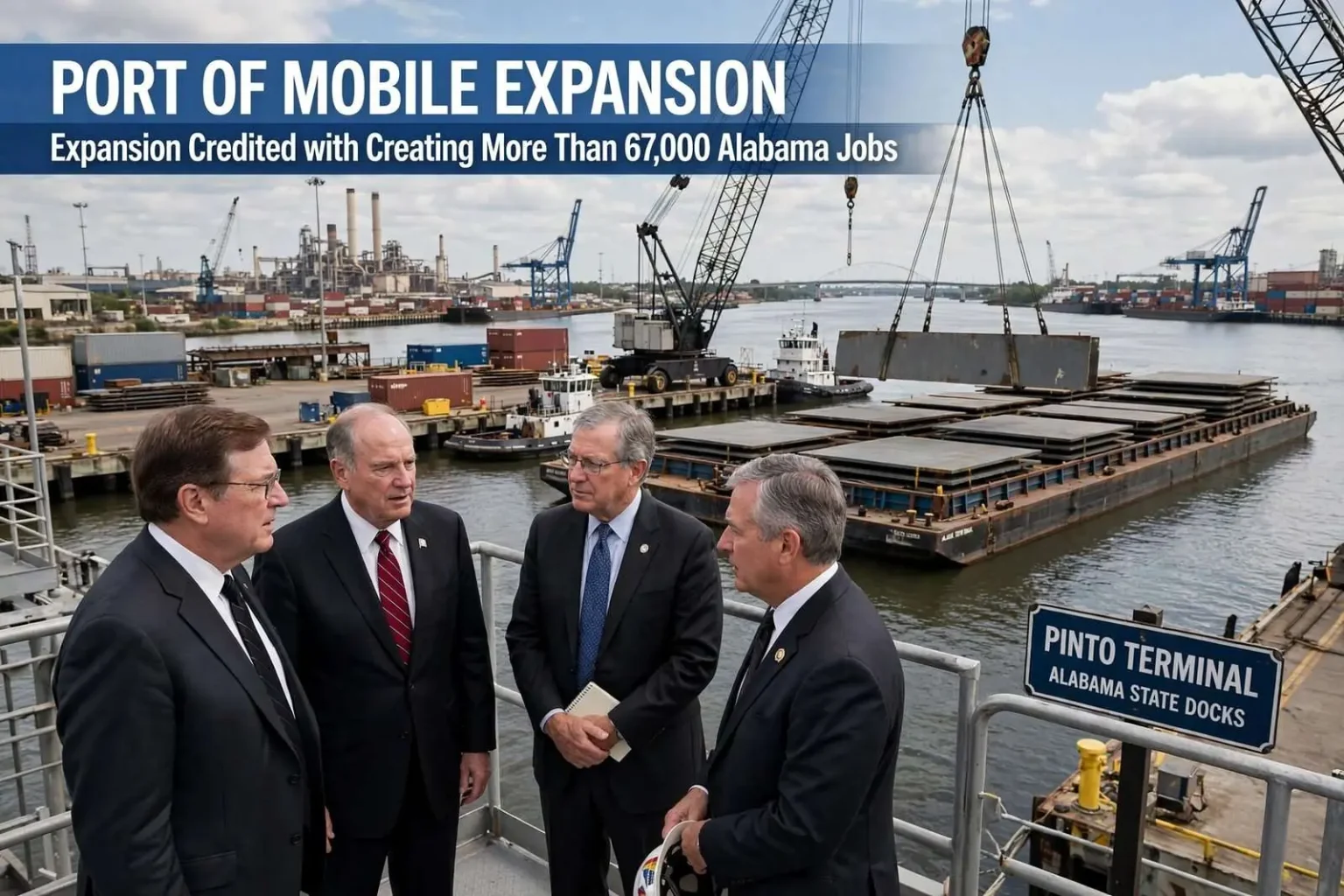
Gov. Bob Riley visited the Alabama State Docks this week to tout the economic payoff of a decade of investment in the Port of Mobile, pointing to more than 67,000 jobs the state says are tied to the seaport’s growth. The visit doubled as a victory lap for a strategy that began with a bond package in 2005 and has since reshaped both the waterfront and the state’s industrial recruitment pitch: build the port first, and the manufacturers will follow.
Riley toured the newly built Pinto Terminal alongside U.S. Rep. Jo Bonner, Alabama State Port Authority CEO Jimmy Lyons and ThyssenKrupp Steel USA President and CEO Christoph Lackinger. The group watched as 40-ton steel slabs were loaded onto barges for the short trip up the Mobile River to ThyssenKrupp’s steel-manufacturing complex in north Mobile County. The movement of slabs by barge is exactly the kind of short-haul, high-volume waterborne logistics the terminal was designed to handle, connecting the port’s cargo operations directly to one of the largest industrial investments in state history.
“Our investments in Alabama’s port have paid off in jobs and opportunities for families throughout the state,” Riley said during the visit. “Even though it is located in Mobile and supports a thriving maritime industry here, our port’s impact reaches literally into every corner of Alabama.”
The governor’s framing reflects the arithmetic behind the port’s expansion. Cargo moving through Mobile serves manufacturers, farmers and retailers far from the coast — coal and timber from the Black Belt and south Alabama forests, steel from Calvert, automotive freight from the state’s manufacturing corridor — which is why port officials have long argued that the docks are a statewide asset funded and justified by statewide returns.
A Decade of Growth
State officials say the Port of Mobile has climbed from the 14th- to the 9th-largest seaport in the country over the past 10 years, with a total economic impact now estimated at $7.9 billion. Much of that growth traces back to 2005, when Riley pushed through an $80 million bond package to fund a major expansion, including a new container and intermodal terminal that more than quadrupled the port’s container capacity.
The bond package marked a turning point for a port that had historically specialized in breakbulk, coal and forest products. Modern container shipping rewards ports that can handle large vessels, turn cargo around quickly and connect to rail and highway networks, and Alabama’s investment signaled to global carriers that Mobile intended to compete for that business. The Pinto Terminal’s construction added modern steel-handling capacity on the Mobile River, complementing the port’s existing terminals for coal, grain and general cargo spread along the waterfront.
Port officials credit those upgrades with helping the state land a string of major industrial employers, including ThyssenKrupp’s massive carbon and stainless steel plant, Hyundai Motor Manufacturing Alabama, Hyundai Heavy Industries, Aker Solutions, Berg Spiral Pipe, International Shipholding, ICS Logistics and APM Terminals. Each of those companies depends on the port in one way or another — for inbound raw materials, outbound shipments or the maritime workforce and supplier network that clusters around a working seaport.
Why the Port Sells Itself to Industry
Bonner said the port’s reach extends well beyond Mobile County. “The expansion of the Port of Mobile, in particular, has reverberations that impact practically every corner of Alabama and a number of surrounding states,” he said, pointing to the state’s natural deepwater channel, workforce and logistics access as key selling points for recruiting industry.
Those selling points give Alabama an argument few states can match. Mobile Bay provides one of the most sheltered natural harbors on the Gulf of Mexico, with deep water close to shore and direct access to inland waterways, rail lines and interstates that run to the Midwest and Southeast. For a manufacturer deciding where to build, the ability to receive heavy components by sea and ship finished product out the same gate is often the deciding factor — and ThyssenKrupp’s selection of a site within barging distance of the docks showed how the argument works in practice.
The ThyssenKrupp facility in north Mobile County, among the largest single industrial investments in Alabama history, illustrates the multiplier effect Riley highlighted. The steel plant draws on the port for inbound raw materials and relies on barge transport for finished slabs, while its construction and operation brought thousands of jobs to the region — jobs that in turn support suppliers, contractors and service businesses across Mobile and Baldwin counties and beyond.
Jobs Across the State
The 67,000 jobs figure cited by state officials includes not only the dockworkers, tug crews, stevedores and terminal employees who work the waterfront, but the truckers, rail workers, warehouse staff and manufacturing employees whose livelihoods depend on cargo moving through Mobile. Port-dependent employment reaches into the automotive plants upstate, the paper and timber operations of south Alabama, and the agricultural shippers who move grain, poultry and cotton through Gulf terminals.
That statewide footprint is why port funding has historically drawn support from legislators with no coastline in their districts. Every cargo container or coal barge that clears Mobile generates activity along the rail lines and highways that lead back to their communities, and the port’s climb in the national rankings gives those lawmakers a concrete measure of the strategy’s return.
The decade-long transformation is still drawing new players. APM Terminals, the container terminal operator that came to Mobile as part of the expansion era, joined a roster that now includes steel producers, shipbuilders, logistics companies and heavy manufacturers — a mix that insulates the port from downturns in any single sector. Port authority leaders say that diversity is deliberate: a port that serves steel, agriculture, forest products and containers at once can keep working when one industry slows.
What Comes Next for Mobile’s Waterfront
Port officials view the current run of growth as a foundation rather than a finish line. The container terminal built with the 2005 bond money positioned Mobile to chase larger container vessels, and the port’s continued investment in terminals, equipment and channel improvements is aimed at keeping the seaport competitive as ships and cargo volumes grow. State leaders have pointed to the past decade — 14th to 9th in the national rankings, $7.9 billion in economic impact, tens of thousands of jobs — as evidence that public investment in the waterfront pays measurable dividends.
Business leaders in Mobile say the momentum feeds the city’s own revival as well, drawing maritime services, law firms, customs brokers and logistics offices to downtown, and reinforcing the port city’s identity in a state better known in recent years for its automotive and aerospace plants.
For the workers who loaded 40-ton steel slabs onto barges this week while the governor watched, the numbers translate into a straightforward reality: the busier the port, the steadier the work. Maritime employment in Mobile spans good-paying jobs that require no four-year degree, from crane operators and welders to tug pilots and logistics managers, and the supplier firms that cluster around the docks add thousands more.
Riley’s visit closed with the same argument that opened the expansion era a decade ago: Alabama’s port may sit in Mobile, but it works for the entire state. The slabs moving up the river to Calvert, the containers rolling out on Norfolk Southern and CSX rails, the coal heading to international markets — all of it is the physical evidence behind the 67,000 jobs and the claim that few public investments anywhere in Alabama have returned more.
The Port’s Place in Alabama History
The Alabama State Docks have anchored Mobile’s economy since the terminal opened more than a century ago, growing from a modest public facility into one of the Gulf’s busiest seaports. Coal, one of the port’s historic mainstays, still moves through what is among the largest coal terminals on the Gulf Coast, alongside forest products, steel, aluminum, grain and refrigerated cargo. That breadth of cargo has always been the port’s strength — when one commodity market sagged, others kept the docks busy and the payrolls steady.
The Pinto Terminal adds a modern chapter to that story. Built on Pinto Island along the Mobile River, the facility was designed for exactly the heavy, project-related cargo that industrial recruitment generates: steel slabs, wind components, machinery and modules too large for ordinary transport. Its proximity to the ThyssenKrupp site made the barge run upriver a matter of miles rather than days, cutting transport costs for one of the state’s flagship manufacturers.
Economic development officials describe the relationship between the port and the state’s industrial recruitment as a flywheel. Port investment attracts manufacturers; manufacturers generate cargo; new cargo justifies further port investment; and the expanded port becomes an even stronger argument for the next manufacturer. The companies recruited during the expansion decade — from automotive suppliers to spiral pipe fabricators — each followed the same logic that brought ThyssenKrupp to north Mobile County: in Alabama, the deepwater dock is next door.