Prancing Elites Dance Troupe Member Arrested on Domestic Violence Charge
A member of Mobile's nationally known Prancing Elites dance troupe was booked into the Mobile County Metro Jail on a misdemeanor domestic violence charge.
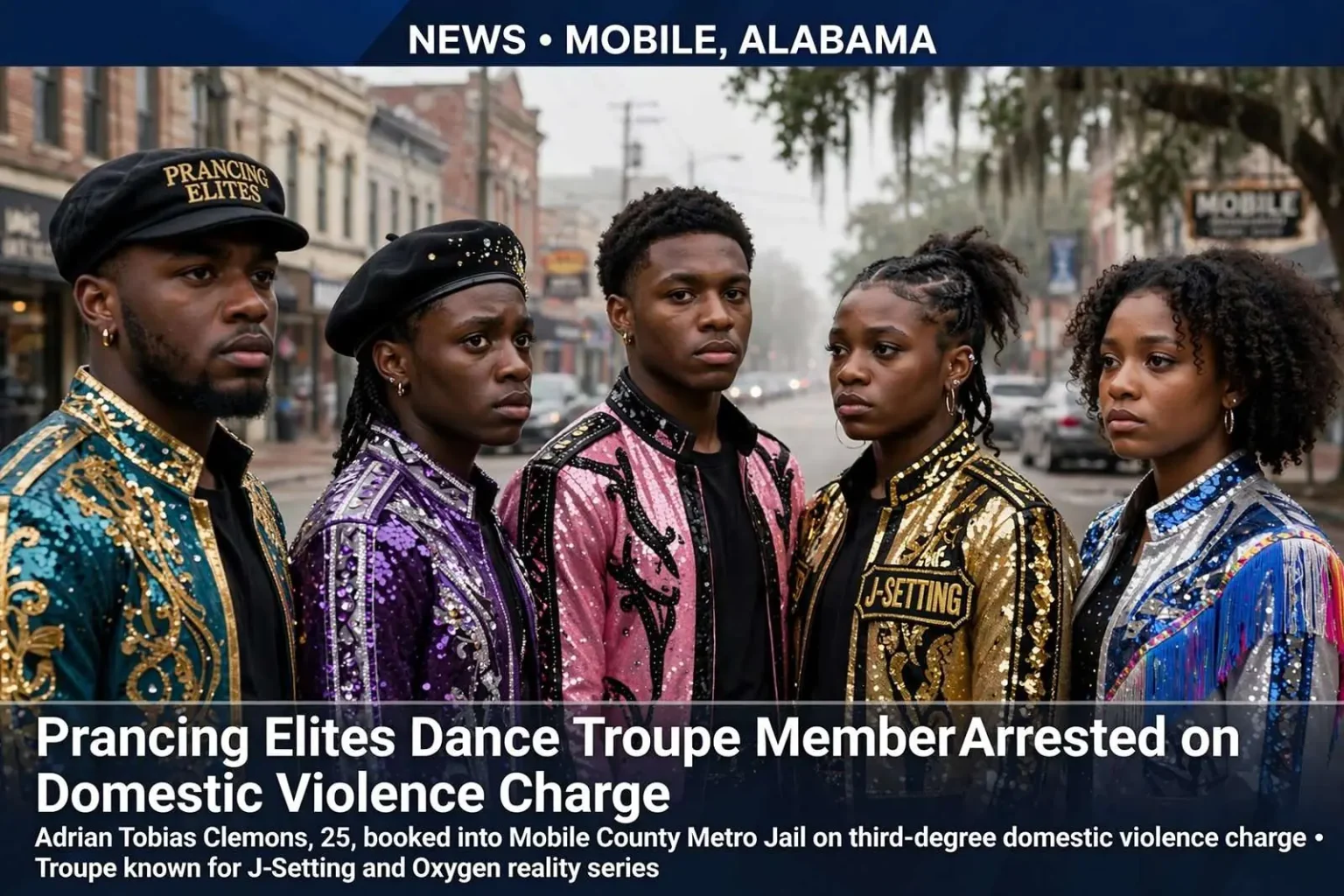
A member of the Mobile-based dance troupe The Prancing Elites was arrested and booked into the Mobile County Metro Jail on a domestic violence charge, according to jail records.
Adrian Tobias Clemons, 25, was taken into custody and charged with third-degree domestic violence, a misdemeanor harassment-level offense under Alabama law. Jail records show he remained in custody following his arrest, though further details about the specific circumstances leading to the charge were not released.
Under Alabama’s domestic violence statutes, third-degree offenses cover conduct such as harassment or reckless endangerment between people in a household or dating relationship, rather than the more serious first- and second-degree charges that involve physical injury. A third-degree charge is nonetheless a criminal matter, handled in the district court system with its own consequences if it results in a conviction.
As with any pending case, the charge represents an accusation rather than a finding of guilt, and the matter is expected to proceed through the Mobile County court system. Clemons had not, at the time of the arrest, spoken publicly about the accusation.
The troupe and its rise
Clemons is one of five members of The Prancing Elites, a Mobile dance troupe known for a cheerleading and hip-hop hybrid style called J-Setting. The style, built on sharp precision moves and elaborate costumes, traces its roots to the marching bands and dance lines of historically Black colleges, and the Elites adapted it into a performance identity entirely their own.
The group first drew national attention after members performed at a Christmas parade in Semmes in 2013, sparking both backlash and a wave of support that eventually helped land the troupe a reality television deal. The Semmes incident became a defining moment for the group: some spectators reacted badly to the troupe’s gender-nonconforming presentation, video of the performance circulated widely online, and the story was picked up by national media outlets.
What could have ended the group’s public life instead amplified it. The support that followed the backlash raised the Elites’ profile far beyond the Gulf Coast, and television producers took notice of both their talent and their story.
The group stars in an Oxygen Network reality series that chronicles their lives on and off stage, including their struggles for acceptance within traditional Mardi Gras and parade organizations around Mobile. The show had recently been renewed for a second season at the time of the arrest, reflecting the troupe’s growing national profile.
What the show documented
The Oxygen series followed the five members through rehearsals, performances and daily life in Mobile, giving national audiences a look at the realities of being openly gender-nonconforming performers in a Deep South city. Episodes dealt with the group’s fights to be included in the region’s many parade organizations, the rejections they received, and the support they found among fans in Mobile and beyond.
The troupe’s experience with parade associations became one of the show’s central threads. Mobile’s Carnival season is organized around mystic societies and marching groups whose memberships are often long-established, and the Elites’ efforts to participate — and the resistance they met — turned the group into a talking point well outside entertainment coverage, drawing in debates about tradition, inclusion and who gets to take part in public celebrations.
For the members, the platform also carried personal weight. The group has used its visibility to speak openly about issues including gender expression and acceptance in the Deep South, and their willingness to live their identities on camera made them figures of significance for viewers facing similar struggles in their own communities.
The arrest’s place in the story
News of the arrest circulated quickly among fans of the troupe, whose members have become recognizable figures in Mobile’s arts and entertainment scene since the show’s debut. Their personal lives, including legal troubles, have drawn public interest beyond typical local crime coverage precisely because the group’s story is one the audience has followed.
Jail records listed the charge as third-degree domestic violence, and Clemons remained in custody while the case moved through the initial stages of the court process. In misdemeanor domestic violence cases in Mobile County, initial proceedings typically include a bond determination and an arraignment date, with protective-order considerations addressed in the early stages as well.
The arrest put a private matter into a public space that has rarely treated the troupe gently. From the Semmes parade backlash onward, the Elites have been subject to a level of scrutiny — supportive and hostile alike — that few local performers experience, and a member’s legal trouble was certain to be discussed far more widely than a similar arrest of someone outside the spotlight.
Neither the troupe nor the network publicly addressed the arrest in the immediate aftermath, and the case moved forward as any misdemeanor would in the Mobile County courts.
J-Setting and the troupe’s craft
The Prancing Elites’ performance style deserves attention on its own terms. J-Setting blends the call-and-response precision of HBCU dance lines with the theatricality of club performance, requiring both athletic control and a commanding stage presence. The Elites brought the style to parades, competitions and shows across the Gulf Coast, building a repertoire that made them standouts in a region rich with marching units and dance teams.
Their commitment to the craft has been central to the group’s resilience. Whatever controversies surrounded their public appearances, the troupe kept performing, kept rehearsing and kept building an audience — an approach that eventually carried them from Mobile parade routes to national television.
Domestic violence law in Alabama
Alabama’s domestic violence statutes, enacted in 2000, categorize offenses by degree. First- and second-degree domestic violence involve serious physical injury or the use of weapons and are charged as felonies. Third-degree domestic violence covers harassment, menacing or reckless endangerment between family or household members and is charged as a misdemeanor, but it still carries the full weight of the criminal courts: arrest, booking, bond conditions and a record that follows a defendant.
The law’s domestic designation matters beyond the classification. Cases between people in a household or romantic relationship are handled with procedures designed for that context, including specialized dockets in some courts and automatic considerations around contact between the parties while the case is pending.
An accusation at this level is not a conviction. Defendants are entitled to the same presumption of innocence as anyone else, and many third-degree cases are resolved through dismissal, diversion or plea to lesser offenses depending on the evidence and the wishes of those involved.
What comes next
For Clemons, the immediate path runs through Mobile County District Court, where the misdemeanor case will be scheduled for initial appearances and, eventually, a disposition — whether by trial, plea or dismissal. For the troupe, the arrest arrived in the middle of a production season, with the renewed series keeping cameras on the group’s lives just as one member’s legal trouble became public.
Fans of the Elites have followed the group through harsher chapters than this one, from the Semmes backlash to the rejections documented on the show. Whether the arrest becomes a footnote or a storyline, the group’s larger history — a small Mobile troupe that turned hostility into a national platform — remains the context in which this news landed, and the standard by which their audience will judge it.
The courts, not the shows and not the social feeds, will settle the charge itself, and the case now proceeds on the same track as any other misdemeanor filed in Mobile County.
Mobile’s entertainment spotlight
The Prancing Elites occupy an unusual place in Mobile’s cultural landscape. The city that gave America Mardi Gras has long been defined by its parade traditions, its mystic societies and its deep performance culture, and the Elites emerged from that world while also challenging it. Their insistence on performing as themselves — in the costumes, hair and makeup that define J-Setting presentation — put them at odds with some traditionalists and endeared them to a national audience hungry for their story.
The Oxygen series brought that tension to viewers nationwide, and Mobile became, for a season of television, a stage on which questions of acceptance and tradition played out in front of millions. Local reactions ranged from pride that the city’s talent was on national television to frustration at how the city was portrayed, and the Elites themselves became the most discussed performers in a city full of them.
That profile is what made the arrest news travel the way it did. A member of a nationally televised troupe being booked into the Mobile County Metro Jail was always going to be covered, shared and argued over — a consequence of visibility the group has dealt with since the Semmes parade video first went viral.
It is also worth remembering what the troupe’s visibility has meant locally. Younger performers in Mobile’s dance community have pointed to the Elites as proof that a Gulf Coast troupe can build something beyond the parade circuit, and the group’s performances at local events have continued to draw the crowds that first rallied to them when acceptance was scarce.
The legal matter now pending in Mobile County District Court is one member’s case, distinct from the troupe’s work. But in a group whose story has always been personal — whose members’ lives are the show — the line between the two is thinner than for most performers, and both the fans and the courts will follow this one to its conclusion.