Prayer Rallies and Voter Fraud Probe Dominate Final Weekend Before Mobile Mayoral Election
With Mobile's mayoral election just days away, supporters of Mayor Sam Jones and challenger Sandy Stimpson held dueling weekend rallies as word spread of a federal investigation into possible absentee ballot fraud.
With Mobile’s Aug. 27 mayoral election bearing down, the final Saturday of the campaign belonged to two very different kinds of gatherings, as supporters of Mayor Sam Jones turned out to pray while backers of challenger Sandy Stimpson fanned out across the city to canvass voters. The split-screen finale gave voters a vivid picture of the two campaigns in their closing posture: an incumbent leaning on the city’s churches and a challenger relying on organization and shoe leather. It also set the stage for a closing week in which the integrity of the vote itself became an open question.
Prayer and praise at Davidson
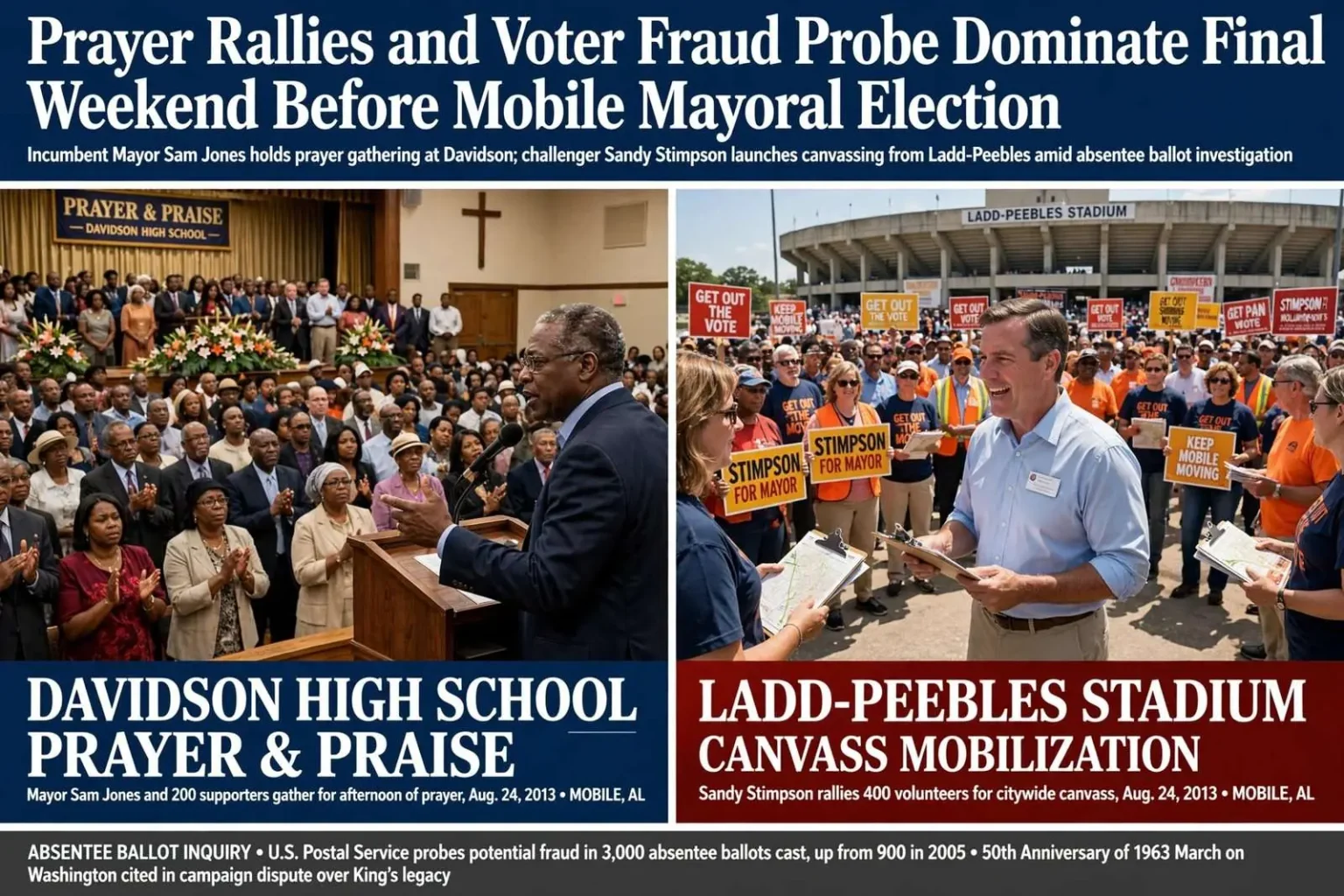
Mayor Jones and roughly 200 supporters filled the auditorium at Davidson High School for an afternoon of prayer and praise. Ministers and deacons offered prayers of thanksgiving, leadership, faith and victory throughout the event, while performers including Jere Thomas and members of St. Peter Baptist Church took part. The format was familiar to anyone who has followed Mobile politics, where the Black church has long served as both a civic anchor and the most reliable engine of turnout in municipal elections.
Jones told the crowd the prayer gathering was the most important stop of his campaign because it refocused attention on what mattered most in the closing days of the race. “This showed us again where we should be looking,” Jones said. “This has been everything that the Lord would have it to be. Let’s show that God’s vote cannot be bought.” The line drew the afternoon’s loudest response, and it doubled as a quiet rejoinder to the controversy already swirling around absentee ballots in the election.
For Jones, seeking a second term as the city’s first Black mayor, the gathering was also a return to the coalition that put him in office eight years earlier. His 2005 victory had been built on strong support from Black precincts and church networks across the city, and the Davidson auditorium crowd — filled with pastors, deacons and church choirs rather than the usual roster of political club members — was a reminder of that base in the final hours of the campaign.
Canvassing from Ladd-Peebles
Across town, Stimpson drew about 400 supporters to Ladd-Peebles Stadium before the group dispersed to roughly 60 intersections throughout Mobile to campaign directly with voters. The stadium, a midtown landmark that has hosted high school football, the Senior Bowl and countless civic gatherings for generations, gave the Stimpson operation room to stage its largest single mobilization of the race. Volunteers waved signs at major thoroughfares through the afternoon while the candidate worked the crowd before the send-off.
Stimpson told supporters he had run a positive campaign and hoped that approach would carry him to victory on election day. “We have kept the high road,” Stimpson said. “When there have been things brought up that have nothing to do with the issues facing the city, we have stuck to what matters.” The businessman and first-time mayoral candidate had built his campaign around the argument that Mobile’s economy and image were underperforming, and his final-weekend message asked supporters to translate enthusiasm into ballots rather than rhetoric.
The two events underscored the strategic difference between the camps. Jones’s operation concentrated its closing energy on a single room of committed supporters, the kind of gathering that reinforces enthusiasm and energizes the network of congregations that would carry voters to the polls. Stimpson’s operation scattered itself across the city map, betting that visible presence at dozens of intersections in the campaign’s final weekend would register with undecided voters who had not yet tuned in.
King’s dream enters the race
The rallies took on added significance because Aug. 24 marked the 50th anniversary of the 1963 March on Washington, the landmark demonstration at which the Rev. Martin Luther King Jr. delivered his “I Have a Dream” speech to a crowd of hundreds of thousands at the Lincoln Memorial. The anniversary was being commemorated nationwide, and in Mobile it became a point of contention between the two camps.
The Rev. Cleveland McFarland criticized signs carried by some Stimpson supporters that read “Keep King’s dream alive,” arguing the slogan misused the civil rights leader’s legacy for political gain. “They say to keep Martin Luther King’s dream alive, you should vote for Stimpson … you do hear what I’m saying,” McFarland said. “We’ve had an afternoon of prayer and praise, not blues and fish plates.”
McFarland also pointed to reports of a campaign flier some had called racist. “People said there was a flier that was racist,” he said. “Well, I think that’s racist to turn King’s dream inside out.” The exchange illustrated how charged the final stretch had become, with the language of the civil rights movement — a shared civic inheritance in a city that experienced the movement’s confrontations firsthand — now pulled into a dispute over which campaign could claim it.
The Stimpson camp did not respond to McFarland’s remarks at the rally, and the candidate’s own message stayed on the theme he had carried all summer: that the campaign was about jobs, finances and the direction of city government. But the clash over the signs and the flier gave the closing weekend a sharper edge than either campaign’s prepared program, and it ensured that the race’s final news cycle would be about more than turnout arithmetic.
An absentee ballot inquiry
Looming over both events was news that the U.S. Postal Service had opened an investigation into possible fraud involving absentee ballots cast in the municipal election. Postal inspectors examine mail-related complaints, and in Alabama elections absentee ballots — which travel through the mail between the voter, the absentee election manager and the counting room — have historically been the part of the process most vulnerable to manipulation. The news landed with particular force in Mobile, where absentee voting in municipal elections has long been concentrated in a handful of precincts and has repeatedly been the subject of litigation and rumor.
Both candidates addressed the matter cautiously when asked. Stimpson called the prospect of fraud disheartening. “It makes me sad that there is possibly voter fraud happening,” he said. “I hope that anyone who did commit fraud would be fully prosecuted to the extent of the law.”
Jones said his campaign had not been contacted by investigators and stressed that ballots themselves, not the envelopes they arrive in, are what matters. “We haven’t received any information or been contacted,” he said. “The absentee ballot is not what’s on the outside of the envelope but what’s inside.” Both men were careful to keep the question separate from their closing arguments, aware that an unsubstantiated fraud claim could stain the entire result regardless of which side it benefited.
The absentee surge
City Clerk Lisa Lambert reported that around 3,000 absentee ballots had been cast in the election, a sharp increase from the last contested Mobile mayoral race in 2005, when only about 900 absentee ballots were cast combined in the general election and runoff. The total represented a more than threefold jump in eight years, a pace that outstripped any plausible growth in the electorate itself and made the absentee pool a meaningful share of the expected vote in a contest where turnout was the decisive variable.
Under Alabama law, casting an absentee ballot requires the voter to state a reason — being out of the county on election day, illness, physical disability, work obligations or membership in the armed forces among them — and each application passes through the clerk’s office before a ballot is issued. The system depends on honesty in the application and privacy inside the envelope, which is precisely why allegations of mishandled ballots draw investigators so quickly. When the process works, the ballot inside the envelope speaks; when someone else handles the envelope, the safeguard is gone.
The surge in absentee voting raised the stakes around the fraud inquiry, since a prolonged investigation could leave the outcome of the mayor’s race unsettled even after polls close Tuesday. In Alabama, contested results are typically resolved through canvassing boards and, if necessary, the courts, a process that can stretch on for weeks. For a city preparing to swear in a new administration and pass a new budget, the prospect of a shadow over the count was itself a civic cost.
Both candidates said they hoped the matter would be resolved quickly. “We are hoping we can get the plurality we need the first time, where we cannot be concerned about the absentee votes or a runoff,” Stimpson said, referring to the possibility that no candidate would win an outright majority, triggering a runoff election. Mobile’s municipal rules require a majority to win the office outright, meaning the presence of the investigation over the absentee pool was most consequential if the race finished close.
Jones said he doubted the ballot investigation would stretch beyond election day, expressing confidence that voters would have a clear answer on who would lead Mobile for the next term. The Aug. 27 election capped a closely watched campaign between the incumbent mayor and his challenger, with both camps making final appeals to voters in the campaign’s last days through faith, grassroots canvassing and public statements addressing the integrity of the vote. Whatever the investigators found, the campaigns agreed on one thing: the count itself, and the voters whose ballots made it up, deserved the benefit of the doubt until the evidence said otherwise.