
PRE-GLO Exhibition Opens at Mobile’s Centre for the Living Arts
The Centre for the Living Arts in Mobile opened PRE-GLO, a multimedia exhibition featuring Mario Ybarra Jr.'s billboard art and photography.
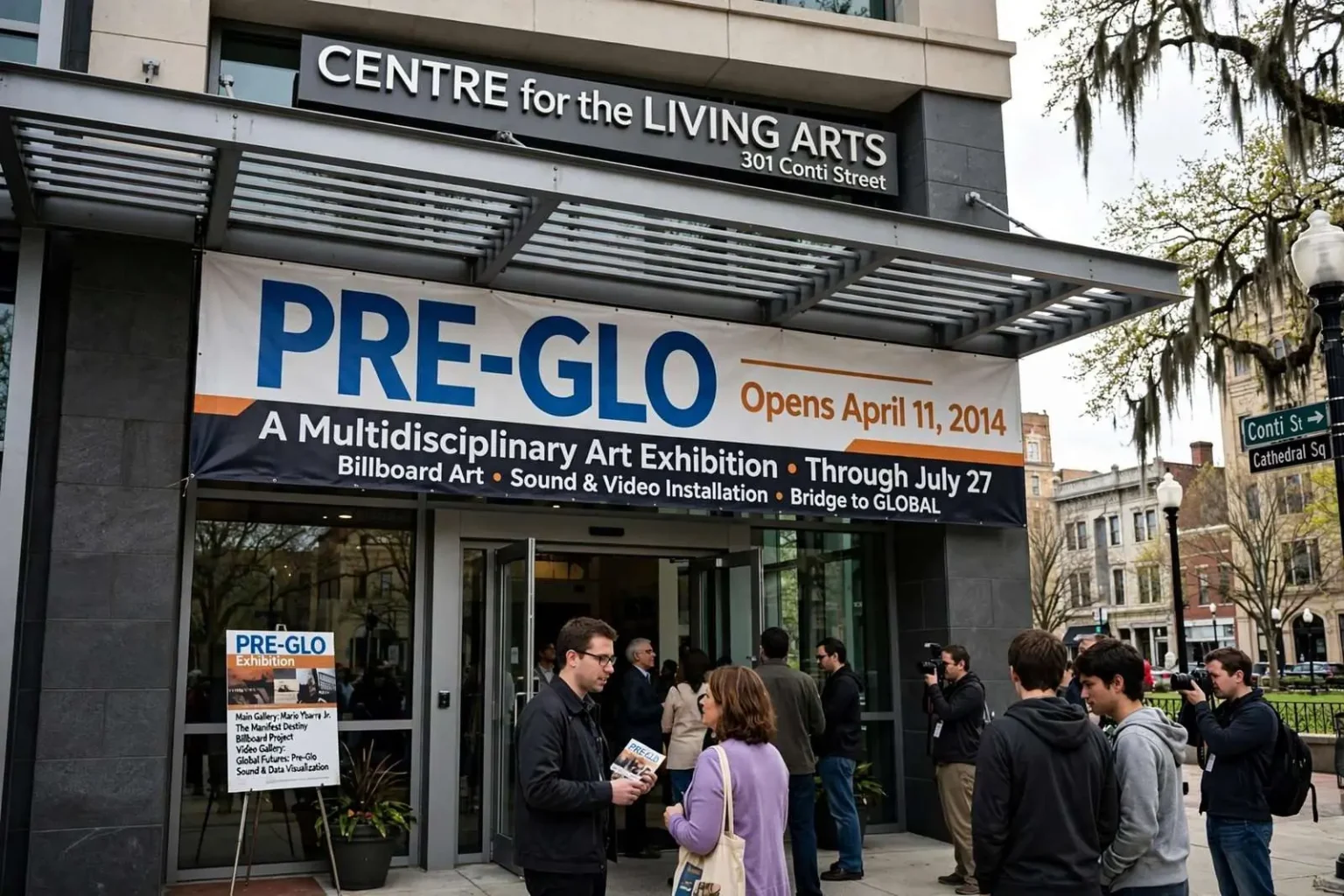
The Centre for the Living Arts in downtown Mobile welcomed visitors to PRE-GLO, a multidisciplinary art exhibition that opened on Friday, April 11, 2014. The show ran through July 27 and served as a bridge to GLOBAL, the Centre’s ambitious nine-month initiative scheduled to launch in September 2014. Together, the two presentations marked one of the most expansive programming pushes in the venue’s history, and they positioned Mobile as a stop on a contemporary art circuit that more often reserves its attention for much larger cities.
Billboard Art Takes Center Stage
The Main Gallery featured work by Los Angeles-based artist Mario Ybarra Jr., whose billboards were part of The Manifest Destiny Billboard Project organized by LAND (Los Angeles Nomadic Division). The large-scale project traced the path of American territorial expansion along Interstate 10, stretching from Florida to California and involving approximately 100 billboards by 10 different artists through spring 2015. By following the interstate that ties the Gulf Coast to the American Southwest, the project made the highway itself a gallery and asked drivers in cities like Mobile to encounter contemporary art in the middle of an ordinary commute.
Ybarra Jr., a visual and performance artist known for blending street culture with fine art, drew on what he called “barrio aesthetics” from Los Angeles neighborhoods. His chapter of the project inserted the daily culture of one city into another, creating visual contrasts between familiar and foreign urban landscapes. For Mobile viewers, that meant seeing images rooted in the textures of Southern California — its signage, its streets, its everyday visual language — mounted in an Alabama context, where they read differently than they would at home.
The billboards had been on display in both Mobile and Baldwin counties since January 2014 before being brought indoors for the exhibition. That outdoor phase made the work genuinely public art, visible to anyone who traveled the area’s highways whether or not they ever set foot in a gallery. Bringing the pieces inside the Centre allowed visitors to study them up close and to consider them as parts of a single artistic statement rather than as roadside interruptions between commercial pitches.
The choice of Interstate 10 as the project’s spine was not incidental. The highway is the main east-west artery of the American Sunbelt, running through eight states and some of the fastest-growing metropolitan areas in the country, Mobile among them. LAND conceived the billboard series as a contemporary retelling of nineteenth-century expansion, using a form of outdoor advertising normally reserved for commerce to raise questions about land, identity, and who gets to define a region’s image.
Global Futures: Sound and Video Installation
The Video Gallery housed Global Futures: Pre-Glo, curated by Tom Leeser of the Center for Integrated Media at CalArts. The installation merged themes of globalism with technological data visualization, projecting work from the Spatial Information Design Lab at Columbia University, directed by Laura Kurgan, onto the gallery walls. The result transformed the room into an environment where visitors stood inside maps, data, and sound rather than simply looking at framed objects on a wall.
The Columbia lab’s involvement gave the installation an analytical backbone. The lab works at the intersection of design, geography, and technology, turning large collections of information into visual forms that can be read by a general audience. In the gallery setting, that approach invited Mobile viewers to think about how distant places, economies, and events are connected to their own city — a fitting theme for a port town whose history has always been tied to global trade.
Four international sound artists contributed pieces that served as “cardinal points” within the space, orienting listeners much like compass directions orient a map. Stephanie Cheng Smith recorded sounds captured aboard a ship at sea, while Leeser himself contributed field recordings of Nepali and Tibetan chants performed during a walking ritual at the Boudhanath Stupa in Kathmandu. Kristin Pora Haraldsdottir presented rare recordings of Icelandic folk poems, and together the contributions carried listeners from ocean shipping lanes to the Himalayas to the North Atlantic without ever leaving the Video Gallery.
Each of the sound elements rewarded close attention on its own terms. The shipboard recordings captured the ambient life of maritime travel — an experience familiar to many Mobile residents through the port, but rendered here as something meditative and strange. The chants recorded at the Boudhanath Stupa documented one of the largest and most sacred Buddhist sites in the world, where pilgrims circle the great dome in prayer. The Icelandic folk poems, preserved in recordings that are not widely available, connected the exhibition to an oral tradition stretching back centuries.
The pairing of these sounds with large-scale visual projections reflected a broader shift in contemporary exhibition practice. Museums and art centers across the country have increasingly favored immersive, multisensory installations over rows of discrete objects, and PRE-GLO brought that approach to Mobile at a time when the city’s cultural institutions were working to broaden their audiences. For students, artists, and curious residents along the Gulf Coast, it offered a firsthand look at how technology, sound design, and data are reshaping what an exhibition can be.
A Bridge to GLOBAL
Everything about PRE-GLO pointed toward what came next. GLOBAL, the Centre’s nine-month initiative set to launch in September 2014, was designed as a deeper exploration of the same questions about connection, technology, and place that PRE-GLO introduced. By framing the spring and summer show as a bridge, the Centre gave Gulf Coast audiences a chance to ease into a large, demanding theme before the full program arrived, building familiarity and anticipation along the way.
That staging mattered for a venue of the Centre’s size and mission. Contemporary art that deals with globalism and data can feel abstract to a general audience, and institutions that present it successfully tend to do so through sustained programming rather than single-shot exhibitions. Spreading the work across two shows gave schools, arts groups, and casual visitors multiple entry points, and it allowed the Centre to sustain a conversation downtown through most of a year.
What the Exhibition Meant for Mobile
For local artists and arts organizations, the arrival of artists and curators with national and international profiles provided an uncommon point of contact. The Centre for the Living Arts, located at 301 Conti Street in downtown Mobile, had made a practice of bringing outside contemporary work to the city while keeping its galleries open to community programming, and PRE-GLO fit squarely within that model. Exhibitions of this kind give area artists a chance to study professional presentation, installation techniques, and curatorial thinking without traveling to New Orleans, Atlanta, or beyond.
There was also a practical, civic dimension. Downtown Mobile’s revitalization has long depended on attractions that draw people into the historic core after business hours, and cultural venues play an outsized role in that equation. A show with billboard art already visible on highways in Mobile and Baldwin counties had a built-in public audience: drivers who had seen the work outdoors had a reason to come downtown and see where it came from. The exhibition effectively used the region’s own roads as advertising.
Educators also had reason to pay attention. The exhibition’s mix of highway-scale design, recorded sound, and scientific visualization crossed the usual boundaries between art class, geography, and technology, making it a ready-made field trip subject for high school and college instructors across the region. Projects like The Manifest Destiny Billboard Project and Global Futures: Pre-Glo demonstrate to students that careers in art now extend into curation, sound engineering, and data design, fields that barely register in most conversations about creative work.
The timing placed PRE-GLO within a busy stretch for the city’s cultural calendar, arriving as spring festival season gave way to the long Gulf Coast summer. Indoor, air-conditioned exhibitions hold obvious appeal in July in south Alabama, and the Centre’s run through July 27 let the show serve summer visitors as well as the local audience that followed it from opening day.
An Unusual Showcase
What distinguished PRE-GLO most was its scope of origin. Work on view had come from Los Angeles, New York, Kathmandu, and Iceland — an unusual geographic spread for a Gulf Coast exhibition space. The show treated Mobile not as a stopover but as a legitimate node in a national conversation about art, place, and technology, and it asked local audiences to see their own interstate, their port, and their city as part of that conversation.
For the duration of its run, the Centre for the Living Arts offered residents of Mobile and Baldwin counties a chance to experience billboard-scale public art in a gallery setting, sound art gathered from three continents, and data-driven projection work from one of the country’s leading university design labs — all within a few blocks of Dauphin Street. As a preview of GLOBAL, it set a high bar, and as a statement about Mobile’s place in the contemporary art world, it made the case plainly: the city’s galleries could host work built for the whole country.