Preview: Ed Snodderly of ‘O Brother’ Fame Plays Satori Coffee House for IMC
Ed Snodderly, known from O Brother Where Art Thou?, played Satori Coffee House for USA's Independent Music Collective in Mobile.
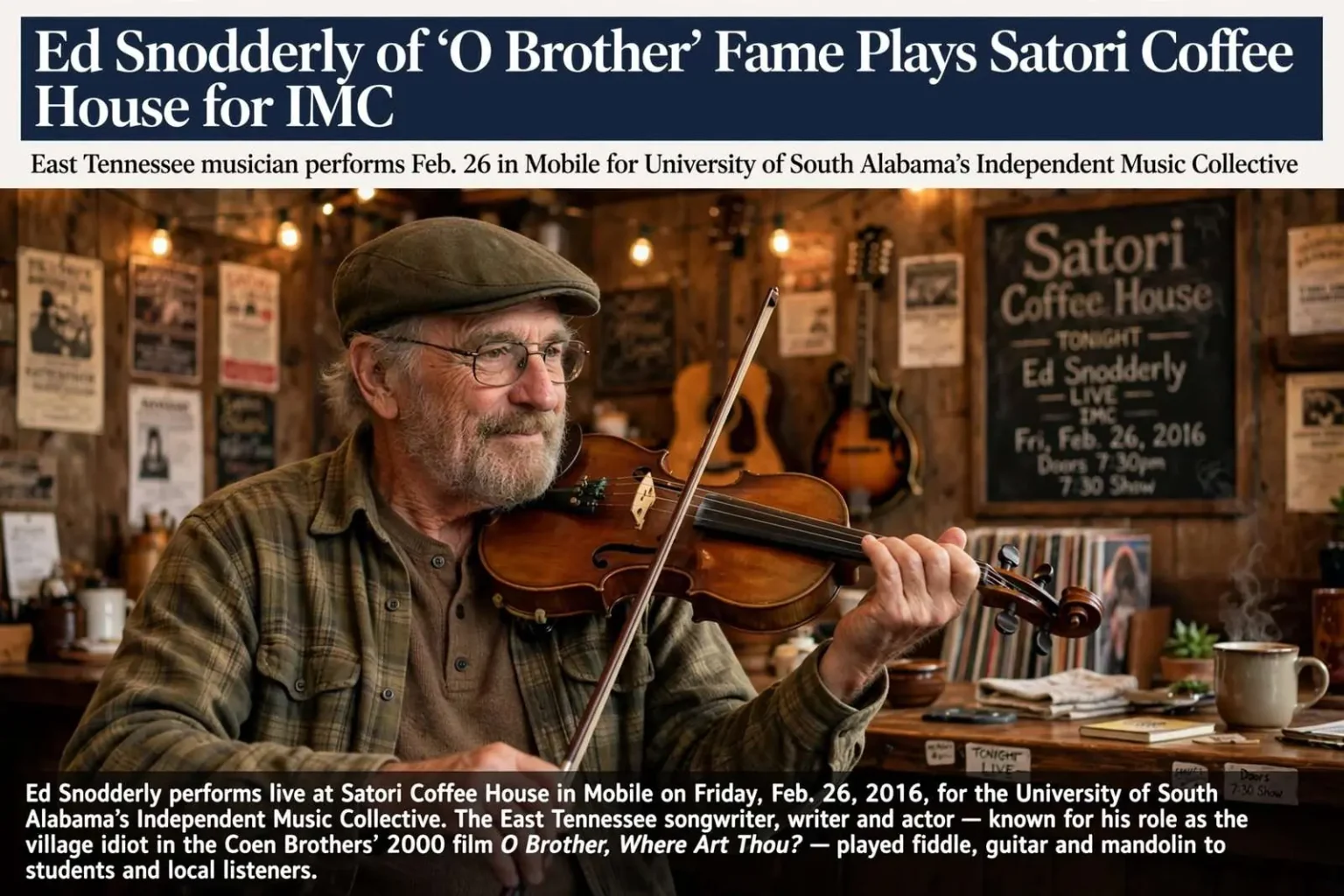
If you have seen O Brother, Where Art Thou?, you have seen Ed Snodderly. The East Tennessee musician, writer and actor appeared in the Coen Brothers’ 2000 film as the village idiot, but his roots run deep in southern music.
The film credit introduced Snodderly to millions of viewers who never knew his name, yet for audiences along the Appalachian chain he had long been a fixture — a player whose command of old-time instruments and whose storytelling songs made him a natural fit for a movie steeped in Depression-era southern music. The Coen Brothers built “O Brother” around a soundtrack of authentic mountain and roots material, and the presence of working musicians like Snodderly in even the smallest roles reflected that commitment. His scene as the village idiot remains a favorite among fans of the film, a brief turn of comic work from a man whose real vocation has always been the music.
A Lifetime in Southern Music
“Southern music is pretty darn cool because it has everything that southern people like,” Snodderly said. Born to a family of fiddlers and guitarists, he plays guitar, mandolin and fiddle, and teaches in the Department of Appalachian Studies at East Tennessee State.
Few musicians arrive at old-time music by accident, and Snodderly’s path ran straight through family. Growing up among fiddlers and guitarists meant the repertoire was absorbed at home, in kitchens and porches, long before any stage called. That inheritance shows in his playing, which treats the old tunes not as museum pieces but as living material to be shaped by each performance. His teaching post at East Tennessee State places him inside one of the nation’s few university programs devoted to Appalachian studies, an academic home for the music, stories and crafts of the southern mountains that grew out of the region’s own effort to preserve its heritage.
Lyrics from his song “The Diamond Stream” are enshrined in the wall of Nashville’s Country Music Hall of Fame. That honor is a rare form of recognition — not an award for a hit record, but an acknowledgment that a songwriter’s words belong among the permanent record of the music. For a writer working in old-time and traditional styles, far from the commercial mainstream, the Hall of Fame inscription stands as proof that the tradition’s songbook is still being written.
He comes from the hills, an area of old-time music and bluegrass, and describes southern music as largely about family and a strong sense of place. “I am from close to the earth people,” he said.
That phrase — close to the earth — is more than a humble flourish. It is a description of the musical geography Snodderly comes from, the hill country of East Tennessee where fiddle tunes, ballads and gospel songs passed down through families carry the accents of the ridges and valleys that produced them. Southern music, in his telling, is not primarily an industry or a genre; it is an inheritance, carried by people whose identities are tied to particular ground. Every old-time performance is therefore also a document of place, and Snodderly’s songs read that way: narratives rooted in specific landscapes, told in the voice of someone who has lived there.
The connection between family and music runs through his career the way it runs through the tradition itself. Old-time music was never built for concert halls; it was built for gatherings, for dances, for the passing of evenings among neighbors. When Snodderly describes southern music as being about family and place, he is describing the conditions under which the music actually lives — conditions a coffee house appearance recreates better than any arena could.
Catch Him in Mobile
Mobilians could experience Ed Snodderly live on Friday, Feb. 26, 2016, at Satori Coffee House as part of the University of South Alabama’s Independent Music Collective. The IMC showcases the best independent performers in its yearly series.
Satori Coffee House has long served as one of Mobile’s most intimate listening rooms, a space where the coffee house format — small room, close tables, quiet audience — puts the performer within a few feet of the crowd. For a storyteller like Snodderly, whose songs intertwine through narrative and whose between-song talk is part of the performance, the setting is ideal. The University of South Alabama’s Independent Music Collective built its yearly series around exactly this kind of booking, bringing independent artists whose work falls outside commercial radio to a Mobile audience that might otherwise never see them.
Snodderly played a set of songs that intertwine through story and lyrics, with three albums available at the show ahead of a mid-year release. The threading of songs through shared stories and recurring lyrical figures gives his sets the feel of a single extended work rather than a list of tracks — an approach that suits a writer whose Hall of Fame-honored lyrics are built to carry meaning across songs.
Doors were at 7:30 p.m., with local musician Eric Erdmann opening. USA students attended free; others were asked for a $5 suggested donation.
The modest cover reflects the IMC’s mission. The collective exists to put students and local listeners in front of working independent artists at a price nobody has to think about, and the free admission for USA students makes the series one of the most accessible cultural offerings on the university calendar. Local openers like Erdmann round out the picture, giving Mobile songwriters a slot in front of a listening audience and continuing the collective’s role as a connector between the university community and the city’s independent music scene.
The pairing of Snodderly with a college-town coffee house suited both sides. For the touring musician, a listening room of that size is where his material works best; for the audience, the chance to see an actor from one of the most celebrated films of its era — and a songwriter whose words are literally set into the wall of the Country Music Hall of Fame — for a five-dollar donation was a rare bargain.
Why a Night Like This Matters
Appearances like Snodderly’s at Satori keep a musical tradition alive in front of new audiences. Old-time and Appalachian music survives not through mass media but through rooms like this one, where a performer can explain where a song came from, demonstrate three instruments over the course of an evening, and leave the crowd understanding the music as family history rather than product. The IMC’s series has done that work show by show, and a February night with a Coen Brothers alumnus and Hall of Fame-honored songwriter was among its strongest arguments for the format.
For Mobile audiences, the evening offered a direct line to the musical culture of the southern Appalachians, delivered by someone raised inside it. Between Erdmann’s opening set, the intertwined song cycle, three albums on the merch table and a new record on the way, the night traced the full arc of a working traditional artist’s career — past, present and upcoming — in the space of a coffee house evening, with doors at 7:30 and the whole thing available to students for free.
Snodderly’s connection to “O Brother, Where Art Thou?” also gave the Mobile date an extra draw. The film, loosely based on Homer’s Odyssey and set in Depression-era Mississippi, became a cultural phenomenon in large part because of its music, and its soundtrack sparked a worldwide revival of interest in old-time and bluegrass recordings. Musicians who appeared in the film or on its soundtrack found their careers reaching audiences far beyond the folk festivals and coffee houses where the tradition normally lives. Snodderly’s turn as the village idiot placed him inside that moment, and audiences who came to Satori out of curiosity about the film often left as fans of the songs themselves.
His three albums on hand at the show traced the breadth of his writing, each carrying the narrative approach that defines his sets. The promised mid-year release added another reason for the attentive listener to follow up after the evening ended. For a songwriter whose lyrics earned a permanent place in the Country Music Hall of Fame’s wall, the chance to hear the material performed and explained in a room of a few dozen people is the kind of opportunity the Independent Music Collective exists to create — and on a Friday night in Mobile, with doors at 7:30 p.m. and Eric Erdmann opening, it worked exactly as designed.
The East Tennessee hills Snodderly calls home form one of the richest wells of traditional music in America, a region where fiddle tune repertoires, ballad traditions and instrument-building crafts have been passed along continuously for generations. His teaching role in Appalachian studies places him on the transmission line itself, passing the material to students who will carry it forward. That combination — performer, writer, actor, teacher — made his Satori appearance a Mobile rarity: a single evening with a working link in the chain of southern music, offered for the price of a suggested donation and a comfortable seat close to the stage.