Prichard Asks for Patience as Trash, Garbage Collection Runs Behind Schedule
Prichard's Public Works Department is facing staff shortages causing citywide trash and garbage delays. The city says normal schedules should return soon.
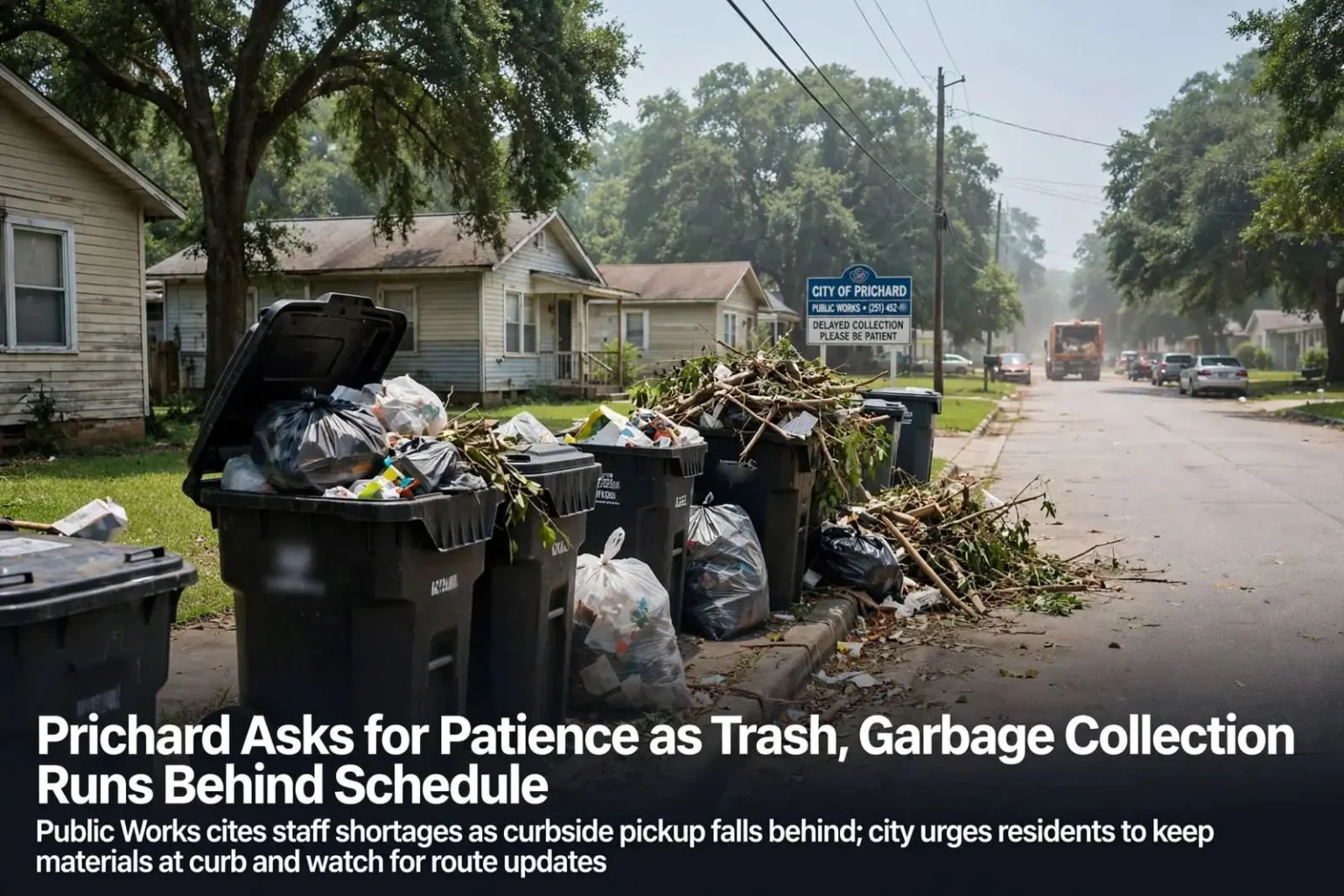
The City of Prichard is asking residents for patience as its Public Works Department works through delays affecting trash and garbage pickup citywide. Officials say the delays stem from staff shortages that have left the department short-handed against its regular collection routes, and that normal schedules should resume “real soon.” In the meantime, collections will continue, though the pace may be slower than usual and some neighborhoods may see pickups arrive later in the day — or later in the week — than they have come to expect.
In a statement, the city said it is working to secure and deploy the resources needed to support curbside collections while keeping Public Works employees safe. The pledge to share updates on temporary route changes as they develop is an acknowledgment that residents plan their weeks around collection days, and that a missed or delayed pickup quickly becomes a neighborhood-level problem if people do not know when the trucks are coming.
Sanitation is among the most visible services a city provides. When garbage and trash collection run on schedule, few residents give it a second thought; when they fall behind, the effects pile up — literally — at the curb. Overflowing carts and stacked yard debris create sanitation concerns that grow worse with each missed cycle, attract pests, and raise health and odor issues that no city wants in its neighborhoods. In Gulf Coast summers especially, a missed collection day is noticeable within hours and a missed week is noticeable from the street. That is why the announcement, and the city’s promise to communicate as conditions change, matter to residents across Prichard’s neighborhoods.
Staff shortages in public works departments have become a widespread problem for municipalities of every size, and smaller cities like Prichard feel the pinch acutely. Sanitation work is physically demanding, performed outdoors in all weather, and often pays less than private-sector alternatives for workers with commercial driver’s licenses. When positions go unfilled, a department that would normally run several collection crews can find itself running fewer, stretching the same routes over more days and falling behind whenever equipment breaks down or workers call in sick.
For residents, the city’s message comes down to three practical points: leave materials at the curb on the scheduled day even if pickup runs late, expect the schedule to be uneven until staffing recovers, and watch for official updates on any temporary route changes. City officials have indicated they would rather residents keep materials ready and wait than pull them back in, since the crews will work through routes as quickly as available staffing allows.
Why sanitation staffing is a hard problem
The workers who collect a city’s garbage and trash do one of the most physically taxing jobs in municipal government, and the requirements of the work narrow the hiring pool. Drivers need commercial licenses; collection crews lift loads all day in heat, rain and cold; and equipment operators must handle trucks and heavy machinery safely in residential streets. When a city loses experienced workers, the replacements are not ready on day one — training and safety instruction take time, which stretches any recovery period well beyond the day a new hire walks in.
The worker-safety language in Prichard’s statement reflects another reality of the job. Collection crews work alongside traffic on residential streets, handle heavy and sometimes hazardous materials, and face the everyday risks that come with machinery and lifting. A department that is short-staffed is also a department where remaining employees shoulder heavier loads, which raises the risk of injury and can push already-strained crews further behind. Cities trying to catch up on routes while protecting their workers face a genuine tension, and Prichard’s statement suggests officials are trying to balance both.
Prichard, a city of roughly 20,000 residents in Mobile County, sits just north of Mobile and shares the region’s hot, humid climate, where uncollected garbage becomes a sanitation concern quickly, especially in summer months. The city, like many of its neighbors, provides curbside collection of household garbage as well as trash — the yard debris, bulky items and limbs that require separate handling from household waste. A slowdown affects both streams, and the visible results accumulate at curbs across the city until routes catch up.
What residents can do while schedules recover
City officials’ advice to residents during collection delays follows a familiar playbook. Household garbage should be bagged and secured in carts with lids closed, both to contain odors and to keep animals out. Trash and debris left at the curb should be stacked neatly, away from mailboxes, water meters and low-hanging limbs, so crews can work quickly when they reach a street. Loose material that can scatter — small limbs, clippings, lightweight items — is best bagged or bundled where the city’s collection rules allow it. Neat, accessible piles are faster to collect, and faster collection is what a short-staffed department needs most.
Communication cuts both ways. Residents who believe their street has been missed can call City Hall or the Public Works Department to report it, which helps officials identify gaps in their routes and adjust as they deploy crews. With the city pledging updates on temporary route changes, residents should also watch official channels — the city’s website, social media accounts and local media — for announcements about which areas are being worked and when normal schedules are expected to resume.
The bigger picture for small-city sanitation
Prichard’s experience is not unique. Municipalities across Alabama and the country have struggled in recent years to fill public works positions, from sanitation collectors to equipment operators, and the shortages have produced similar scenes in communities large and small: delayed routes, extended schedules and city halls fielding calls from frustrated residents. Some cities have responded with pay raises and signing bonuses; others have contracted with private haulers to bridge gaps; still others have simply asked residents to bear with slower service while hiring catches up.
What happens next in Prichard will depend on how quickly the department can rebuild its crews. The city’s assurance that normal schedules should resume “real soon” signals confidence that the shortage is temporary, and the pledge of updates on route changes suggests officials intend to keep residents informed while the recovery plays out. In the meantime, the measure of the response will be visible at the curb week by week — whether the piles shrink, the routes catch up, and the collection trucks return to the schedule Prichard’s neighborhoods are used to.
For a city where sanitation is one of the most tangible services residents receive from City Hall, getting the trucks back on schedule is more than a housekeeping matter. It is a test of basic municipal function, and one the city has publicly committed to passing — with patience requested from residents, resources being secured for the department, and a promise that the updates will keep coming until the job is back on track.
How collection systems work — and why they stall
Most residents see only the truck at the curb, but behind a normal collection week sits a tightly scheduled operation. Routes are laid out so crews finish their areas within a working day; carts and debris piles are collected in a set order; and the trucks return to transfer stations or landfills throughout the day to unload, which caps how much material any single crew can collect regardless of how fast they move. Lose a truck to a breakdown, or a crew to vacancies, and the arithmetic of the whole week comes apart — there is simply no spare capacity to absorb the loss.
That is why staffing shortages hit sanitation so hard compared to other city services. A police department short two officers can still patrol; a public works department missing a crew simply collects less than the city produces, and the difference accumulates at the curb. Heavy rain makes the problem worse by slowing crews further and softening ground where trucks travel, and holiday weeks compress the calendar while residents generate more waste than usual. Recovery is therefore a matter of arithmetic as much as effort: the department must not only complete its current routes but work down the backlog left from the days it fell behind.
The city’s request for patience is, in practical terms, a request for residents to let that arithmetic play out — leaving materials at the curb, keeping carts accessible, and reporting genuine misses so no street gets skipped entirely. Cities that communicate clearly through such periods generally emerge with goodwill intact; those that go quiet tend to find frustration mounting faster than the debris. Prichard’s statement, with its specific commitments to keep collecting, protect workers and announce route changes, is an effort to be in the first category while the department works its way back to normal.