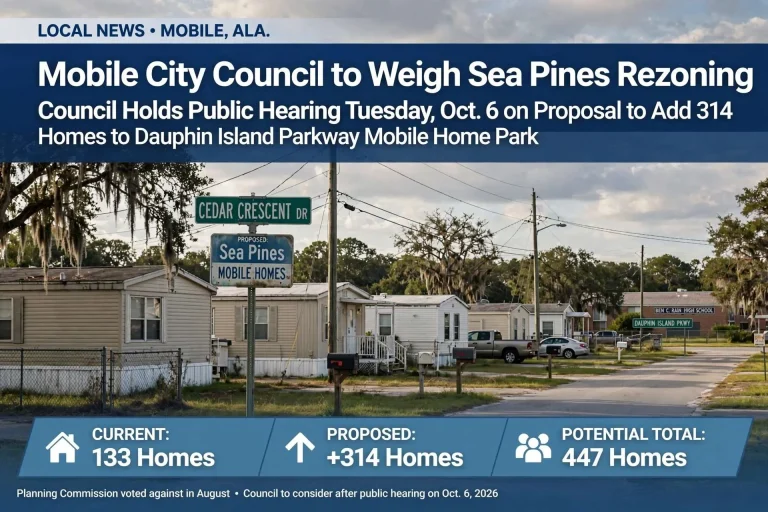
Prichard Opens Bidding on Citywide Garbage Contract and Final Mitchell Library Renovations
Prichard is accepting sealed bids through Sept. 21 for residential garbage collection covering about 8,000 homes and for the final phase of interior renovations at the Mitchell Library in Eight Mile.
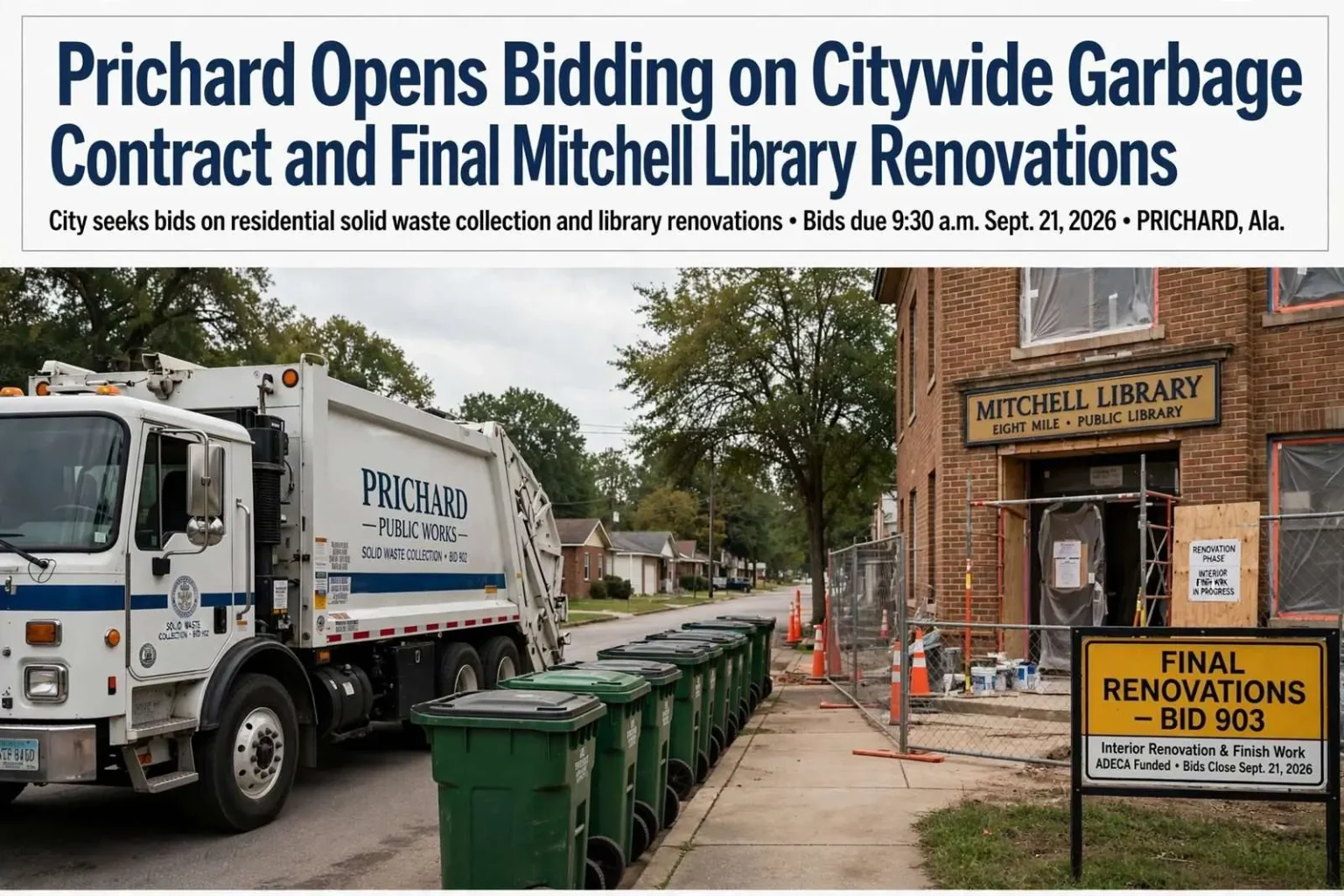
PRICHARD, Ala. — The City of Prichard is accepting sealed bids on two contracts that touch very different parts of daily life in the city: weekly residential garbage collection, and the final phase of renovations at the Mitchell Library in Eight Mile.
Bids on both projects will be accepted through 9:30 a.m. on Sept. 21, 2026. Complete specifications are available from the Office of the City Clerk-Treasurer.
Bid 902: residential solid waste collection
Through Bid 902, Prichard is seeking qualified, licensed solid waste providers to submit proposals for residential garbage collection and related services inside the city limits. The winning contractor would be responsible for furnishing labor, supervision, vehicles, equipment, fuel, insurance, permits, disposal arrangements, reporting and customer-service support.
The service area covers roughly 8,000 residential units, with household garbage collected at least once per week on a consistent route schedule approved by the city.
One requirement stands out. Prichard residents will continue using the city’s existing garbage carts, and the successful bidder may not require residents or the city to replace those carts as a condition of service unless a separate replacement plan receives city approval. That provision spares households the cost and disruption of a cart swap and keeps the city’s existing inventory in service.
The request for proposals also sets several service expectations aimed squarely at accountability. Bidders must commit to keeping a dedicated company supervisor physically present within the city during regular operations, and missed pickups reported by 2 p.m. on a business day are expected to be collected by the close of business the same day.
Those terms follow a difficult stretch for sanitation service in Prichard, and they signal that the city intends to write responsiveness directly into the contract rather than rely on informal assurances.
Bid 903: finishing the Mitchell Library
The second solicitation covers the remaining renovation work at the Mitchell Library in Eight Mile, with project funding and oversight tied to the Alabama Department of Economic and Community Affairs, or ADECA.
Earlier phases of the project addressed the building’s fundamentals: structural repairs and reinforcement, electrical systems, plumbing, HVAC improvements and accessibility features. The upcoming phase turns to interior renovation and finish work — the visible portion of the project that will determine what patrons actually experience when the branch reopens.
The city is asking bidders to price the work by each major area, and to submit a proposed schedule of values along with a construction schedule. That structure lets Prichard evaluate individual line items and make adjustments if necessary to stay within available funding, rather than accepting or rejecting a single lump sum.
What comes next
Contractors and companies interested in either project are encouraged to review all specifications and submission requirements carefully before the Sept. 21 deadline. Both contracts represent meaningful commitments for a city working to stabilize basic services while continuing to invest in community facilities.
Two contracts, two kinds of need
Prichard’s decision to open bidding on both garbage collection and library renovations in the same window is a neat illustration of what a small city council juggles at once: the unglamorous service that touches every household weekly, and the community asset that touches it occasionally but durably. Both contracts are administered through the Office of the City Clerk-Treasurer, and both carry the same deadline, which lets the city run a single coordinated procurement rather than two separate processes months apart.
The garbage contract in context
Residential solid waste collection is one of the few city services a resident experiences directly and repeatedly, which is why the request for proposals leans so hard on accountability. The ~8,000 residential units covered by Bid 902 describe a city of modest size where a missed route is noticed block by block. The requirement that a company supervisor remain physically present in the city during operations, and that missed pickups reported by 2 p.m. be cleared by end of business, is the kind of language that only appears after a service breakdown — and Prichard’s recent sanitation history, cited by the city, is the reason those clauses are written the way they are.
The cart provision is similarly telling. By forbidding the winning bidder from forcing a cart swap, the city protects households from an unexpected expense and protects its own existing inventory from becoming obsolete. Cart mandates are a common friction point in waste contracts, and writing the protection in up front removes a recurring source of complaint before the new contractor starts.
The Mitchell Library and Eight Mile
The Mitchell Library serves the Eight Mile community, an unincorporated area just north of Prichard that has long depended on nearby city and county facilities. Library renovations there are not merely cosmetic; ADECA funding ties the project to state economic and community development goals, and the phased approach — structure and systems first, finishes second — reflects how older branch buildings are brought up to modern code in stages as money allows. The final phase, interior renovation and finish work, is the part patrons will actually see, which is why the city is pricing it area by area rather than as a single lump sum.
Pricing by area with a schedule of values gives Prichard room to trim or phase line items if costs run past available funding, a flexibility that matters for a project whose budget is fixed by the grant rather than open-ended. It also lets the city compare the cost of, say, a reading room against a restroom upgrade and decide what to fund first.
What the dual deadline signals
Setting both bids to close at 9:30 a.m. on Sept. 21, 2026, concentrates the city’s procurement staff and its council’s attention on a single decision day. For vendors, it means reading two distinct specifications — one operational and ongoing, one construction and finite — under the same clock. For residents, it means two of the city’s more visible commitments could move forward together in the fall, weather depending on how quickly awards and notice-to-proceed follow the deadline.
Both contracts represent meaningful commitments for a city working to stabilize basic services while continuing to invest in community facilities, and the language of the solicitations suggests Prichard is trying to bind its contractors to performance rather than promises.
Eight Mile and Prichard’s northern edge
The Mitchell Library serves Eight Mile, an unincorporated community just north of Prichard that has long relied on neighboring municipalities for services the county does not directly provide. Branch libraries in places like Eight Mile function as more than book lenders; they are cooling centers in summer, homework hubs after school, and meeting spaces for residents who have no city hall of their own. Renovating the branch to modern standards is therefore a small but real investment in a community’s daily life, not just a building upgrade.
Why sanitation contracts draw scrutiny
Garbage collection is the service residents judge a city by most harshly when it fails. A missed route is visible from the curb, and a contract that lets a provider disappear for days erodes trust faster than almost any other lapse. Prichard’s detailed accountability requirements — an on-site supervisor, same-day makeup pickups — are the council’s way of converting past frustration into enforceable language. For the roughly 8,000 households covered, the proof will be in whether the new contractor actually meets those standards once the honeymoon of a fresh contract ends.
A council’s balancing act
Prichard’s two simultaneous bids also reveal how a small city allocates its limited administrative bandwidth. Running a competitive procurement for an ongoing service and a construction project at once requires staff time the city may not have in surplus, which is why a single coordinated deadline and a clear Clerk-Treasurer point of contact matter. The hope on both fronts is that better-written contracts — performance-based for sanitation, line-item priced for the library — produce better outcomes than the arrangements they replace, with less day-to-day oversight required from a lean city government.
The longer arc of Prichard’s services
Prichard has spent years working to stabilize the basic services that residents judge a city by, and the two bids reflect that effort from opposite ends: one keeps the weekly trash flowing, the other restores a community building. Both are unglamorous line items in a municipal budget, yet both shape daily life more than a ribbon-cutting ever will. A city that writes accountability into its sanitation contract and finishes a library it started years ago is, in practical terms, doing the slow, steady work of being a place people trust to deliver. The September 21 deadline is the next concrete step in that work, and the council’s choices on who wins the two contracts will be visible on curbsides and at the Mitchell Library branch for years.
How residents can follow the awards
Once the Sept. 21 deadline passes, the city is expected to open and evaluate the sealed bids, and the contract awards will go before the council for approval. Residents interested in the outcome can follow the Clerk-Treasurer’s office for the recommendation and the council agenda for the vote. The terms written into the winning bids — especially the sanitation accountability clauses and the library’s phased finish schedule — will be public record, giving the community a way to hold the city and its contractors to the promises the solicitations now make.