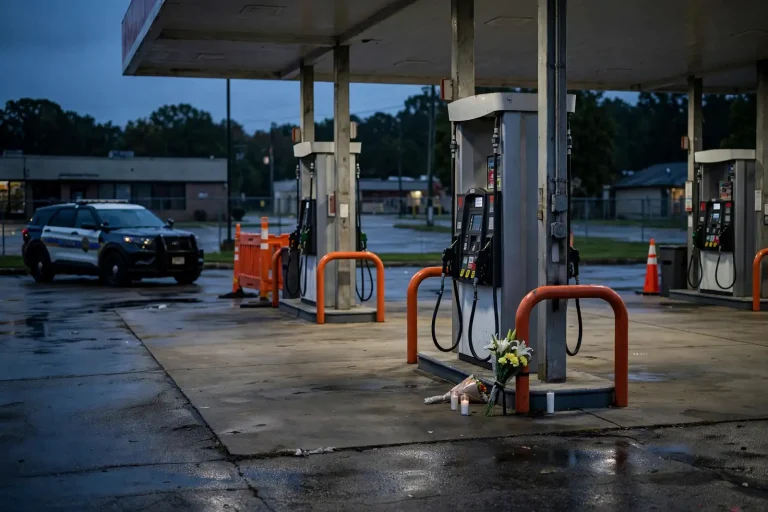
Prichard Police Identify Victim in Fatal Shooting at St. Stephens Wood Apartments
Prichard police identified a 21-year-old Whistler man as the victim of a fatal shooting at an apartment complex, marking the city's 19th homicide of the year.
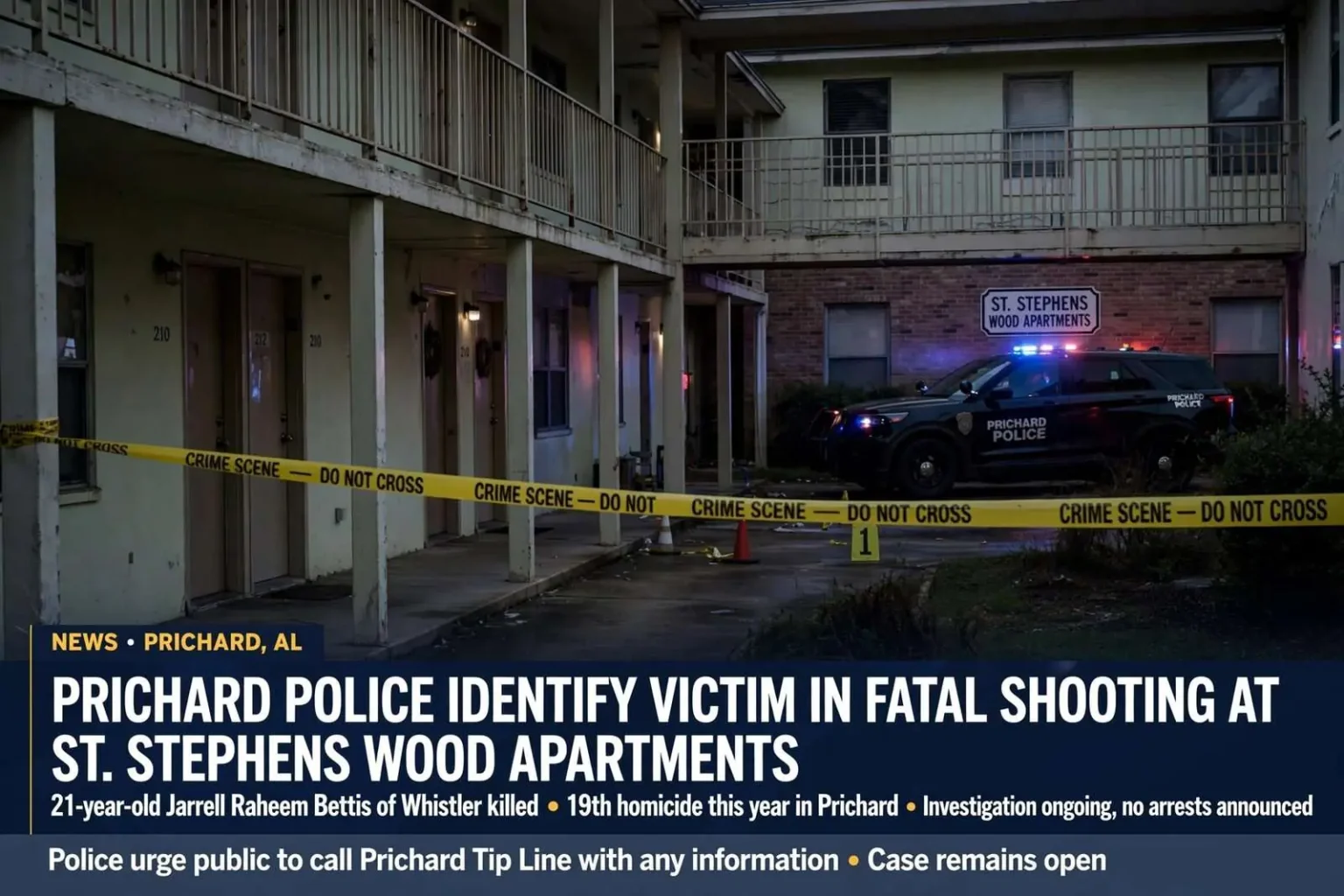
Prichard police have identified the man killed in a shooting late last week as 21-year-old Jarrell Raheem Bettis of Whistler. The young man’s death added another name to the small city’s grim annual count and left investigators working a case that, days in, had produced more questions than answers.
Officers say Bettis was found in a breezeway at the St. Stephens Wood Apartments after passersby alerted authorities to the scene. The discovery, in one of the open-air corridors that connect the complex’s buildings, came as people moved through the property and came upon the wounded man too late for help to arrive in time.
According to Prichard Police spokesman Philip Stiell, the shooting occurred on a Thursday night and investigators are still working to piece together what led to the killing. No arrests had been announced in the days following the discovery of Bettis’ body, and detectives have not said whether they have identified a suspect or a motive, nor whether the shooting was targeted or random.
A city’s 19th homicide
The case marked the 19th homicide recorded in Prichard so far that year, a tally that underscored ongoing concerns among residents and city leaders about violent crime in the small Mobile County municipality. For a city of modest size, the number is stark — and it arrived with months still unaccounted for on the calendar, keeping Prichard on a pace its leaders have spent years trying to change.
Prichard, which sits just northwest of Mobile, has for years grappled with a homicide rate that draws attention well beyond its roughly 22,000 residents. The city’s struggles are well documented: a shrinking tax base, an aging housing stock, and the economic disinvestment that has followed decades of population loss have left the municipality with fewer resources than its crime rate demands, a gap that defines daily life for the police department that serves it.
St. Stephens Wood Apartments, like many multifamily complexes in the area, has seen its share of police calls over the years, and neighbors in the surrounding blocks said they hoped the latest killing would prompt renewed attention to safety in the area. Residents describe a familiar calculus in communities like this one — a handful of addresses that generate a disproportionate share of a city’s calls for service, and a persistent tension between the families who call them home and the violence that occasionally finds them.
How the investigation proceeds
Investigators canvassed the complex in the hours after the shooting, speaking with residents who may have witnessed activity near the breezeway where Bettis was found. Canvassing is slow, unglamorous work — detectives knocking on doors, taking names, asking the same questions in different ways — and its success in a case like this one often depends on whether residents trust the officers at their doors enough to share what they saw.
Prichard police asked anyone with information about the shooting to come forward, stressing that even small details could help investigators build a case. Tips could be phoned in directly to the police department or submitted anonymously through the Prichard Tip Line, a longstanding resource meant to encourage residents to share information without fear of retaliation. Anonymous reporting has become a fixture of investigations in communities where witnesses fear being seen cooperating with police, and detectives acknowledge that many of their cases are built on such calls.
Homicide investigations in Prichard are typically handled by a small detective unit that also covers other violent crime in the city, and cases can take weeks or months to develop as investigators gather evidence, interview witnesses, and build a case for prosecution. The department’s criminal investigators juggle a caseload that larger agencies spread across specialized squads — robbery, assault and homicide all landing on the same desks — which is one reason the city’s clearance rates have trailed the region’s.
The broader struggle over resources
Community members have periodically called for additional resources to be devoted to the department given the volume of violent crime the city has recorded in recent years. Those calls run into the arithmetic of a small city’s budget: Prichard’s general fund must cover police, fire, sanitation and streets from a tax base that has contracted for decades, and every added patrol position or detective competes with other needs no less real.
City officials in Prichard have periodically pointed to economic pressures, population loss, and strained municipal budgets as contributing factors to the challenges facing local law enforcement. The city’s population peaked decades ago and has fallen steadily since, taking businesses and tax revenue with it; what remains is a community with young families, longtime homeowners and churches that anchor its neighborhoods, alongside the concentrated poverty that crime follows.
Community leaders have also organized periodic peace walks and outreach efforts aimed at reducing violence in neighborhoods across the city. Pastors, activists and mothers of victims have led marches through the streets after particularly painful losses, and mentoring programs aimed at the city’s young men have tried to interrupt the cycles that produce 19-homicide years. Those efforts operate on donations and volunteer hours, a fraction of the resources the problem demands.
As of the most recent update, the case remained open, with Prichard police continuing to ask the public for help identifying who was responsible for Bettis’ death. For the family of the 21-year-old from Whistler, the investigation’s pace matters less than its outcome; for the city, the case is one more entry in a ledger its leaders know by heart, and one more argument in the standing debate over what it would take to turn the numbers around.
Understanding Prichard’s crime burden
Prichard’s relationship with violent crime cannot be separated from its economic history. Incorporated in the 1920s as a working-class suburb of industries along Mobile’s northern rim, the city boomed through the middle decades of the century as shipyard, paper mill and chemical plant workers filled its modest neighborhoods. As those industries contracted and families moved to newer suburbs in west Mobile and across the bay, Prichard’s population and tax base eroded, leaving a city with aging infrastructure and a smaller, poorer population to maintain it.
The fiscal strain became famous at the turn of the century, when the city’s pension obligations drove it into bankruptcy — the rare municipality that had actually gone through the process. Recovery has been slow, and public safety spending has been a persistent squeeze: the police department has fought for years to keep its ranks filled in a labor market where neighboring agencies pay more and carry smaller caseloads.
Those realities shape every homicide investigation in the city. A department stretched across patrol shifts has fewer detectives available to work a killing like Bettis’ full time, and every day a case stays open is a day its witnesses scatter, its evidence ages and its leads cool. Detectives know the arithmetic as well as anyone, and it is why they press so hard in the first week.
The view from the neighborhoods
For residents of the St. Stephens Road corridor, where the apartments take their name, the concern is less about statistics than about repetition — the sense that the same handful of blocks absorb the same kind of loss year after year. Parents describe keeping children indoors after dark, and older residents recall when the corridor’s shops and restaurants made it a destination rather than a caution. The breezeway where Bettis was found is the kind of ordinary space — a walkway between front doors — that residents say should feel safe at any hour.
Community organizations working the area emphasize that the violence is concentrated, not universal: most residents are never touched by it directly, and most blocks go months without an incident. That distinction matters to outreach groups trying to organize neighborhoods, since fear can be as corrosive as crime itself when it convinces residents that nothing can change.
The peace walks that follow homicides serve that dual purpose — honoring victims and reclaiming streets in the same gesture. When dozens of residents march past the site of a shooting carrying candles, the message is aimed at two audiences at once: the families grieving inside, and the young men outside who are watching what their community will tolerate.
What a tip is worth
Detectives working the Bettis case will spend the coming weeks doing what homicide investigators in small cities always do: re-interviewing the residents of the complex, pulling whatever camera footage exists in the neighborhood, checking whether the young man’s phone and associations point to a motive, and waiting for the anonymous call that breaks the case. Most such cases in the city have been solved the same way — a friend or neighbor who eventually picks up the phone.
Police stress that tipsters can remain anonymous and that no detail is too small: a car seen idling, an argument heard hours before, a face in the breezeway that did not belong. For a 19-homicide city with a small detective squad, public help is not a supplement to the investigation; most often, it is the investigation. Until the calls come, Jarrell Raheem Bettis’ name joins the city’s count, and the case remains open.