
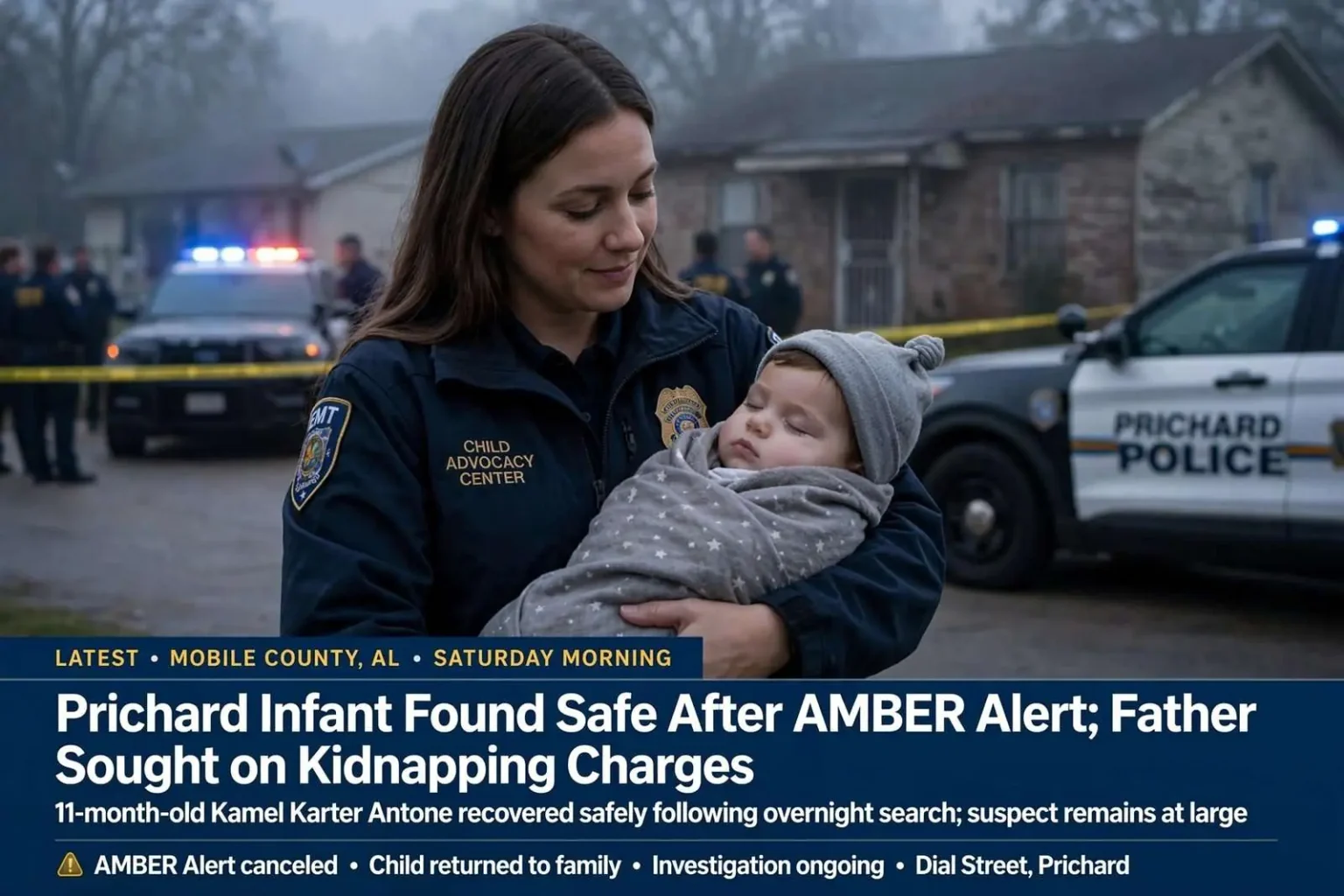
An 11-month-old Prichard child who was the subject of a statewide AMBER Alert early Saturday morning has been found safe, investigators with the Child Advocacy Center said. The infant, Kamel Karter Antone, was returned to family members after an overnight search that stretched across the Mobile County area and kept authorities and relatives working through the early morning hours.
According to investigators, the child was taken around 11 p.m. Friday from a home in the Dial Street area of Prichard. The child’s father, Jakobie Antone, forced his way into the home through a barred door, assaulted the child’s mother and left with the baby, authorities said. The forced entry through a secured door was one of the details investigators highlighted as they worked to determine the circumstances of the abduction.
The Alabama Law Enforcement Agency issued the AMBER Alert before 4 a.m. Saturday as authorities searched for the pair. The alert blasted out descriptions and details to law enforcement agencies, news outlets, and wireless devices across the state, the standard mechanism Alabama uses when a child abduction meets the criteria for statewide notification. Once the alert went out, information about the case moved quickly through the region.
How the Overnight Search Ended
After the alert went out, relatives reached Jakobie Antone, who agreed to meet them and turned the child over early Saturday morning, investigators said. The handoff brought the overnight search to a close, and the infant was examined and returned to family members. ALEA has since canceled the alert, the formal step that ends statewide notifications once a child is confirmed safe.
While the child’s recovery resolved the most urgent part of the case, Jakobie Antone remains at large and faces charges, authorities said. Investigators have not announced a timeline for an arrest, and the case remains active. Anyone who sees him is urged to call 911 rather than approach him directly.
For the family on Dial Street, the outcome was the one every AMBER Alert search hopes for: a child brought home within hours of the first notification. For the investigators who worked the case, the resolution underscored how quickly family networks and public alerts can combine when a young child is taken.
How AMBER Alerts Work in Alabama
The AMBER Alert program — the name stands for America’s Missing: Broadcast Emergency Response — is a voluntary partnership between law enforcement agencies, broadcasters, and transportation departments that activates urgent bulletins in child abduction cases. Alabama’s program is coordinated through ALEA, which serves as the state’s clearinghouse and issues alerts once investigators confirm that a case meets the program’s criteria.
Those criteria are deliberately strict. An alert generally requires a confirmed abduction, a belief that the child faces a risk of serious bodily harm or death, and enough descriptive information — about the child, the abductor, or a vehicle — to make a public alert useful. Not every missing-child case qualifies, which is why the decision to activate the statewide system typically comes after a rapid review by the investigating agency and ALEA.
When an alert is issued, the information is pushed to commercial radio and television stations through the Emergency Alert System, to cellphone users through the Wireless Emergency Alerts program, and to highway message signs along interstate and state routes. In the Mobile area, where many residents commute across state lines into Mississippi for work, the regional reach of the alert network matters: notifications are often shared across state borders when a suspect may be traveling.
The wireless component has become the most visible part of the system. A single buzz on millions of phones delivers the alert text, which typically includes a vehicle description and any other identifying details investigators have confirmed. Police agencies credit those notifications with generating tips that lead to recoveries, and they also acknowledge that the alerts work best when the public reads them closely and reports anything relevant immediately.
The Role of the Child Advocacy Center
Investigators with the Child Advocacy Center were cited in the update on the child’s recovery, a reflection of how these cases are handled in the Mobile County area. Child advocacy centers exist to coordinate the response to cases involving child victims, bringing together law enforcement, child protective services, prosecutors, and medical and mental health professionals so that a child is interviewed and examined as few times as possible by the smallest possible number of people.
That coordination matters most in the hours and days after a recovery. A child taken from a home in the middle of the night, even an infant too young to understand what happened, still needs medical evaluation and a safe placement. Family members who receive a child back under these circumstances are typically interviewed as part of the ongoing investigation, and the advocacy center model is designed to keep those interviews consistent and to avoid re-traumatizing the child or the family members left behind.
In Mobile County, the advocacy center model has been part of the local child-protection landscape for decades, and cases like this one — an infant taken during a domestic dispute — are among the most common scenarios the center’s partner agencies handle. Domestic-related abductions by a parent account for a significant share of AMBER Alert activations nationally, which shapes how investigators approach them: the child’s location is often tied to the suspect’s family and social network.
The Dial Street Area and Prichard’s Response
Dial Street sits in a residential section of Prichard, the city of roughly 20,000 people that borders Mobile’s northern edge along the Mobile County line. Prichard neighborhoods like this one are close-knit, and news of a doorstep abduction in the dark hours of a Friday night spread quickly through the community even before the statewide alert reached phones. By the time the alert was formally canceled Saturday morning, the case had been widely shared across the metro area.
Prichard police and Mobile County-area agencies routinely assist one another on cases that cross jurisdictional lines, and an abduction case draws that cooperation immediately. ALEA’s State Bureau of Investigation provides additional resources for major cases, and the Mobile County Sheriff’s Office and neighboring municipal departments can be brought in for searches, canvasing, and follow-up interviews. The overnight search for Kamel Karter Antone fit that pattern: multiple agencies working the same short list of places the child and suspect might be.
The speed of the resolution also reflected the domestic nature of the case. When a child is taken by a parent or close relative, investigators concentrate on family members and known associates, and in this case the family’s own outreach produced the meeting that ended the search. Relatives reached Antone and persuaded him to hand the child over, a resolution investigators confirmed in their account of the overnight events.
Charges and the Path Ahead
Jakobie Antone faces charges in connection with the abduction, authorities said, and remains at large. The legal consequences of a parental abduction with aggravating circumstances — the forced entry through a barred door and the assault on the child’s mother — can range from felony interference with custody to burglary and assault charges, depending on what prosecutors file based on the evidence investigators assembled during the overnight search.
Law enforcement officials urged anyone who sees Antone to call 911 immediately rather than confronting him. The mother’s injuries and the circumstances of the break-in remain part of the active investigation, and additional charges are possible as the case moves forward.
For now, the case stands as an example of the alert system working as designed. A child was taken from a home just before midnight, a statewide alert was live before 4 a.m., and the child was back with family before the workday began — all while the man accused of taking her remained wanted and the investigation continued.
What Residents Should Know About AMBER Alerts
For Gulf Coast residents, the case is a reminder of how the alert system expects the public to respond. When an AMBER Alert arrives on a phone, the most useful actions are simple: read the full alert text, note the vehicle description and any tag information, and call 911 with anything relevant — no matter how minor it seems. Investigators consistently say that tips which appear insignificant to a caller can be the detail that breaks a case, because the person receiving the tip has context the caller does not.
Residents should also be aware of what alerts do not cover. AMBER Alerts are reserved for the most serious abduction cases, so a missing teenager or a child believed to have left on their own will usually generate a different kind of notice — a news release, a social media post, or an endangered missing person advisory — rather than the phone-blaring statewide alert. Knowing the difference helps the public calibrate how urgently to respond to each kind of notice.
Family Abductions and Domestic Violence
Child advocacy and law enforcement professionals note that abductions by a parent during a domestic dispute are a recurring pattern in AMBER Alert cases across the country. The circumstances described in this case — a forced entry, an assault on the child’s mother, and the removal of the child — mirror that pattern, and they explain why domestic violence resources are often part of the follow-up in these cases.
Advocates in the Mobile area point families toward protective order processes through the district court, local domestic violence shelters and hotlines, and the victim services offices attached to area police departments. When a custody dispute or separation turns violent, those resources exist precisely because situations like the one on Dial Street can escalate quickly and without warning.
The assault on the child’s mother is also a reminder that the adults in these cases are victims too. The mother survived the attack and her child was recovered, but the family will deal with the aftermath — legal proceedings, safety planning, and the emotional weight of the night itself — long after the alert notifications stop.
A Rare Positive Outcome
National AMBER Alert statistics consistently show that a majority of activations end with the child recovered, and cases resolved within the first 24 hours — as this one was — are the most common successful outcome. The combination of a fast alert, an engaged family network, and a suspect who was reachable by relatives produced a resolution in this case that authorities described in straightforward terms: the child is safe, and the man accused of taking her still faces the charges.
Investigators closed out the public side of the search Saturday morning when ALEA canceled the alert, but the criminal case remains open. Police across the Mobile area will continue to look for Jakobie Antone, and the public’s role has not ended: anyone with information about his location is asked to call 911, or to contact Prichard police or the Child Advocacy Center with details.
For the family and neighbors who spent the night watching for updates, the outcome is the simplest possible summary of the case: an 11-month-old who was taken from a Dial Street home is back with family, safe and accounted for, and the system built to find children like him worked the way it was designed to.


