Prichard Mother Charged After Officials Say 7-Month-Old Had Broken Bones
Prichard police charged a mother with endangering a child after a 7-month-old baby was found crying and later discovered with broken bones.
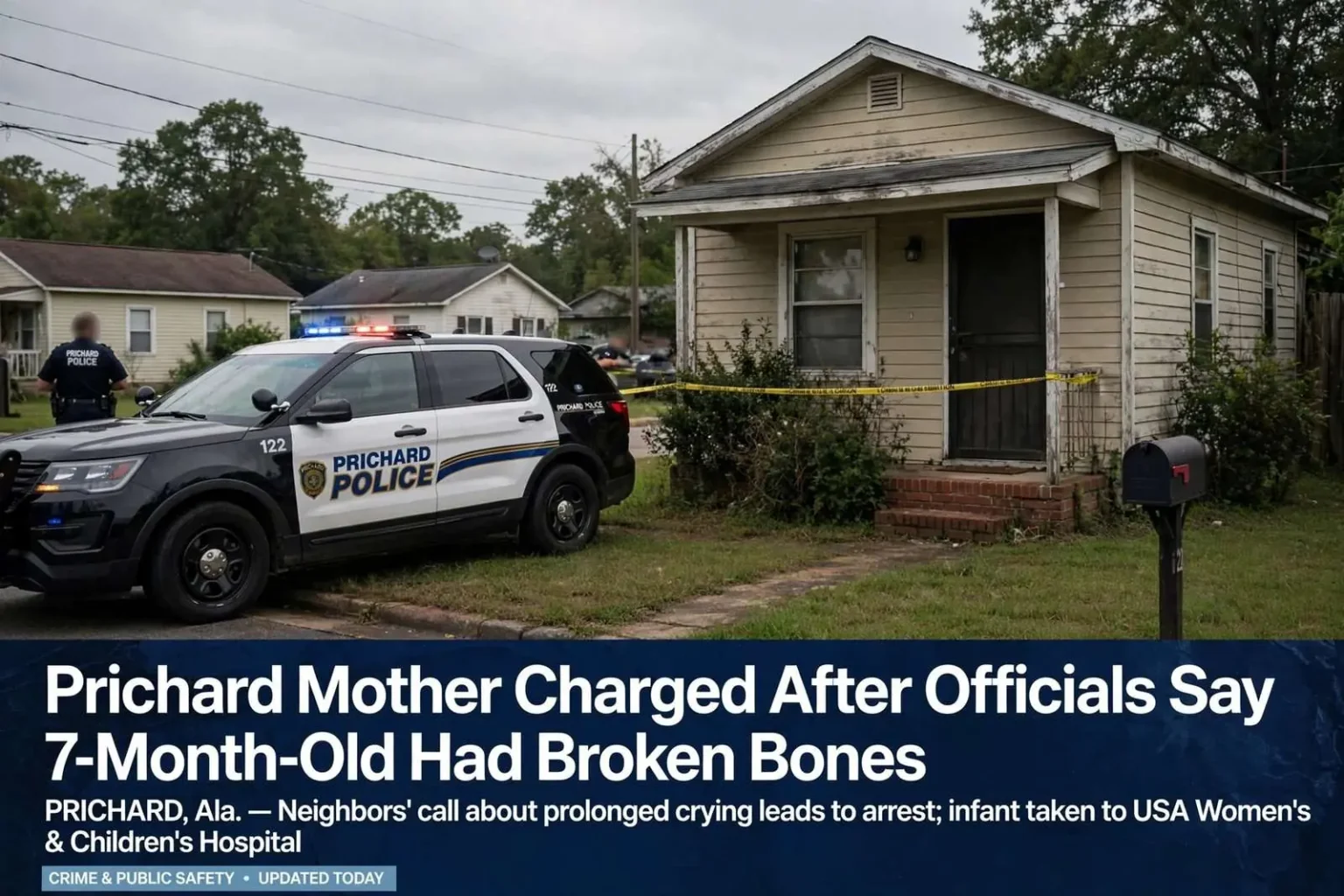
PRICHARD, Ala. — A Prichard mother is facing a child endangerment charge after authorities said her infant was found with broken bones. Prichard police identified the suspect as Ardenesa O’Neal, 36, who is charged with endangering a child. According to police, neighbors called after hearing a baby crying inside a nearby home. When officers arrived, they requested a detective from the Child Advocacy Center to assist with the investigation. The seven-month-old baby was found crying and taken to USA Women’s & Children’s Hospital for evaluation, where officials said examinations revealed broken bones. The case remains under investigation as authorities determine the full circumstances of the child’s injuries.
The call that set the case in motion came not from inside the home but from the neighborhood around it. Residents who heard an infant crying for an extended period contacted police, and their decision to pick up the phone brought officers to the scene. In child-welfare cases, that kind of call is often the first and only chance authorities have to intervene, since infants cannot report what is happening to them and injuries may be invisible to anyone outside the household.
When officers arrived, they found the baby crying inside the residence and immediately moved to have the child evaluated medically rather than treating the situation as a routine disturbance call. A seven-month-old cannot explain pain or point to an injury, so medical professionals rely on physical examination and imaging to determine what has happened. It was that evaluation at USA Women’s & Children’s Hospital, not anything officers could observe at the scene, that revealed the broken bones.
Recognizing the specialized nature of the case, officers requested assistance from a detective assigned to the Child Advocacy Center, a multidisciplinary approach used across Mobile County when the youngest and most vulnerable victims are involved. Rather than relying solely on patrol officers, investigators trained in child abuse interviewing and evidence collection take the lead, coordinating with medical staff, social workers, and prosecutors from the earliest hours of the case.
How child abuse investigations work
Fractures in infants are treated by medical and law enforcement professionals as significant findings. Babies at that age are not mobile enough to suffer most accidental breaks on their own, which is why hospital protocols require careful documentation and, in many cases, a full skeletal survey to identify all injuries. Medical findings from a children’s hospital evaluation often become central evidence in the criminal case and in any dependency proceedings involving the child’s care.
The Child Advocacy Center model exists to keep investigations consistent and to reduce trauma to the child. In Mobile County, the Gulf Coast Regional Child Advocacy Center brings together law enforcement investigators, county Department of Human Resources caseworkers, medical providers, and victim advocates so that a child’s medical care, safety placement, and the criminal case proceed in coordination rather than in separate silos. Interviews, when they occur, are conducted by professionals trained to work with victims who are too young to speak.
Alongside the criminal charge, the county’s Department of Human Resources typically becomes involved to determine where the child will live during and after the investigation. That can mean placement with a relative, a foster home, or another safe setting while courts weigh the evidence. The criminal case and the child-welfare case run on separate tracks, but both turn on the same underlying question: how the injuries occurred and who is responsible for the child’s safety.
Alabama law takes a layered approach to cases involving injured children. In addition to felony assault statutes that may apply depending on the severity of injuries, the state’s child endangerment law criminalizes exposing a child to circumstances that endanger their health or welfare. Charges can be revised as medical evidence develops — an initial charge is frequently upgraded or supplemented once hospital findings are complete and investigators have interviewed everyone with access to the child. Under Alabama’s mandatory reporting statute, doctors, nurses, teachers, and dozens of other professionals are legally required to report suspected child abuse, and the reporting duty extends to any citizen who has reasonable cause to believe a child is being harmed.
For the neighbors who made the call in this case, that legal framework provides protection as well as encouragement. Reports made in good faith to law enforcement or to the state’s child-abuse hotline are confidential, and people sometimes hesitate because they are unsure whether what they heard rises to the level of an emergency. Police departments across the region consistently give the same answer: call, and let trained officers and investigators decide. A call that turns out to be nothing costs a few minutes; a call that is not made can cost a child’s life.
The role of USA Women’s & Children’s Hospital
USA Women’s & Children’s Hospital, part of the University of South Alabama health system in Mobile, serves as the region’s primary children’s hospital, drawing pediatric cases from across southwest Alabama and the Gulf Coast. Its pediatric teams handle the evaluations that child-abuse investigations depend on, and hospital staff work closely with investigators when examination findings raise questions about how an injury occurred. For families from Prichard and other Mobile County communities, it is typically the closest facility with that level of pediatric capability.
Prichard, the community where the case began, sits just north of Mobile in Mobile County and operates its own police department serving roughly 19,000 residents. Like departments of its size, Prichard police rely on partnerships — with county investigators, hospital staff, and state agencies — to handle complex cases that a small department could not manage alone. The request for a Child Advocacy Center detective in this case is an example of that system working as designed.
What happens next
As of the initial report, the investigation remained open, with authorities working to establish the full circumstances of the child’s injuries. That work typically includes medical follow-up, interviews with household members and anyone else who cared for the child, and a review of the family’s history with child-welfare agencies. Once investigators complete their work, the case moves to the Mobile County District Attorney’s Office for presentation to a grand jury, which decides whether additional or upgraded charges are warranted.
The charge of endangering a child is a serious one, and a conviction can carry prison time under Alabama law, though the specific exposure depends on the facts proved and the defendant’s record. Like any defendant, the person charged is presumed innocent unless and until proven guilty in court, and the charges at this stage represent accusations, not findings.
Anyone who suspects a child is being abused or neglected can report it to local police or to the Alabama Department of Human Resources’ centralized child-abuse hotline, which operates around the clock. Reports can be made anonymously, and mandatory reporters and ordinary citizens alike are protected when they report in good faith. Child-welfare officials stress that the earliest possible report gives investigators the best chance to protect a child before an injury becomes a tragedy.
Pediatricians say the injuries seen in infant abuse cases are often discovered only when something else prompts a medical visit — which is why delayed cries for help, like the prolonged crying neighbors reported here, can be the warning sign that matters. Caregivers sometimes attribute an infant’s prolonged crying to colic or fussiness, and there are cases across the country where persistent crying masked an untreated injury for days or weeks. Medical staff evaluating a baby with a fracture will also look for older healing injuries, because a pattern of injuries at different stages of healing is one of the clearest indicators of abuse rather than accident.
That medical uncertainty is also why authorities move deliberately in cases like this one. Charging decisions are made based on what the evidence supports, and evidence in infant-injury cases builds over time: imaging results, consultation with pediatric specialists, statements from everyone with access to the child, and the scene examination of the home itself. Prosecutors in Mobile County generally prefer to present a complete case to a grand jury rather than charging quickly and revising later, though the initial endangerment charge allows the case to move forward while the investigation continues.
Warning signs and prevention
Child-welfare agencies in Alabama and across the Gulf Coast publish guidance for recognizing abuse, and much of it centers on changes that are hard to explain. Injuries in non-mobile infants, bruises on areas of a baby’s body not typically injured by ordinary handling, fear of a particular adult, or a caregiver’s refusal to let others see the child all warrant a call. So does a child who seems persistently hungry, dirty, or unsupervised, since neglect is the most common form of maltreatment reported nationwide.
Prevention resources exist in Mobile County for families under stress before abuse ever occurs. Crisis nurseries, parenting classes, home-visiting programs for new mothers, and faith-based family support organizations all operate in the region, and many accept self-referrals. Advocates point out that infant caregiving is exhausting and that crying — the trigger for many abuse cases — peaks at around two months of age. Programs teaching caregivers to place a crying baby safely in a crib and step away for a few minutes have been credited with reducing infant injuries, a message local health departments repeat during child-abuse awareness campaigns.
For the community around the home where this case began, the episode underscored the same lesson investigators emphasize after every case: children are protected when the adults around them act. The neighbors in this case heard something, judged it worth reporting, and made the call that brought officers to the door. From there, the systems designed for exactly this situation — patrol response, hospital evaluation, Child Advocacy Center investigation, and Department of Human Resources involvement — took over.
The child’s recovery and long-term placement will depend on findings that authorities have not yet released, including the severity of the fractures and the medical prognosis. Updates in the case are expected to come through the Prichard Police Department and the Mobile County court system as the investigation advances. What remains public at this stage is the charge, the child’s condition as described by officials, and the open question of the full circumstances — which investigators, hospital staff, and prosecutors will now work together to answer.