Prichard Police Seek Tips in Fatal Shooting on Canada Court
Prichard police are asking for the public's help identifying who shot and killed a man near Main and Parson streets in a homicide investigation.
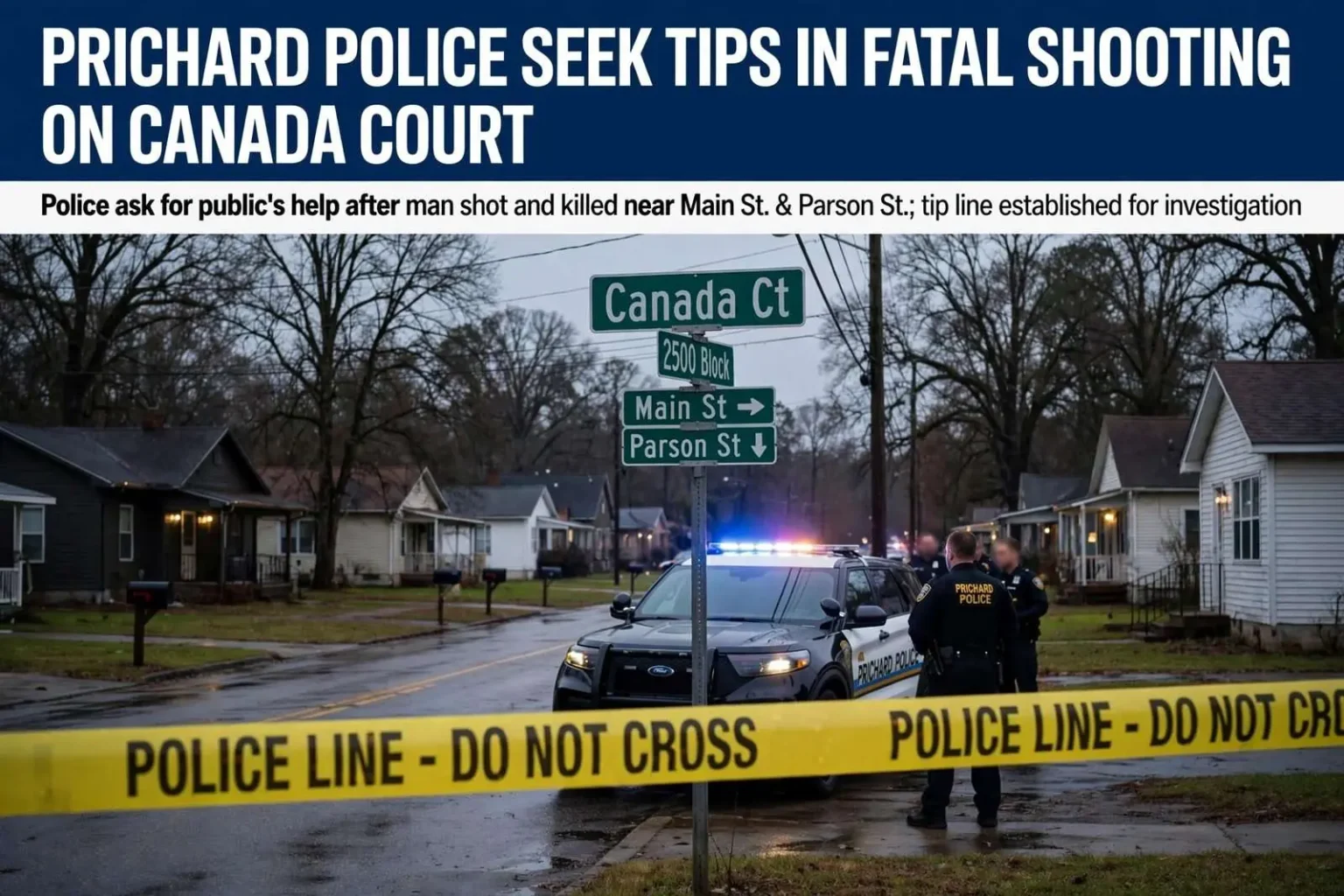
Prichard police are asking residents for help solving a homicide after a man was shot and killed earlier this week near the intersection of Main Street and Parson Street. According to police, the shooting happened in the 2500 block of Canada Court. The victim was taken to USA Hospital, where he was pronounced dead on arrival.
Investigators have not released the man’s identity publicly, saying they are withholding his name until his family has been formally notified. Detectives have not announced any suspects or identified a motive for the shooting as the investigation continues. Police are treating the case as an active homicide investigation and are urging anyone with information about the incident to come forward.
The Neighborhood and the Search for Witnesses
The Canada Court area sits within a residential section of Prichard near the Main Street and Parson Street corridor, a part of the city that has seen periodic violent crime in recent years. Prichard police have increasingly relied on tips from residents to help build cases in shootings where witnesses may be reluctant to come forward on their own.
Investigators have set up a tip line specifically for this case, asking anyone with knowledge of the shooting, the people involved, or events leading up to it to contact Prichard detectives directly. Police did not disclose additional details about the circumstances of the shooting, including whether investigators believe it was targeted or random, citing the ongoing nature of the investigation.
Homicide investigations in smaller municipalities like Prichard often depend heavily on community cooperation, since local departments typically operate with fewer investigative resources than larger metro police agencies. Detectives have emphasized that any piece of information, even details that may seem minor, could help move the case forward. As of the time of the police request for tips, no arrests had been announced in connection with the shooting. Prichard police said the investigation remained open.
A Small Department Confronting Big-City Problems
Prichard, a city of roughly 19,000 people bordered by Mobile and Chickasaw, fields one of the smaller police departments in Mobile County, and its detectives routinely work cases without the specialized units, crime lab capacity and analytical staff that larger agencies take for granted. When a homicide happens inside the city limits, Prichard investigators handle the case with support available from county and federal partners, but the daily work — canvassing doors, interviewing witnesses, following tips — falls to a small investigative staff. That reality makes community cooperation not a courtesy but a necessity: in a case with no announced suspect and no announced motive, the witnesses who live on Canada Court and the surrounding blocks hold most of the evidence that exists.
The Main Street and Parson Street corridor runs through the heart of Prichard’s residential districts, and Canada Court branches off it as a residential street of the kind where neighbors know each other’s cars and routines. Detectives in cases like this one typically move block by block in the first days, asking about vehicles seen leaving the area, arguments heard in the hours before the shooting, and anyone who might have surveillance footage from doorbell cameras or home security systems — technology that has transformed witness canvasses in cities across Mobile County, where residents increasingly capture footage police would once have had to reconstruct entirely from memory.
How the First Days of a Homicide Case Unfold
The sequence that brought the victim to USA Hospital — the region’s major trauma center on the University of South Alabama’s campus — reflects the standard response to a shooting in any Mobile County municipality: paramedics stabilize and transport, and the receiving hospital makes the formal pronouncement that turns a shooting scene into a homicide investigation. USA Hospital’s role means the fatal outcome was documented in Mobile even though the shooting occurred in Prichard, and the official determination of death anchors the timeline detectives work from.
Withholding the victim’s name until family notification is standard procedure in homicides, both as a matter of courtesy to the family and as an investigative tool — the hours before a name becomes public are often when detectives quietly establish the victim’s movements, associations and enemies without alerting anyone who might be involved. Once the family has been notified, investigators can seek the public’s help more specifically, asking about the victim’s last known whereabouts and contacts. Until then, the department’s request for tips necessarily remains general.
The absence of an announced suspect or motive at this stage is common rather than alarming. Homicide units build cases in layers: first the scene and the forensic evidence, then the victimology — who the victim was, where he had been, who might have reason to harm him — and only then the identification of suspects. Tips from the community accelerate every layer, and detectives stress that callers do not need to know what matters; a fragment of information that seems trivial to the caller can slot into place beside evidence the detectives have not disclosed.
Why Tips Decide Cases Like This One
In shootings in residential neighborhoods, physical evidence is frequently thin: shell casings, perhaps a vehicle description, and little else. The difference between a case that is solved and one that goes cold is usually the testimony of people who saw or heard something — and in communities where witnesses fear retaliation or distrust the process, anonymous tip lines exist precisely to lower that barrier. Tipsters can provide information without giving their names, and crime stoppers-style programs across Mobile County add reward incentives for tips that lead to arrests in violent felonies.
Prichard police have leaned on that model repeatedly in recent years, and city officials have repeatedly paired the requests for tips with assurances that anonymity is protected. The calculus for detectives is straightforward: every unsolved shooting in a neighborhood raises the risk of retaliation and deepens the reluctance of the next witness, while an arrest — even in one case — signals to residents that coming forward produces results. The department’s emphasis that even minor details could help reflects that strategy: it wants every call, not just the dramatic ones.
What Residents Can Do Now
Detectives are asking anyone with knowledge of the shooting on Canada Court — what they saw, what they heard, who was in the area, or what they may know about the people involved or events leading up to it — to contact Prichard detectives directly through the tip line established for the case. Those who prefer anonymity can still provide substantive help, and investigators say details about events before the shooting are as valuable as accounts of the shooting itself, since establishing the victim’s movements and encounters in his final hours is often how a motive first comes into view.
For the residents of the Canada Court area and the wider Main Street and Parson Street corridor, the department’s message is that the case remains open and active, that no arrest has been made, and that the investigation’s next break depends on the people who live closest to where it happened. The family of the man killed — his name still withheld out of respect for those still being notified — is waiting on what those residents know.
Prichard’s Context: A Small City Under Strain
Prichard’s circumstances shape every homicide investigation the city faces. Once a thriving industrial suburb of Mobile, the city has weathered decades of population loss and economic contraction that have strained its tax base and, with it, every municipal service including its police department. The city filed for bankruptcy in the late 1990s — the first Alabama municipality to do so — and its fiscal recovery has remained a constraint on department staffing ever since. What that means in practice for a case like the Canada Court shooting is that Prichard detectives rely more heavily than their counterparts in larger cities on partnerships: the Mobile County Sheriff’s Office, Mobile Police Department investigators, federal ATF and FBI resources when gun violence cases warrant them, and the county forensic infrastructure that no small city could maintain alone.
It also means the department’s relationship with residents carries more weight than public relations. In a city Prichard’s size, officers and residents often know one another by name, and the credibility of the department’s assurance that tipsters will be protected is built through those standing relationships. Community organizations and church leaders in Prichard have historically played the bridge role, passing information between neighborhoods reluctant to call police directly and detectives who need it — a channel that matters most in exactly the kind of case now under investigation, where no suspect has been named and no motive announced.
The Broader Toll of Gun Violence on Mobile County’s Small Cities
The Canada Court homicide adds to a persistent pattern of gun violence in Mobile County’s smaller municipalities, where shooting deaths occur at rates comparable to far larger cities but with a fraction of the investigative resources. Prichard’s officials have repeatedly joined Mobile County’s mayors and the district attorney’s office in regional anti-violence efforts, emphasizing that the guns involved in local shootings flow through the same markets and the same countywide networks regardless of municipal lines. Each unsolved case, they have argued, weakens deterrence across the region — a lesson detectives carry into every new investigation.
For the family now grieving a death the public cannot yet read about, and for the neighbors on Canada Court who heard whatever happened in the dark on their street, the case’s outcome rests on the same request the department has repeated: anyone who knows anything, call. Detectives say they will take the call, protect the caller and follow the smallest detail as far as it leads. In small-city homicide work, that is how cases close.