
Prichard’s ‘Love Thy Neighbor Day’ Food Drive Hands Out Groceries Drive-Through Style
Prichard's Love Thy Neighbor Day committee handed out a truckload of groceries drive-through style at Mt. Calvary Missionary Baptist Church.
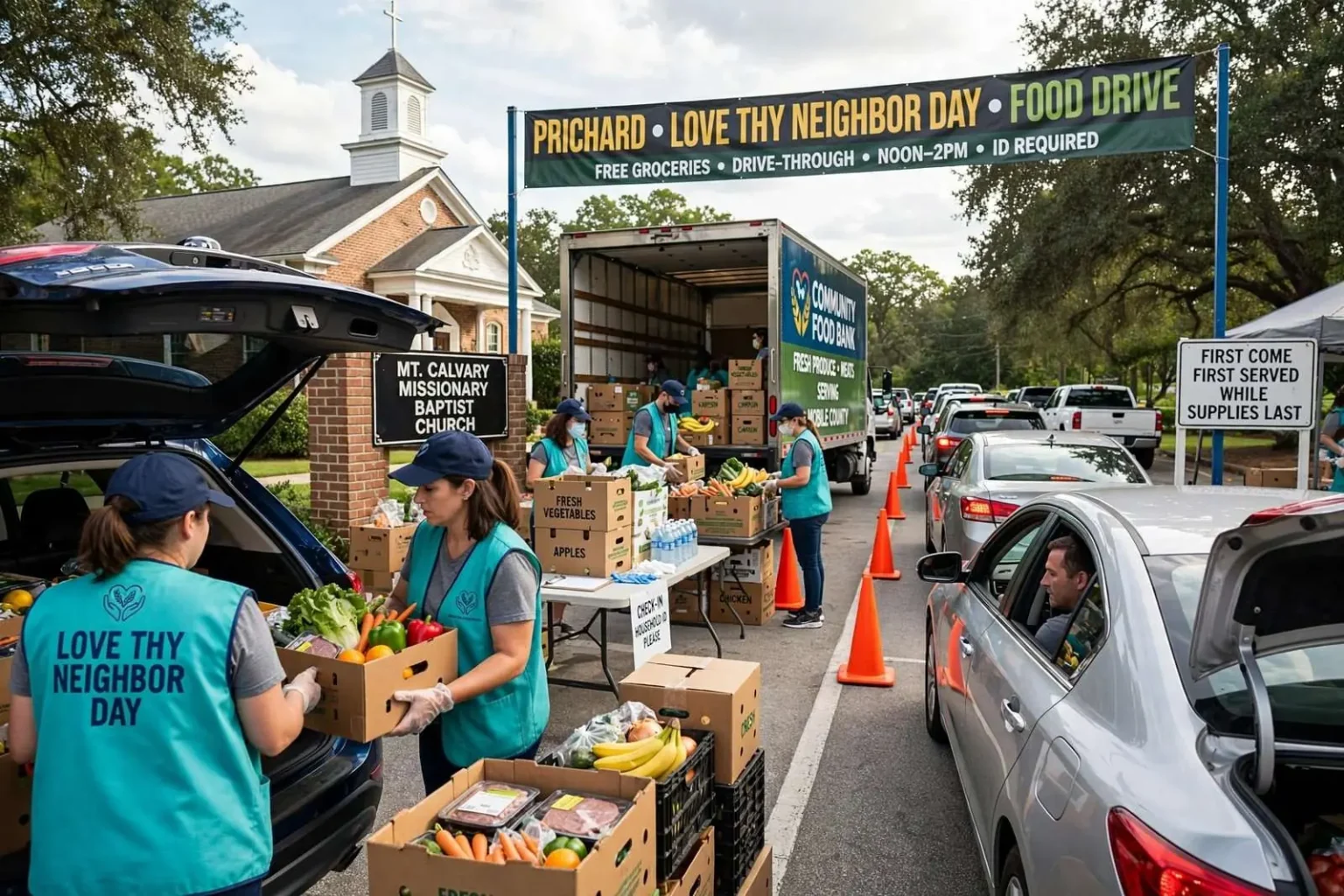
The annual Prichard ‘Love Thy Neighbor Day’ committee kept its tradition of community giving going Friday with a food drive at Mt. Calvary Missionary Baptist Church. A truckload of fruits, vegetables and assorted meats was distributed free of charge on a first-come, first-served basis until supplies ran out, with identification required from each household.
Organizers ran the giveaway as a mobile pantry: families stayed in their cars and filed through the line while committee members loaded the groceries into their vehicles. Distribution ran from noon to 2 p.m., a window that has become familiar to households that rely on the event from year to year.
The drive-through format has become the standard for food distributions across the Gulf Coast in recent years, and for good reason. It moves cars through quickly, protects the health of both volunteers and recipients, and allows families with limited mobility, no childcare, or no transportation alternatives to receive groceries without leaving their vehicles.
Prichard, a city of roughly 20,000 residents just north of Mobile, has one of the higher poverty rates in the state, and community food distributions play a meaningful role in how many of its households stretch their monthly budgets. Local churches and civic groups have organized giveaways for decades, but the coordinated mobile pantry model has expanded their reach considerably.
A Tradition Rooted in the Community
The Love Thy Neighbor Day committee has built its annual effort around the simple premise in its name — that neighbors take care of neighbors — and the Friday giveaway reflects that mission in practical form. The committee draws support from volunteers, donors, and partner organizations who supply the food and labor needed to move a truckload of groceries into dozens of family vehicles in a matter of hours.
Mt. Calvary Missionary Baptist Church has served as a host site for community efforts like this one, offering its grounds and its presence in the neighborhood as a gathering point. Churches across Prichard have long functioned as anchors for community support, from food pantries to back-to-school drives to holiday meal programs.
The food distributed Friday covered the core of a household grocery list: fresh fruits and vegetables alongside assorted meats. Perishable distributions like this one differ from shelf-stable pantry programs because the items cannot be stored for long, which is precisely why organizers hand them out quickly and directly to families who can use them right away.
How the Line Worked
Households were asked to present identification, a requirement that helps organizers track distribution and ensure the food reaches as many separate families as possible rather than being claimed repeatedly by the same households. First-come, first-served means timing matters, and lines for popular giveaways in Prichard often form well before the scheduled start.
From noon until 2 p.m., volunteers moved between the truck and the line of vehicles, loading boxes and bags while families waited in their cars. The system requires coordination — volunteer teams assigned to traffic flow, loading, and record-keeping — but it routinely moves a large volume of food in a short window.
For recipients, the groceries represent more than a single meal. A supply of produce and meats can free up a portion of a household’s food budget for other essentials, an advantage that families in a city where many residents commute to work outside Prichard have learned to plan around.
Food Insecurity on the Gulf Coast
Prichard’s need is part of a larger regional picture. Mobile County sits in a stretch of the Gulf Coast where food insecurity rates have consistently run above national averages, driven by wages that lag behind rising living costs and by limited access to full-service grocery stores in some neighborhoods.
Regional food banks and their network of partner agencies supply much of the food that flows through community distributions like Friday’s, channeling donations from grocers, manufacturers, and federal commodity programs into local hands. Churches and volunteer committees then handle the last mile — the face-to-face work of getting boxes into cars and vans.
The mobile pantry model that the Love Thy Neighbor Day committee uses is now one of the most common formats in that network. Instead of asking residents to travel to a fixed pantry with limited hours, the food comes to a neighborhood site, hosted by a church or community center that residents already know.
That approach matters in a city like Prichard, where transportation can be a barrier. Residents without a reliable vehicle depend on distributions within walking distance or on the bus lines that connect the city’s main corridors, and a drive-through event lowers that hurdle considerably.
The People Behind the Effort
Committee-driven giveaways like Friday’s run on volunteers: members who plan the event, coordinate the food supply, direct traffic, load groceries, and keep the line moving through the two-hour window. The work is seasonal in rhythm — an annual effort — but the preparation stretches well beyond distribution day.
Soliciting donations of fresh produce and meats takes lead time and relationships with suppliers, and the committee’s ability to put a truckload of food on the ground each year reflects those partnerships. Donors who support the effort range from area businesses to individual neighbors who contribute what they can.
The identification requirement and the first-come, first-served structure keep the event orderly, but organizers also emphasize the spirit of the day: no lengthy paperwork, no income verification, just a household ID and a place in line. The simplicity is deliberate, designed to remove the barriers that keep some families from seeking help elsewhere.
What Comes Next
Friday’s giveaway was part of the committee’s annual calendar, and the organization has signaled that community giving remains its continuing mission. Residents who missed the distribution can watch for the committee’s next event or contact Mt. Calvary Missionary Baptist Church about other assistance programs in the area.
Households needing food support between events have options: regional food banks maintain listings of partner pantries across Mobile County, and several Prichard churches operate ongoing food ministries with regular hours. City officials have also periodically helped publicize large distributions, recognizing the role they play in the community’s fabric.
For the volunteers who loaded cars Friday afternoon, the measure of the event is straightforward — how many households drove away with the makings of real meals, and how quickly the line moved while the supply lasted. On that count, the tradition held for another year in Prichard.
Prichard’s Broader Context
The city’s challenges with poverty and disinvestment are well documented. Once a thriving industrial and residential suburb, Prichard saw manufacturing jobs and retail activity migrate away in the closing decades of the twentieth century, taking much of the city’s tax base with it and leaving neighborhoods with aging housing and fewer services.
City government has worked for years on redevelopment efforts, from revitalization plans for the Main Street corridor to public safety investments, and community organizations have filled gaps where municipal resources fall short. Food distributions, youth programs, and senior services operated by churches and nonprofits carry much of that load.
Events like Love Thy Neighbor Day do more than hand out groceries — they reinforce the social ties that community advocates say are Prichard’s greatest asset. Neighbors see each other at the church grounds, volunteers catch up with families they have served for years, and word travels about other forms of assistance available in the area.
The committee’s formula of a recognizable host site, a fixed time window, and a simple entry requirement has proven durable. Each year’s event builds on the reputation of the last, and the noon-to-2 p.m. window gives working families a realistic chance to attend without missing a full shift.
Friday’s distribution continued a tradition that has outlasted economic ups and downs in the city, and organizers indicated the tradition of community giving will carry on in the years ahead.
Volunteering and Supporting Future Drives
Committee events of this scale always need hands, and organizers typically welcome new volunteers in the weeks before distribution day. The jobs range from heavy lifting — loading cases of produce and frozen meats — to traffic direction, registration, and cleanup, so residents of nearly any ability can find a role.
Donations follow a similar pattern. Cash contributions let the committee purchase exactly what is needed for the truckload, while in-kind gifts of food or supplies — boxes, bags, ice, and gloves — reduce the event’s costs. Local businesses that want to help can reach out through the host church to be connected with the committee’s organizers.
Those who plan to attend future distributions can prepare by arriving early, having household identification ready, and leaving space in the vehicle for boxes of fresh food. Perishables should be refrigerated promptly after pickup, a detail organizers stress because the produce and meats handed out are meant for immediate household use.
The mobile pantry format also depends on the weather holding. Distributions occasionally shift schedules in heavy rain or storms, so families planning to attend are advised to confirm timing with organizers before the event window opens.
Friday’s event once again showed how the pieces fit together in Prichard: a committee with a mission, a church with the space, a truckload of good food, and a line of neighbors ready to receive it. For two hours on a Friday afternoon, that combination put groceries into household after household — and kept a beloved tradition alive.


