Proposed Alabama bill would give residents a tax credit for storm shelters
A proposed Alabama bill from Rep. Joe Lovvorn would let residents claim a tax credit for building or buying a storm shelter or safe room.
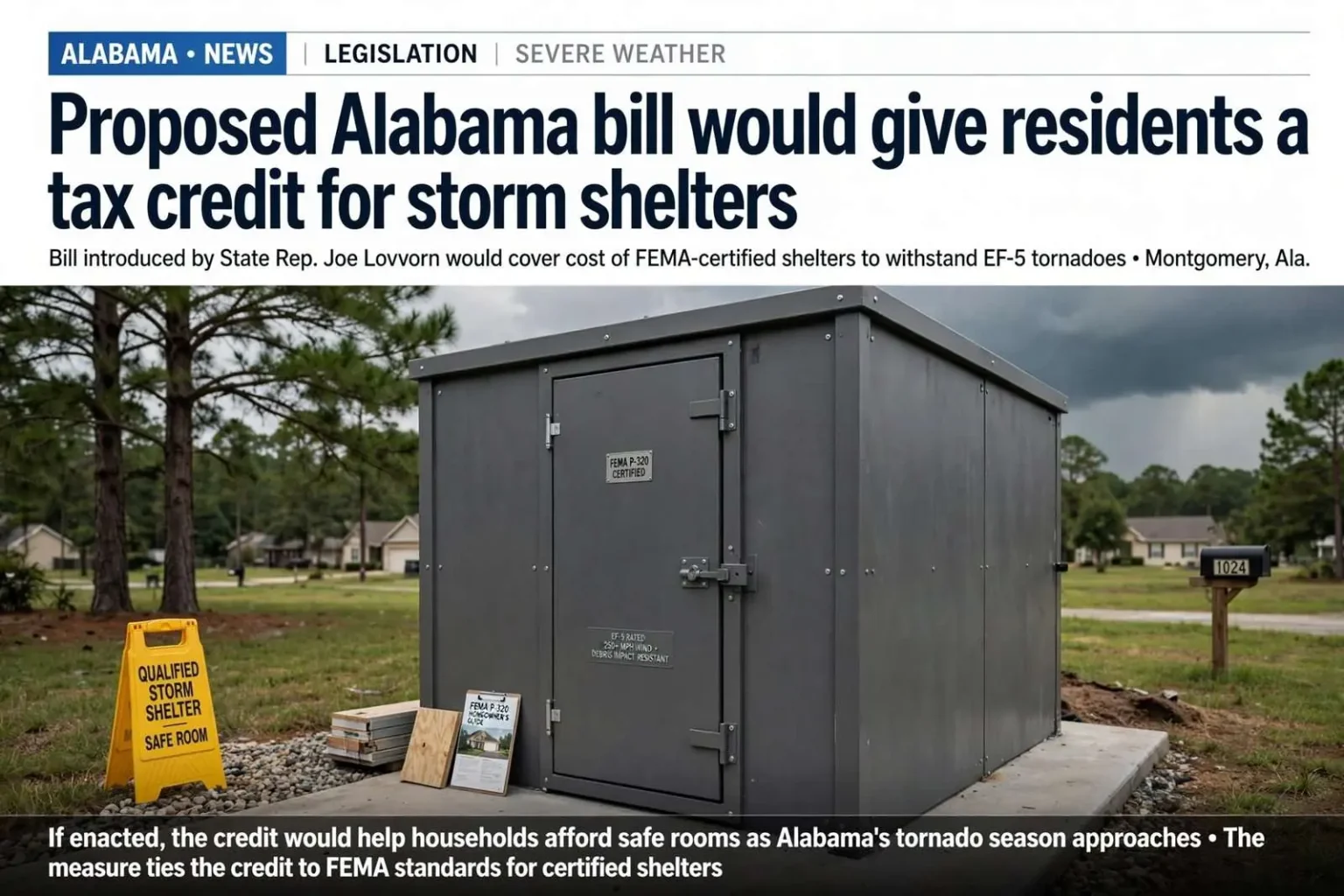
MONTGOMERY, Ala. — A newly proposed Alabama bill would give residents a tax break to help cover the cost of qualified storm shelters. State Rep. Joe Lovvorn, a Republican, introduced the legislation in the Alabama Legislature last week, putting a state incentive behind the safe rooms that emergency management officials have urged Alabamians to build for years. The proposed tax credit would cover the cost of constructing, buying or installing qualified storm shelters and safe rooms built to withstand an EF-5 tornado. To qualify, the structures must also meet or exceed FEMA’s minimum criteria for shelters.
If approved, the credit would make it more affordable for Alabama households to add a safe room as severe-weather season approaches. The proposal arrives against the backdrop of a state that sits at the heart of Dixie Alley, the Southeast’s own tornado corridor, where violent storms have repeatedly produced deadly outbreaks and where the cost of sheltering has been the most commonly cited barrier to protection.
What the bill would do
The legislation’s mechanics are straightforward: a household that constructs, purchases or installs a qualified storm shelter or safe room would claim a tax credit against its Alabama liability, offsetting a defined portion of the cost. The qualification standard is drawn from two benchmarks that safety engineers use nationwide. The first is structural resilience — the shelter must be capable of withstanding an EF-5 tornado, the top of the Enhanced Fujita scale, where winds exceed 200 mph and the debris load includes entire structures and vehicles. The second is FEMA’s published criteria for shelters, which specify design pressures, anchoring requirements, door and latch standards, and ventilation that together produce a tested envelope capable of protecting occupants through a direct hit.
Those criteria matter because not every structure sold as a storm shelter meets them. Above-ground safe rooms built to FEMA standards use reinforced concrete or steel panels anchored to a slab; in-ground shelters installed in garages and yards rely on engineered doors and vents to survive both the wind and the debris it carries. FEMA guidance, published as P-320 for homeowners and P-361 for designers, lays out the specifics, and manufacturers whose products pass the testing regimes certify their units accordingly. The bill ties the credit to that certified tier, screening out marginal products and ensuring the public money attached to the credit purchases real protection.
Why Alabama needs shelters
Alabama’s severe-weather history explains the urgency behind the proposal. The state has endured some of the deadliest tornado events in modern American history, most catastrophically the April 27, 2011 outbreak, which killed more than 230 Alabamians across the state and produced EF-5 damage in Hackleburg, Phil Campbell and Smithville’s path toward Marion County. Earlier outbreaks in 1932 and 1956, the deadly March 2019 Lee County tornado, and recurring January and March storm seasons have all underscored the same vulnerability: much of Alabama’s housing stock, particularly older homes and manufactured housing, offers minimal protection against violent tornadoes.
The gap between need and capacity is well documented. National surveys and state-level analyses have repeatedly found that a small fraction of Alabama households have access to a storm shelter or safe room, with cost the leading reason. A residential shelter typically runs several thousand dollars installed — out of reach for many households in a state where median incomes trail the national average — and prior federal programs offering shelter rebates have operated with limited funding and long waiting lists. A state tax credit, if enacted, would put a recurring incentive in the tax code rather than depending on annual appropriations.
How the credit would work for households
Under the proposal as introduced, a resident who installs a qualifying shelter would claim the credit on their state income tax filing, covering the documented cost of construction, purchase or installation. The credit’s structure — whether refundable, carry-forward or capped — would be set in the bill’s final text, and fiscal notes during committee consideration would establish its expected cost to the state’s Education Trust Fund or General Fund depending on how the legislation routes the revenue reduction.
For homeowners weighing the investment, the credit would stack onto other support that has existed in various forms. Federal grant programs through FEMA’s Hazard Mitigation Assistance have occasionally funded community safe rooms, and some counties and municipalities have operated shelter rebate programs when funding permitted. The proposed state credit would be the broadest application of public money yet, reaching every Alabama taxpayer who installs a certified shelter regardless of county program availability.
Emergency managers emphasize that a shelter is one layer of a broader preparedness plan. Households are advised to maintain multiple ways to receive warnings — NOAA weather radios and smartphone alerts alongside sirens — and to have a plan for reaching the shelter quickly when a warning is issued. But the advice itself acknowledges the limit of every other option: in an EF-5 tornado, the only reliably survivable locations are engineered shelters and safe rooms, and that is precisely the standard the bill attaches to the credit.
The path through the Legislature
The bill’s journey now follows Alabama’s regular legislative process: committee review in the House, where fiscal notes and stakeholder input will shape the final provisions, then floor votes, the Senate’s consideration and, if passed, the governor’s signature. Storm shelter legislation has surfaced in previous sessions in various forms, and the proposal’s fortunes will depend on the state’s fiscal outlook and the priority legislative leadership assigns to severe-weather preparedness in the session ahead.
For Alabamians who have postponed a shelter purchase because of cost, the bill’s introduction is the signal to watch. If enacted, the credit would make certified protection meaningfully cheaper at exactly the moment the state’s next severe-weather season approaches, and emergency management officials would gain another tool in their long effort to end the state’s recurring tornado death toll. Rep. Lovvorn’s proposal now rests with his colleagues in the Legislature, whose decision will determine whether Alabama’s tax code joins its building codes in the work of keeping residents alive through the storms the state knows are coming.
The shelter landscape in Alabama
Alabama’s existing shelter resources have grown unevenly across the state. Community safe rooms — larger structures serving neighborhoods, schools and mobile home communities — have been built with federal hazard mitigation funding in selected counties, and some municipalities have opened public shelters on campus properties and fairgrounds. But residential coverage remains sparse. Surveys following major outbreaks have found that most Alabamians killed in tornadoes died in site-built homes without basements or in manufactured housing, the two categories where access to an engineered shelter would have made the greatest difference.
The state’s geography compounds the challenge. North Alabama’s Tennessee Valley communities — Huntsville, Decatur, Florence and the surrounding counties — sit in a region with a long, documented history of violent tornadoes, while central Alabama’s corridor through Tuscaloosa, Birmingham and the Black Belt has seen repeated deadly storms. South Alabama’s tornado threat arrives mostly with landfalling hurricanes and spring squall lines, but the state’s exposure is statewide, and so is the housing stock’s vulnerability. A tax credit available to every resident, rather than targeted through county programs, matches the shape of the risk.
Manufacturers and installers of certified shelters operate across the state, with products ranging from in-ground steel and concrete units to above-ground safe rooms that can be installed in garages, closets and new construction. The FEMA criteria the bill references are the same standard those manufacturers build to for federal programs, so the credit’s qualification requirements would not create a new certification hurdle — they would attach public money to the standard that already defines genuine protection.
The fiscal debate
Tax credit legislation in Alabama always runs into the state’s revenue structure. The General Fund, which finances most non-education state services including emergency management agencies, is chronically strained, and any credit that reduces tax revenue must be weighed against the programs that compete for the same dollars. Supporters of shelter incentives argue the fiscal math favors prevention: the state’s share of disaster response, recovery costs and the long-term economic damage of deadly storms dwarfs the cost of the credits, and every death prevented is a saving that no budget line captures.
Past federal experience offers a precedent both sides cite. FEMA’s residential shelter rebate programs, funded through hazard mitigation grants, have demonstrated demand — programs in Alabama and other tornado-belt states have been oversubscribed whenever offered — and have also demonstrated cost-effectiveness, since a shelter’s installed cost is a fraction of the per-capita losses the state absorbs in major outbreaks. Whether that argument carries the day in the Legislature will depend on the session’s broader budget politics and on how the bill’s sponsors structure the credit’s annual cap, if any, to bound its cost.
What residents should know about qualifying shelters
For homeowners who would use the credit if it passes, the practical starting point is understanding what qualifies. FEMA’s criteria call for a shelter designed to resist the wind pressures and debris impacts of extreme tornadoes — tested door assemblies, anchored foundations, ventilation that functions under load — and the agency’s published homeowner guidance explains the options in plain terms. Above-ground safe rooms must meet the same performance standards as in-ground units; neither is automatically better, and the right choice depends on the site, the water table, the budget and the household’s needs.
Installation choices matter as much as the unit itself. An in-ground shelter in a garage requires enough clearance for the door swing and for occupants to reach it quickly; an above-ground safe room needs a slab capable of taking the anchoring hardware. Homeowners in manufactured housing face particular considerations, since the units themselves cannot anchor a shelter and placement must account for transportation to the site. Reputable installers handle these questions as a routine part of the job, and the certification documentation they provide — proof the unit meets FEMA criteria — would be exactly the record a household needs to claim the credit on a state filing.
Emergency managers also remind residents that a shelter purchase should be paired with a warning plan. Alabama’s tornado seasons produce storms that can strike with little daylight and short lead times, and the households that survive best are those that receive the warning, act immediately and know their shelter is ready — clear access, charged flashlights, and no stored items blocking the door. The proposed tax credit lowers the cost of the structure; the plan that makes it useful remains free.
A waiting season
Until the Legislature acts, Alabama’s severe-weather timetable continues regardless of the bill’s status. The state’s primary tornado seasons — late winter into spring, with a secondary peak in November — arrive whether or not the credit passes, and emergency management officials’ advice to residents is unchanged in the meantime: know your safe place, have a way to receive warnings, and consider what protection your home can provide. The proposal from Rep. Lovvorn would, if enacted, turn the state’s tax code into part of that answer, aligning financial policy with the engineering reality that in the strongest tornadoes, only a built shelter stands between a family and the storm. The bill now awaits committee action, and its progress will be watched most closely by the residents who live in the path of the next outbreak.