PSC Candidate McNeil Proposes Alabama Data Center Accountability Plan
Democratic PSC candidate Robert McNeil is proposing an Alabama Data Center Accountability Plan with regional reviews and water conservation standards for large computing facilities.
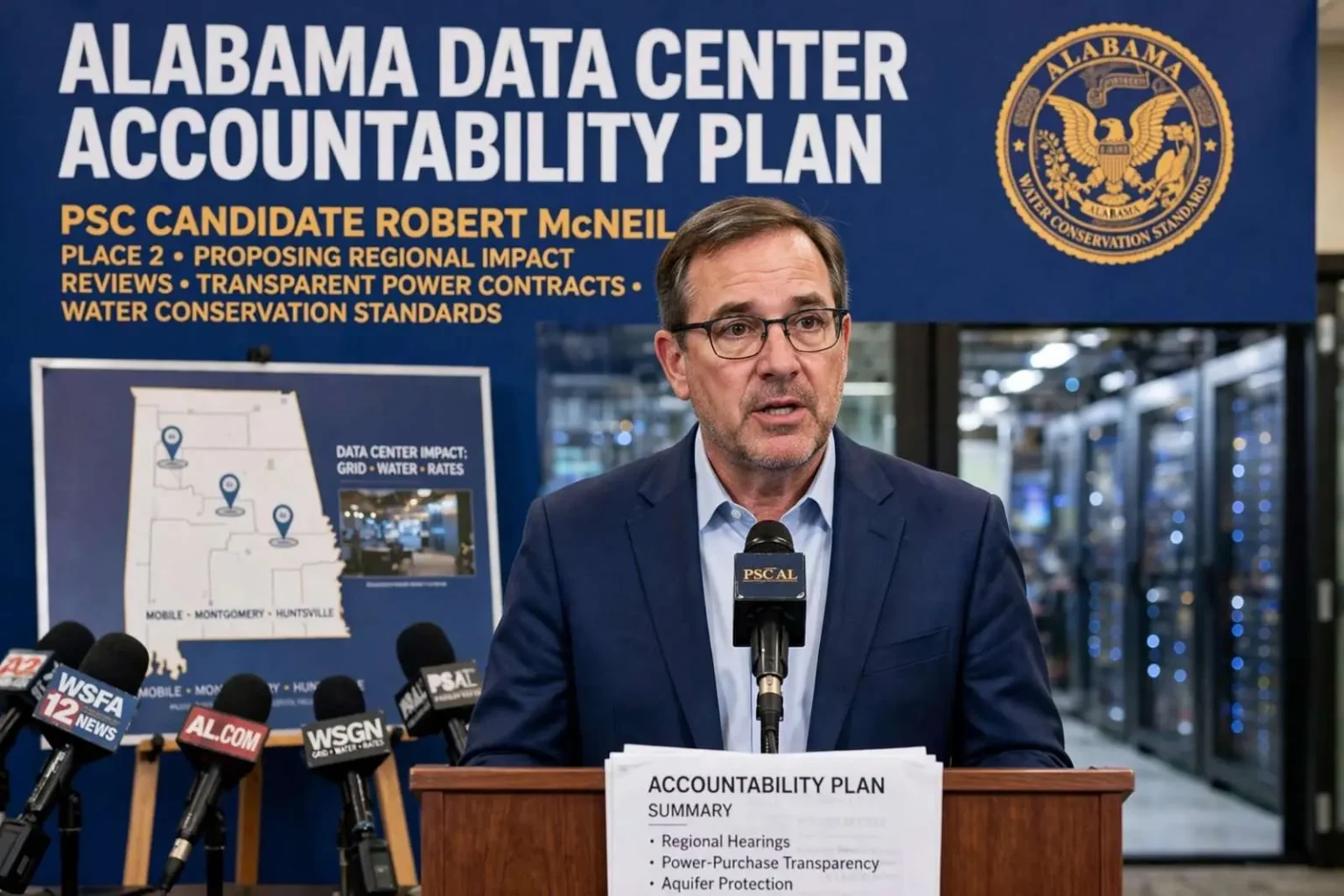
Robert McNeil, a Democratic candidate for Alabama Public Service Commission Place 2, is calling for an “Alabama Data Center Accountability Plan” that would establish binding standards for how large computing facilities are approved, built and monitored across the state. McNeil said the framework is needed as data center demand grows rapidly nationwide, warning that Alabama risks soaring costs, unstable service and depleted water resources if the state does not act soon.
The proposal puts a growing national issue squarely in front of the state commission that regulates Alabama’s utilities. Data centers — the warehouse-scale facilities that house the servers behind cloud computing, streaming and artificial intelligence — are being sited across the Southeast at a rapid pace, drawn by cheap land, available power and tax incentives. Each facility can draw as much electricity as a small town, and many require substantial water for cooling. For a state like Alabama, where electric rates are set through the Public Service Commission and where rural water systems supply both households and industry, McNeil argues that the arrival of these facilities is too consequential to be left to case-by-case negotiations.
“When people talk about data centers, they focus on the jobs and investment, and those are real,” McNeil said. “But behind every server rack is a massive load on our grid and our aquifers. Without accountability, homeowners, small businesses and farmers pay the hidden costs. My plan puts them first, not the shareholders.”
McNeil’s framing taps into a debate playing out in statehouses across the country. Utilities and data center operators point to the investment and construction jobs that facilities bring, along with the long-term tax revenue that can flow to local school systems. Critics respond that the permanent employment at a finished data center is modest relative to its footprint, and that the larger risk falls on ratepayers if utilities must build new generation and transmission capacity to serve loads that can relocate as quickly as they arrived. In several neighboring states, disputes over who pays for the infrastructure that serves hyperscale facilities have become recurring fights in rate cases and legislative sessions.
What the Plan Would Do
The plan calls for regional impact reviews that would give localities a voice in projects affecting their communities, including hearings that would examine grid capacity, water use and infrastructure needs. Under the proposal, a proposed facility would not simply be a matter between a developer and a local permitting office; the effects on the surrounding electrical grid, water supply and roads would be examined in open hearings where county and municipal officials, water authorities and residents could raise concerns before construction begins.
McNeil said transparent power-purchase agreements would ensure data centers pay their fair share and do not shift costs onto residential customers. Power-purchase agreements are the contracts through which utilities and large customers commit to long-term electricity arrangements, and they have become a battleground in the data center debate nationally. Advocates of transparency argue that the public should be able to see the terms under which a utility commits to serve a hyperscale customer — including who pays for new substations, transmission lines and generation — because ratepayers ultimately stand behind the utility’s balance sheet.
The third pillar of the plan is water. McNeil’s proposal calls for enforceable water conservation standards that would prohibit new facilities from depleting local aquifers. Much of south and central Alabama depends on groundwater, and unlike a power plant’s fuel purchases, the cost of a depleted aquifer is borne by everyone who shares it — households, farms and the small municipal systems that often lack the legal resources to contest a large industrial user. Requiring conservation measures and withdrawal standards in advance, rather than after problems emerge, is the plan’s answer to that imbalance.
McNeil’s candidacy comes at a time when the Public Service Commission’s traditional portfolio — setting rates for Alabama Power, overseeing gas utilities and regulating telecommunications — is colliding with newer questions about technology infrastructure. The commission’s decisions on how large new industrial loads are classified and charged ripple directly into what residential customers pay, which is why data center policy has begun appearing in utility commission races across the South. A candidate’s position on where those costs land is, in practical terms, a position on future electric bills.
For south Alabama specifically, the intersection is immediate. The region’s economy is diversified across sectors including aerospace, shipbuilding, healthcare, tourism, agriculture, and port-related commerce, and each of those sectors is both a beneficiary and a potential casualty of how the state manages large-scale computing growth. Shipyards and aerospace suppliers run power-hungry operations of their own; farmers and the towns along the Gulf Coast depend on reliable and affordable water; hospitals and universities are themselves heavy technology users with their own data needs.
The Port of Mobile is among the largest in the nation by tonnage and supports a wide range of logistics and industrial activity. Port communities have watched the national boom in industrial-scale computing with particular interest, because ports, rail lines and cheap industrial land are exactly the combination data center developers look for. Mobile’s emergence as a logistics hub means the region is likely to see proposals of this kind, and the question McNeil is raising — who reviews them, on what terms, and with whose interests at the table — will arrive regardless of who holds the commission seat.
Major employers in the region include military installations, hospitals, universities, and manufacturing facilities, all of which anchor local economies that depend on predictable utility costs. Economic development organizations at the city and county level work to attract investment and retain jobs, and state incentive programs frequently play a role in site-selection decisions. That competitive dynamic cuts both ways in the data center debate: incentives and fast approvals help a state win projects, but McNeil’s plan argues that the terms of those approvals should be written down and enforced rather than negotiated quietly project by project.
The proposal is also a reminder of how campaign issues migrate between levels of government. About Federal Campaign Finance: U.S. House campaigns are subject to federal campaign finance law administered by the Federal Election Commission (FEC). Candidates must disclose their donors and expenditures in regular reports filed with the FEC, which are public. Individuals, political action committees, political parties, and other groups may contribute within statutory limits, while so-called independent expenditure groups may spend unlimited sums provided they do not coordinate with a candidate’s campaign. Analysts frequently review quarterly FEC filings to gauge a campaign’s financial strength and momentum.
McNeil’s race, by contrast, is for a state office, and campaigns for the Public Service Commission operate under Alabama’s state campaign finance rules rather than the federal framework that governs congressional races. The distinction matters for voters trying to follow the money: a state utility commission seat is won with in-state donations and local coalitions, and the interest groups most invested in the outcome are the ones regulated by the commission itself — utilities, telecommunications companies and, increasingly, the developers of the industrial facilities the commission’s rate decisions touch.
Whether the accountability plan becomes law is another question entirely. A candidate for a Place 2 seat on the commission can set the agenda through campaign platforms and, if elected, through votes on rate cases and rulemakings, but binding standards for data center siting would likely also require action by the Legislature, which writes the state’s incentive laws and land-use framework. McNeil’s proposal is therefore as much a challenge to the state’s policymakers as it is a campaign platform — an argument that Alabama should decide the rules of the data center boom before the boom decides them for Alabama.
The national backdrop gives the argument urgency, at least in McNeil’s telling. Across the Southeast, utilities have announced successive rounds of new generation capacity driven in part by projected data center demand, and regulators in several states have begun requiring utilities to demonstrate that large new customers will pay their own way before approving infrastructure expansions. Water disputes have followed a similar arc, with cooling demands colliding with droughts and aquifer declines in several fast-growing regions. Alabama’s advantage, McNeil argues, is that it can adopt protections while the facilities are still mostly prospective, rather than retrofitting rules after aquifers and ratepayers are already committed.
Critics of this kind of plan typically raise two objections: that heavy review processes slow economic development in a state that needs it, and that utility policy is better handled through the commission’s existing rate-case machinery than through new siting standards. McNeil’s answer, in essence, is built into the plan’s structure — the reviews are regional and open, the power-purchase terms are transparent rather than new, and the water standards apply only to new facilities. Whether that balances out as a reasonable safeguard or a costly hurdle is the debate the campaign will carry through the election.
What is not in dispute is the scale of what is coming. The computing demands behind artificial intelligence, cloud services and streaming have made data centers one of the fastest-growing categories of industrial construction in the country, and states across the Southeast are competing for them with tax abatements and ready sites. Alabama will host more of this construction in the coming years; the open question is on whose terms. McNeil’s Alabama Data Center Accountability Plan is his answer: reviews before approval, transparency in the power contracts, and water standards with teeth — with homeowners, small businesses and farmers, as he puts it, paying nothing they did not agree to.