PSC Runoff Puts Coal Ash at Plant Barry Back in the Spotlight
Alabama Public Service Commissioner Chip Beeker and challenger Robert McCollum head to a June 21 runoff, with McCollum pushing for more scrutiny of Alabama Power's coal ash storage at Plant Barry on the Mobile River.
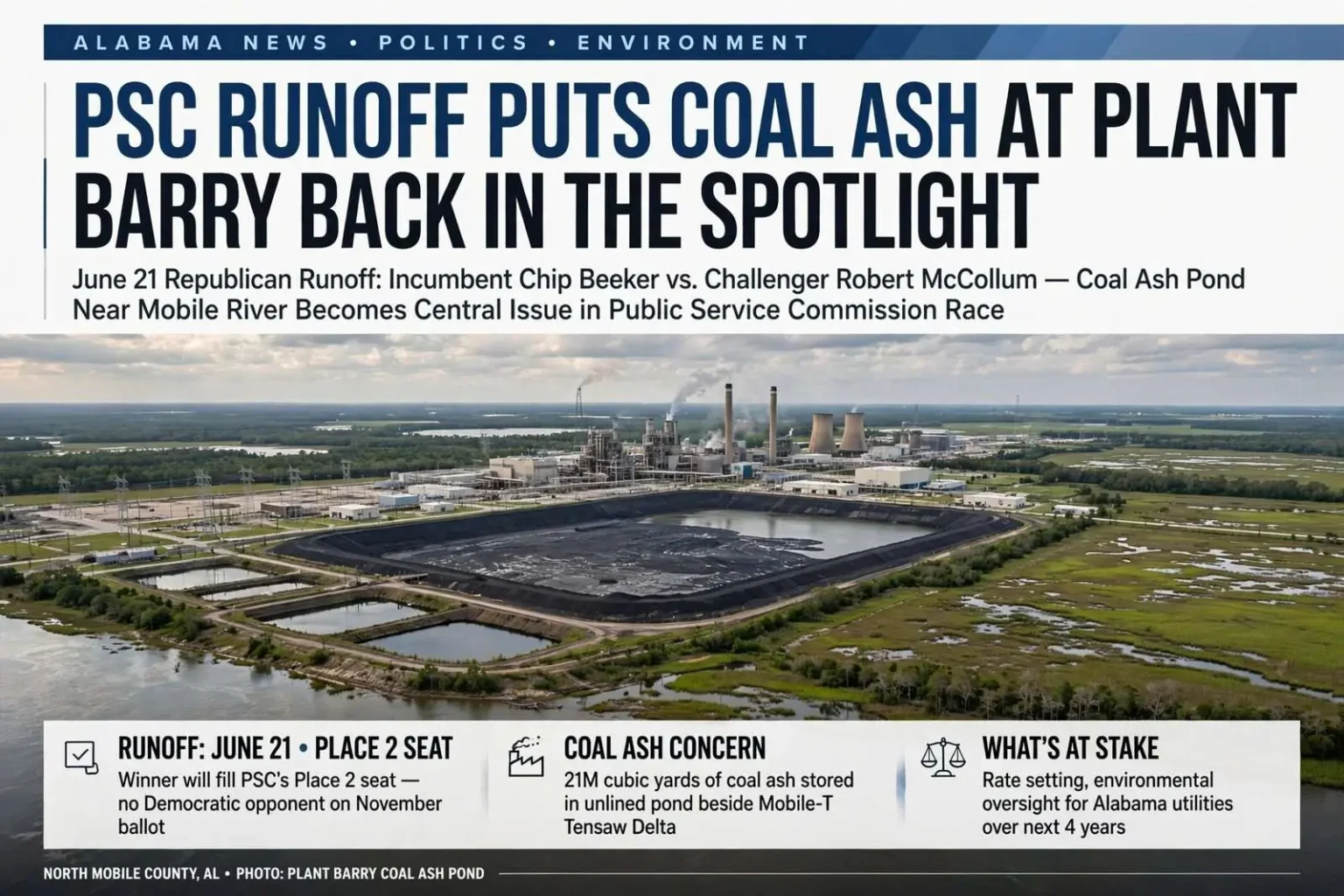
Two Republican candidates for a statewide seat that regulates utilities across Alabama are headed to a runoff election, with one contender pressing to put the storage of millions of tons of coal ash beside the Mobile River under closer scrutiny. Incumbent Public Service Commissioner Chip Beeker and challenger Robert McCollum of Dadeville will face off on June 21 for the Republican nomination for the PSC’s Place 2 seat. The three-member Public Service Commission oversees essential utility services statewide, including electricity, telecommunications and water rates. The runoff matters because no Democrats qualified for the race, meaning the winner of the Republican runoff will fill the seat.
What the Primary Showed
Beeker, who has held the seat since 2014 and previously served as a Greene County commissioner, led the May 25 Republican primary with 43 percent of the vote. McCollum finished second with 35 percent, edging out a third candidate, Robin Litaker, who took 21 percent and was eliminated from contention. The relatively narrow margin for an incumbent suggested at least some dissatisfaction with Beeker among Republican primary voters, and McCollum has been quick to capitalize on that opening. He has staked out a position on the coal ash storage pond at Alabama Power’s Plant Barry that differs sharply from the utility’s preferred closure plan, and that contrast is likely to dominate the runoff campaign.
Money in the Race
Campaign finance filings show a lopsided financial battle heading into the runoff. Beeker has raised nearly $270,000 since the start of the year, a total boosted by a $100,000 loan from his own business, Beeker Catfish & Cattle Farm in Eutaw. Political action committees have contributed another $112,450 to his campaign, with the Alabama Development PAC, Farm PAC and T-Town PAC II among the largest donors. Beeker also received a $25,000 individual donation from Jayne Colgrove of Boligee, an incorporating officer for REM Directional Drilling, a company with a history of gas pipeline work in Alabama. McCollum, by contrast, has raised about $19,300, with $15,000 of that coming in after he advanced to the runoff. He has not received any PAC funding so far. McCollum, a California native who has lived in Tallapoosa County and built a background in construction and small business, said he sold three of his business ventures to help fund his run for office.
Coal Ash at Plant Barry
On policy, Beeker has emphasized what he calls a track record of supporting balanced regulation, predictable rate decisions and oversight that he argues has kept Alabama’s utilities among the most reliable in the Southeast. McCollum has focused much of his energy on the coal ash issue. Plant Barry, an Alabama Power facility in north Mobile County, sits on the Mobile River and holds an estimated 21 million cubic yards of coal ash residue in an unlined pond. Alabama Power has proposed capping the material in place, a method that has been approved by the Alabama Department of Environmental Management but that environmental groups, including Mobile Baykeeper, argue risks long-term groundwater contamination. McCollum has said he would push for stricter oversight of that closure plan and for stronger monitoring requirements.
The coal ash question is not abstract for residents of north Mobile County. The pond sits within sight of the Mobile-Tensaw Delta, one of the most ecologically important wetlands in the country, and any breach or slow leak would affect downstream waters that supply both drinking water and habitat for commercial fisheries. McCollum’s campaign has used the issue to draw a sharp contrast with Beeker, who has generally been supportive of Alabama Power’s preferred closure approach. The runoff will test whether that contrast is enough to overcome Beeker’s substantial financial advantage.
What the PSC Does
The Public Service Commission is one of the state’s least visible but most consequential elected bodies. Three commissioners, each elected to a four-year term, set the rates that Alabama Power, Alabama Gas and the state’s rural electric cooperatives can charge their customers. They approve or reject large utility construction projects, oversee some telecommunications regulation, and have a say in how water and sewer utilities operate in parts of the state. Decisions made by the PSC affect every household and business that pays an electric bill, which is essentially every household and business in Alabama. Turnover on the commission tends to be slow, and incumbents who raise enough money to run a credible campaign rarely lose.
How the Runoff Will Work
The June 21 runoff will be open to any voter who participated in the May 25 Republican primary or who casts a Republican ballot in the runoff. Because no Democrats qualified for the Place 2 race, the Republican nominee will be all but guaranteed the seat in November. McCollum’s team has spent the weeks since the primary trying to convert Litaker’s supporters, while Beeker has worked to consolidate his own base and to put more money on the air. Both campaigns have focused heavily on north Alabama, where most of the early primary vote came from, but the Mobile County coal ash question is likely to draw significant attention in the final weeks of the race, particularly among coastal voters who have followed the Plant Barry debate closely. Turnout in a June runoff in Alabama is typically low, often below 15 percent of registered voters, which means a relatively small shift in any one constituency could decide the outcome.
What Is at Stake
Beyond the immediate race, the runoff will shape how Alabama approaches some of the most consequential utility questions of the next several years. Whoever wins will have a seat at the table as Alabama Power and other utilities navigate the transition away from coal, as federal regulators tighten rules on coal ash disposal, and as the state considers new investments in natural gas, nuclear and renewable generation. The PSC’s three-member makeup matters in ways that go beyond any single case, because two commissioners can outvote the third on most substantive matters. Beeker’s incumbency, if it survives, would continue a pattern in which the commission’s decisions align closely with the preferences of the state’s largest investor-owned utility. McCollum, by contrast, has suggested he would be a more independent voice, particularly on environmental questions and on issues affecting smaller customers and rural cooperatives. The choice voters make in the runoff will help determine how that balance plays out over the next four years.
For Mobile and Baldwin county voters, the runoff carries particular weight because of the Plant Barry question. The coal ash pond has been a recurring subject of public meetings, environmental lawsuits and state regulatory proceedings for the better part of a decade. Mobile Baykeeper and other advocacy groups have argued that the cap-in-place approach favored by Alabama Power leaves too much ash in contact with groundwater for too long, and that the monitoring requirements attached to the closure permit are not strict enough to catch problems before they spread. Alabama Power has countered that the closure method complies with all applicable state and federal rules, that the synthetic cap is engineered to last for decades, and that the site will be monitored for at least 30 years after closure.
Independent Commission Versus Advocacy
The PSC is not the body that directly approved the Plant Barry closure plan. That decision was made by the Alabama Department of Environmental Management, which issued the final permit earlier this year. But the PSC has the power to set the rates that Alabama Power charges its customers, and that rate-setting authority gives the commission a way to influence how much money the utility has available for environmental remediation and how aggressively it pursues alternative closure methods. A commissioner who wanted to push the utility toward a more expensive excavation approach would have leverage, at least in principle, by tying future rate decisions to the company’s environmental performance. McCollum has suggested he would be that kind of commissioner. Beeker has indicated he would prefer to leave those decisions to ADEM and the courts.
The Stakes for Ratepayers
Whichever candidate wins, the commission will continue to oversee rate cases that affect every electric customer in Alabama. Alabama Power’s most recent rate filings have drawn criticism from large industrial customers and from some residential ratepayer advocates, both of whom have argued that the utility’s returns are higher than they should be. The PSC’s Place 2 seat has historically been held by a commissioner who is broadly supportive of the state’s investor-owned utilities, and a McCollum win would be a noticeable departure from that pattern. A Beeker win, by contrast, would represent continuity. With the runoff likely to draw low turnout and with neither candidate facing a Democratic opponent in the fall, the June 21 result will effectively decide who occupies the seat for the next four years.
What Happens After June 21
The winner of the Republican runoff will be sworn in for a new term early next year, joining the commission’s other two members. The seat has been held by Beeker since 2014, and a successful McCollum challenge would mark one of the more notable upsets in recent PSC history. Beeker’s fundraising edge and incumbency make him the favorite, but McCollum’s message on coal ash and other environmental issues has clearly connected with some primary voters, and his campaign has been more aggressive than Beeker’s in the days since the May 25 vote. Coastal Alabama residents who follow the Plant Barry question closely will be watching the result with particular interest, knowing that the next four years of PSC decisions will help determine whether the Mobile River remains protected from the legacy of a century of coal-fired power generation.