
Public COVID-19 Vaccination Site Planned for the Mobile Civic Center
Mobile partners with USA Health for a public COVID-19 vaccination site at the Civic Center as ADPH opens appointments to seniors 75+ and first responders.
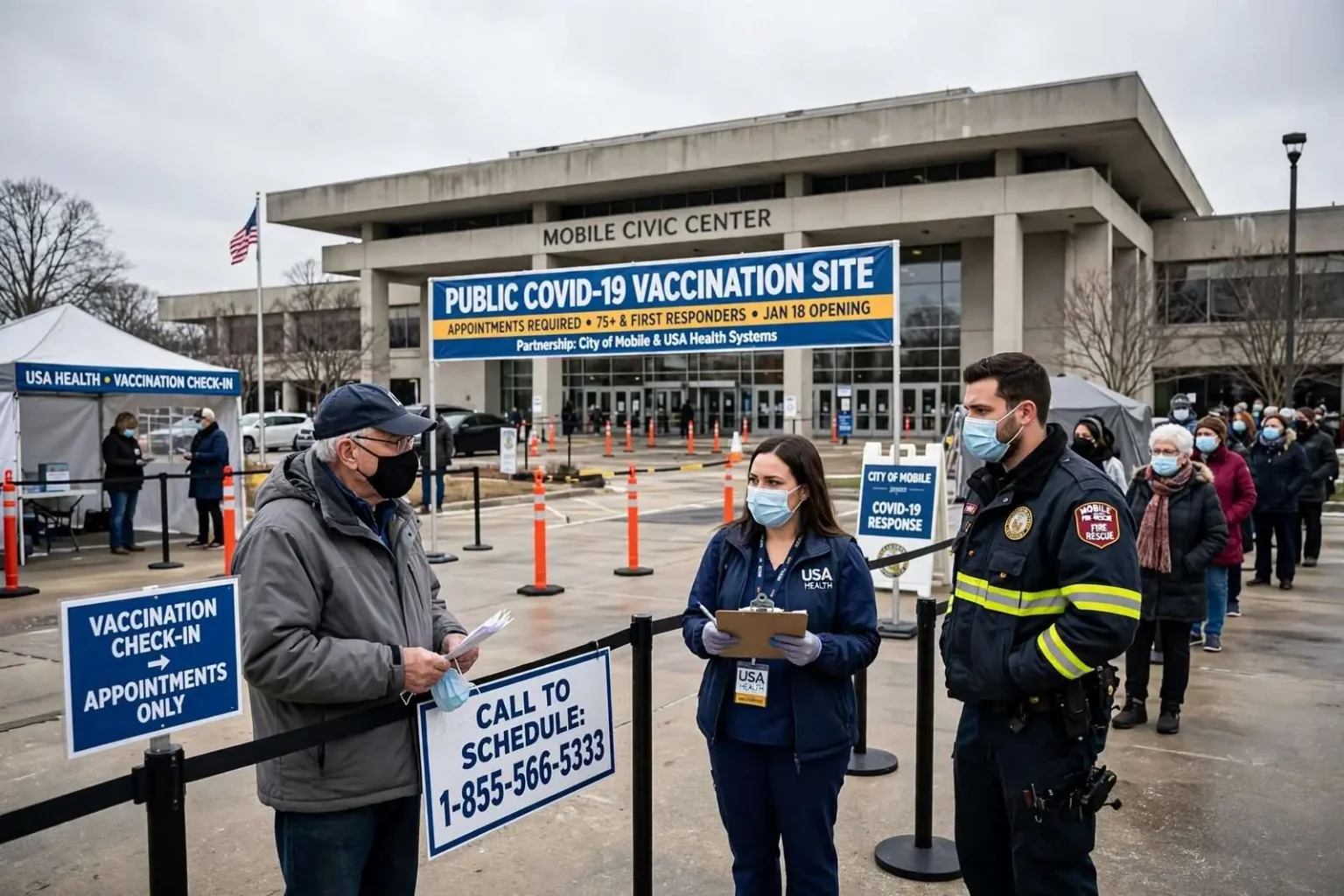
MOBILE, Ala. — A public COVID-19 vaccination site is in the works for the Mobile Civic Center, under a partnership between the City of Mobile and USA Health Systems, a plan that would put a mass vaccination operation in the city’s downtown convention complex as Alabama worked to speed shots into arms during the pandemic’s deadliest stretch.
Mayor Sandy Stimpson announced the plan in his nightly newsletter, saying the city would release details later that week on how the site will operate. The announcement signaled that Mobile’s largest public assembly facility — a downtown complex that normally hosts concerts, trade shows, Mardi Gras balls and sporting events — would be pressed into public health service as a vaccination hub, echoing the mass-clinic model that cities across the country were adopting in the first months of the vaccine rollout.
The announcement came as the state expanded vaccine access. Gov. Kay Ivey had just revealed that the Alabama Department of Public Health would begin offering free COVID-19 vaccinations — by appointment only — to residents 75 and older as well as first responders starting Monday, Jan. 18. The move opened eligibility to some of the Alabamians at highest risk of severe illness and death, following the earlier rounds that had prioritized front-line health care workers and residents and staff of long-term care facilities.
Appointment scheduling has been strained: the ADPH line has been overwhelmed with calls as newly eligible residents rushed to book slots. Residents can schedule a free vaccination appointment by calling toll-free at 1-855-566-5333.
Why the Civic Center
The Mobile Civic Center has long been the city’s indoor gathering landmark, a complex in the heart of downtown that includes an arena, a theater and exposition space. Facilities of that kind have unique advantages as vaccination sites: wide-open floor plans that allow clinic stations to be spaced out, large parking areas and loading zones for traffic flow, existing security and utility infrastructure, and locations that residents already know how to find. During the pandemic, convention centers, arenas and fairgrounds across the country were converted into mass vaccination and testing operations for exactly those reasons.
Partnering with USA Health Systems gives the city access to the clinical side of the operation. USA Health, the health system affiliated with the University of South Alabama, anchors tertiary care for the Gulf Coast region through University Hospital and its network of clinics and physicians, and its staff had already been at the front line of the pandemic response in Mobile since the first cases arrived. A civic-center-scale clinic run with health system support meant the ability to administer vaccinations at a volume far beyond what a single clinic office could handle.
The details that remained to be announced — hours of operation, how appointments would be managed at the site, whether the clinic would serve only those already eligible or expand as supply allowed — were the same questions every Alabama community faced in that phase of the rollout, when vaccine demand dramatically exceeded the doses the state was receiving from federal allocations each week.
Alabama’s phased rollout
Alabama received its first vaccine shipments in December 2020, beginning with health care workers and long-term care residents through a federal pharmacy partnership. The state followed the phased prioritization guidance issued by the federal Advisory Committee on Immunization Practices, adapted to Alabama’s supply. Each widening of eligibility — and the move to include everyone 75 and older plus first responders was one of the largest to that point — produced a surge of calls that repeatedly overwhelmed appointment phone lines across the state.
The strain on the ADPH toll-free line reflected both the size of the newly eligible population and the limits of phone-based scheduling in a state where many older residents do not use online booking systems. Health officials urged patience and asked that family members and caregivers assist with appointments where possible, while local officials — Mobile’s among them — worked to stand up additional capacity so that appointments could be offered closer to home.
First responders near the front of the line
The inclusion of first responders in the Jan. 18 eligibility expansion carried particular importance in Mobile County, where fire and EMS personnel, law enforcement officers and dispatchers had spent nearly a year exposed to the virus through their daily work. First responders could not screen away their exposure risk: ambulance crews transport suspected COVID patients, police officers answer calls at infected households, and firefighters perform rescues without knowing the medical status of the people inside. Vaccinating that workforce protected not only the workers themselves but the continuity of emergency services, which could be crippled by quarantine-driven staffing shortages if outbreaks swept through a shift.
For residents 75 and older, the stakes were starker still. Older Alabamians accounted for the overwhelming majority of the state’s COVID-19 deaths throughout the pandemic, and every expansion of vaccine access to seniors translated directly into protection for the population most likely to die if infected. Mobile County, with one of Alabama’s largest populations, had recorded thousands of cases and hundreds of deaths by that point in the pandemic, and the county’s older residents — like seniors across the Gulf Coast — had spent months isolated from churches, grandchildren and normal life while awaiting the vaccine.
What a mass site changes
A public vaccination site at the Civic Center promised several practical gains for Mobile residents. Scale: a well-run mass clinic can administer many times the doses of a physician’s office in a day. Coordination: a single, well-publicized location reduces the confusion that had marked the early rollout, when residents juggled hospital waitlists, county health department appointments and pharmacy registrations. And equity: a downtown site accessible from across the county, run as a public operation with free appointments, lowered the barrier for residents without regular medical care — the population most likely to fall through the cracks of a purely private distribution system.
City officials across the Gulf Coast had been watching mass-site models elsewhere and adapting them locally, and Mobile’s partnership approach — city government providing the venue and logistics, the health system providing clinical staff — mirrored the template that other Alabama cities were pursuing at the same time. The details Stimpson promised later that week would determine how quickly the site could begin operating and how many appointments it could support daily.
Until then, the guidance for Mobile-area residents remained the same as it had been: appointments were required, the vaccine was free, eligibility was set by the state’s phase plan, and the toll-free ADPH scheduling line — 1-855-566-5333 — was the door through which the newly eligible had to pass. Officials continued to urge residents not to show up at sites without appointments, both to protect the flow of the clinics and to preserve doses for those on the schedule.
The Civic Center plan was, in the end, a snapshot of that moment in the pandemic: a city repurposing the building where it throws its biggest celebrations to run one of the most consequential public health operations in its history, and a community queuing — by phone, patiently — for the shot that would begin the return to normal life.
Reaching older residents without the internet
One of the persistent challenges of Alabama’s early rollout was access. Online appointment portals worked well for younger, connected households, but the residents most in need of the vaccine — those 75 and older — were also the least likely to be comfortable booking a slot through a website. That reality made the telephone line the primary gateway to vaccination for many seniors, and it made the capacity of that line a genuine public health issue. Family members, neighbors and church communities across Mobile County stepped in to place calls on behalf of older relatives, a pattern that repeated in every county as eligibility widened.
Community organizations played a growing role as well. Senior centers, homebound meal programs and faith communities worked to identify older residents who needed help navigating the system, while pharmacies and health providers coordinated their own allocations alongside the county health department’s efforts. Every additional vaccination site — and the Civic Center project promised one of the county’s largest — reduced the distance and the waiting between an eligible senior and an appointment.
The weeks ahead
Officials cautioned that the pace of vaccination depended ultimately on supply. Alabama’s weekly federal allocations in the rollout’s early months were far below the number of residents who wanted appointments, which meant that even a fully operational mass site could book out quickly. Public health leaders set expectations accordingly: the eligibility expansion meant seniors and first responders could finally get in line, but getting in line still meant waiting for a dose to arrive.
For Mobile, the civic-center site represented both infrastructure and reassurance — a visible sign that the city was building toward the volume of vaccination the moment demanded. As details were finalized and announced later that week, residents were pointed to the same free, appointment-based process, and health officials repeated the advice that had defined the rollout so far: keep the appointment, wear the mask, and keep up the precautions that had carried the community through the winter surge until the vaccine could do its work.


