Quiet Streets, Closed Restaurants and a Bright Spot: Mobile Adjusts to Life Under Quarantine
As COVID-19 closures hit Mobile restaurants like Heroes Sports Bar and Grille, a Grand Bay Middle School student's essay about the local favorite offered owner David Rasp a welcome bright spot during a difficult week.
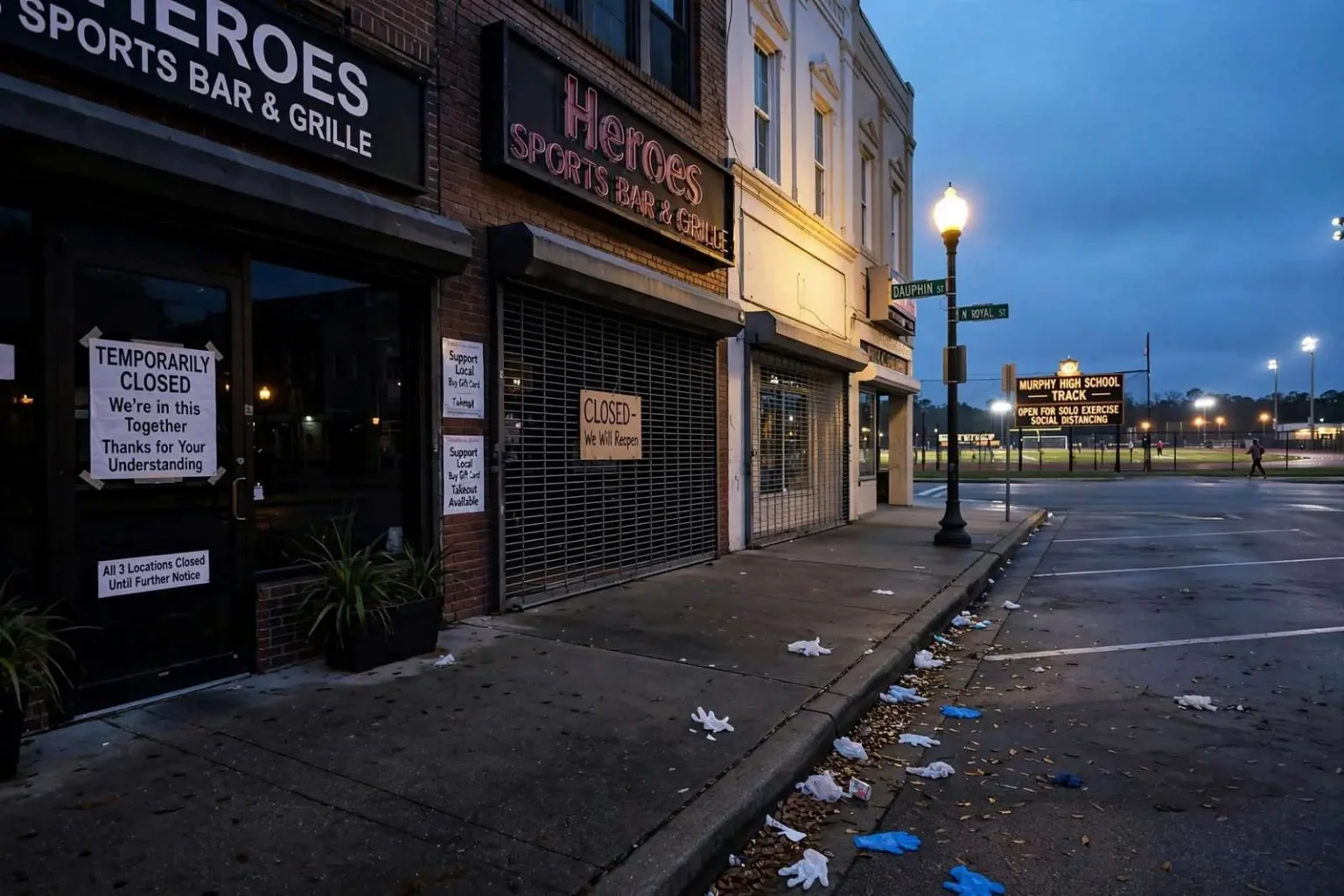
Mobile settled into an unfamiliar quiet last week as residents adjusted to life under the statewide effort to slow the spread of COVID-19, trading crowded restaurants and packed school hallways for long walks, empty parking lots and a lot of time at home. The order that closed dining rooms, suspended in-person classes and pushed workers out of offices touched nearly every corner of daily life in a city of roughly 190,000 people, and the streets reflected it. Downtown blocks that would normally hum with lunch traffic sat still, and neighborhood intersections carried only the occasional car.
But even with public life on pause, the small moments that make up daily life around the city kept happening, from late-night strolls to acts of kindness that offered a bright spot in an otherwise difficult stretch. Across Mobile County, residents found themselves doing ordinary things in extraordinary circumstances: shopping for neighbors who could not risk a trip to the grocery store, waving to one another from a distance, and rediscovering sidewalks and parks that had long been part of the scenery rather than the destination.
A Saturday Night Air Guitar Solo at the Murphy Track
One of those moments unfolded on a recent Saturday night at the Murphy High School track, where a lone walker got some fresh air and exercise while keeping well clear of anyone else, in keeping with the social distancing guidance public health officials have urged residents to follow. The track, normally crowded with runners and school athletes, stood empty except for one figure making the loop under the lights.
Headphones in and clearly enjoying the music, the walker broke into an impromptu air guitar solo partway through the loop, a small, funny scene that a few neighbors happened to catch and couldn’t help but smile about. It was the kind of lighthearted moment residents said they needed as the reality of the outbreak settled in around them. In a stretch of weeks dominated by news conferences, case counts and canceled events, an anonymous resident losing an invisible guitar solo on a high school track became exactly the sort of story neighbors passed along to remind each other that the city’s sense of humor had survived the shutdown intact.
The scene also illustrated how public spaces that were built for gatherings have taken on a new role during the outbreak. School tracks, parks and walking trails around Mobile have become one of the few places residents can still leave home legitimately, and health officials have continued to distinguish between crowded group activities, which remain off-limits, and solitary outdoor exercise, which they encourage as long as people keep six feet apart. The lone walker at the Murphy track, keeping well clear of anyone else while getting some fresh air, was following that guidance to the letter, even while providing the week’s best entertainment to anyone who happened to be watching.
A New Kind of Litter Along Springhill Avenue
Not every neighborhood story from the past couple of weeks has been so charming. Along Springhill Avenue and in pockets throughout Mobile, residents have long complained about litter tossed from car windows, but neighbors say they have noticed a troubling new addition to the usual roadside debris: discarded disposable gloves.
With protective gloves increasingly common as shoppers and workers try to guard against the virus, sanitation-minded residents are asking people to dispose of used gloves properly rather than tossing them out along city streets, noting that used personal protective equipment left in parking lots and roadways poses its own health concerns beyond the usual litter problem. A carelessly discarded glove that might have been in contact with contaminated surfaces is a different category of hazard than a soft drink cup, and residents worry that children, pets and sanitation workers could come into contact with it before it is picked up.
The problem is not unique to Mobile. Cities across the country have reported the same pattern as glove use has surged among people who would rarely have worn them before the outbreak. Public health guidance has consistently emphasized that gloves are only one layer of protection, and that hand washing remains more important, but for many residents the gloves have become a fixture of every trip to the store or pharmacy. The request from Mobile neighbors is a simple one: if the gloves come off in a parking lot or on a street, they should go into a trash can, not onto the ground.
City crews and volunteers who take part in cleanup efforts around Mobile have their work cut out for them under normal circumstances, and the addition of used protective gear to the roadside debris stream has added a new wrinkle to a familiar chore. Residents who have organized informal cleanups along Springhill Avenue and other corridors say the message to fellow citizens is about shared responsibility: the same care people are taking to protect themselves from the virus should extend to how they dispose of the equipment that protection requires.
Restaurant Closures Hit the Local Economy
Meanwhile, the pandemic’s economic toll has already reached Mobile’s restaurant scene. David Rasp, who owns both locations of Heroes Sports Bar and Grille along with The Royal Scam, announced that he would be temporarily closing all three restaurants because of the outbreak, joining restaurant owners across the region grappling with how to keep staff and customers safe while facing a sudden loss of business.
The closures leave servers, cooks and other restaurant workers throughout the area without steady income during an already difficult time, a hardship echoed at restaurants and small businesses across Mobile County as owners try to navigate an uncertain few months ahead. Restaurant work is among the most common jobs in the local service economy, and unlike office employees who can shift to working from home, servers and kitchen staff have no remote option when the dining room goes dark.
The suddenness of the disruption has been part of the shock. Restaurants that were planning for a busy spring season, with festival crowds, graduation parties and tourism traffic, instead had to close their dining rooms with almost no warning as the statewide restrictions took effect. Some have attempted to continue with takeout and delivery, but owners have been blunt that carryout alone rarely replaces the revenue of a full dining room, particularly for establishments whose appeal is as much the gathering as the food.
For a city whose food culture runs deep, from neighborhood sports bars to the restaurants clustered around Dauphin Street downtown, the sight of dark dining rooms has been one of the most visible signs of the outbreak. Heroes Sports Bar and Grille has long been a fixture for families and fans gathering to watch a game, and The Royal Scam has built its own loyal following, which is precisely why the decision to close all three temporarily landed with such force on the people who worked there and the customers who considered them regular stops.
Rasp’s decision reflected the calculus facing owners across the region: weighing the costs of staying partially open against the risk to employees and customers, and deciding that closing, however painful, was the responsible choice until it is safe to reopen. Restaurant owners throughout Mobile County have made similar calls, and trade groups at the state level have pressed for relief measures to help independent restaurants survive the shutdown and rehire their staffs when the restrictions lift.
A Middle School Essay Offers a Bright Spot
Amid that tough news, Rasp received a letter that he said brightened an otherwise rough week. Jennifer Tschudy’s seventh-grade language arts class at Grand Bay Middle School had been working on persuasive writing, and students were assigned to make the case for their pick of the area’s best restaurant.
One student’s essay championing Heroes USA impressed the class enough to be chosen as the winning submission, and the student’s family shared it with Rasp. The timing could hardly have been better, arriving just as the owner was announcing the temporary closure of his restaurants and absorbing the weight of that decision.
The essay praised the food in vivid detail, calling the wings “so hot and fresh” and noting that the kitchen would always fix an order that wasn’t quite right. But it was the writer’s memories of the restaurant that stood out most, including a recollection of the last conversation the student had with a grandfather there. In a single school assignment, the student had captured what a neighborhood restaurant actually is to the people who grow up around it: not just a place to eat, but a place where the memorable moments of a family’s life quietly accumulate.
The student also complimented the waitstaff, comparing their patience and warmth to Santa Claus and thanking them for looking out for customers with allergies or particular tastes. It is hard to imagine a higher compliment in the restaurant business, and Rasp said the letter was a welcome reminder of why local restaurants matter to the community beyond just the food, serving as gathering places for first dates, birthdays, family celebrations and quiet, memorable conversations.
The assignment itself was a fitting product of the moment. With schools closed across Alabama and students learning from home, teachers like Tschudy have been finding ways to keep coursework connected to the world their students can actually see, and a persuasive essay about the best local restaurant asked seventh graders to think carefully about something familiar and put their reasoning on paper. The winning essay’s journey from a classroom assignment to the desk of a restaurant owner gave the exercise a real audience, which is the kind of outcome writing teachers hope for.
What the Small Moments Add Up To
Community members have echoed that sentiment in recent days, encouraging neighbors to support local restaurant workers and owners however they can while dining rooms sit empty. Suggestions have ranged from ordering takeout when possible to buying gift cards to redeem later, a practice that puts cash in a restaurant’s hands now and promises a customer when the doors reopen. Some residents have organized efforts to tip generously on delivery orders, recognizing that the driver and the kitchen staff are both working under strain.
The broader context for these small gestures is a community coming to terms with how long the disruption might last. Public health officials have been careful not to promise a quick return to normal, and the statewide restrictions that closed dining rooms and schools remain in place with no firm end date. In the meantime, the parts of civic life that continue — a walker on an empty track, neighbors urging one another to throw away their gloves, a middle schooler’s essay about chicken wings — are doing the work of keeping the community connected while it waits.
As Mobile residents continue adjusting to social distancing and the closures rippling through the local economy, small gestures like the middle schooler’s essay have offered a bit of levity and connection during a stressful stretch for the community. Teachers, restaurant owners, sanitation workers and ordinary neighbors have all found themselves playing unexpected roles in the same collective project of getting through a spring that no one planned for.
Local business owners and residents alike say they are hopeful that Mobile’s restaurants and the people who keep them running will bounce back once the outbreak eases. The restaurants that have closed temporarily, including Rasp’s three, have been clear that the goal is to reopen and welcome back their staffs and regulars, and the outpouring of support from customers suggests a patient base waiting for them. When the dining rooms fill again, the first conversations will no doubt include stories from the shutdown — the empty streets, the glove litter, the air guitar on the Murphy track, and the seventh-grade essay that reminded one owner why his restaurants were worth closing to protect.
Until then, the city’s quiet continues, punctuated by the small moments that have always made up daily life in Mobile, now seen with fresh eyes by residents learning how much they took them for granted.