Recovered veteran continues leadership role at NAS Pensacola museum
Retired Rear Adm. Kyle Cozad leads the National Naval Aviation Museum foundation in Pensacola after recovering from a spinal injury.
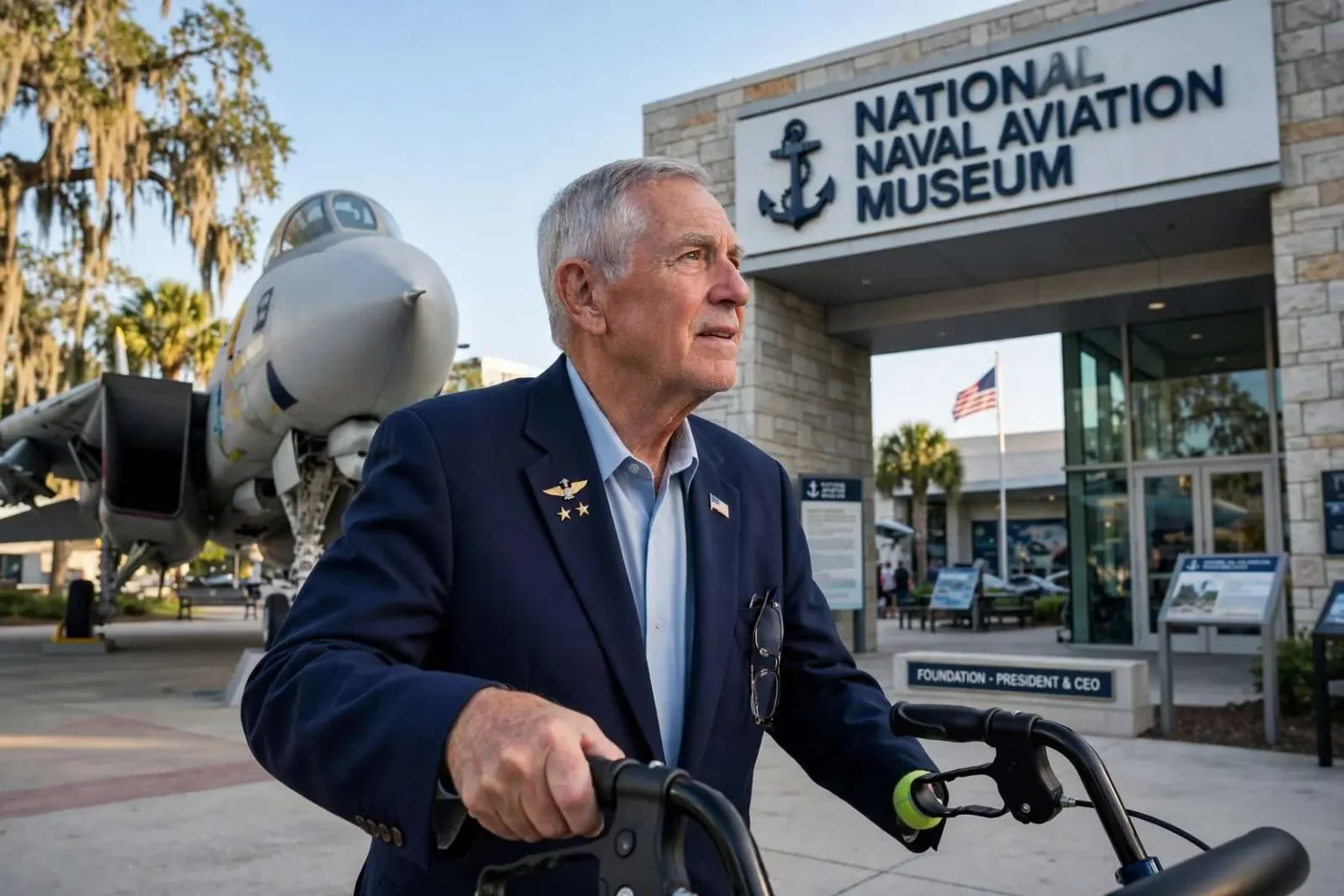
PENSACOLA, Fla. — Retired Rear Adm. Kyle Cozad is leading the National Naval Aviation Museum foundation in Pensacola after recovering from a severe spinal injury he suffered in a fall at home — a comeback that carried him from intensive care to the top job at one of the nation’s most-visited military museums.
Cozad, who graduated from the United States Naval Academy in 1985 and became a Naval aviator, was serving as commander of the Naval Education and Training Command at Naval Air Station Pensacola when he slipped and fell in his kitchen. The fall broke two vertebrae and left him with serious spinal cord trauma. He spent more than a week in intensive care and five weeks in physical therapy, working his way back from an injury that, for many patients with similar trauma, ends careers and reshapes lives permanently.
Today Cozad walks with the aid of a walker and serves as president and CEO of the museum’s foundation, the nonprofit organization that supports the National Naval Aviation Museum at NAS Pensacola. He said the Navy allowed him to remain in his role during his recovery, which he called rare, and he credited his family — including a son who followed him into naval aviation — for their support through the injury and rehabilitation. His motto, he said, is to never let anyone tell you what you cannot do.
The Injury and the Recovery
A kitchen fall is the kind of ordinary accident that strikes without warning, but the consequences Cozad faced were anything but ordinary. Breaking two vertebrae with spinal cord trauma means the spinal column’s protective structure is compromised and the cord itself — the pathway for every signal between brain and body — has been damaged. Treatment typically begins with surgical stabilization, followed by intensive care to monitor for complications, and then the long, repetitive work of rehabilitation, where physical therapists help patients rebuild strength, balance and mobility millimeter by millimeter. His timeline — more than a week in the ICU and five weeks in physical therapy — tracks with serious spinal injuries of this kind.
Recovery from spinal cord injury is measured in degrees. Some patients regain full function; many learn to live with permanent changes. That Cozad now walks with a walker, and leads an organization while doing it, places him among the fortunate outcomes, and it reflects both his own persistence and the support structure around him. He has been candid in crediting his family, and pointed in describing how unusual it was for the Navy to hold his position open while he healed — an accommodation that senior officers injured in the line of duty, let alone at home, rarely receive. The decision speaks to how the Navy valued his leadership at the training command, and it gave him a role to return to while his body caught up with his will.
His story resonates within a military community that knows spinal injuries primarily as combat wounds. Aviation itself is a dangerous profession, and naval aviators train throughout their careers for ejections, crashes and water survival. An admiral felled by a slip in his own kitchen is a reminder that the most serious injury of a long career can come from the least expected place — and that the recovery is measured not in medals but in the slow return of everyday function.
A Career in Naval Aviation
Cozad’s path to Pensacola ran through the institutions that define naval aviation. Commissioned after his 1985 Naval Academy graduation, he entered a flight training pipeline that funnels every Navy and Marine Corps aviator through Naval Air Station Pensacola, the “Cradle of Naval Aviation,” where student pilots complete their initial flight instruction. Over a naval career spanning more than three decades he rose through command positions at sea and ashore, accumulating the experience in aviation, operations and training that would eventually place him atop the Navy’s education enterprise in Pensacola.
As commander of the Naval Education and Training Command, Cozad led the organization responsible for training nearly every sailor and aviator who enters the fleet — from boot camp curricula and technical schools to flight training and professional military education. The command is headquartered at NAS Pensacola, making its commander one of the most senior military figures in the Pensacola area, with oversight reaching training commands across the country. It is a role that shapes the Navy’s future in bulk: the standards set there define how hundreds of thousands of sailors learn their trades.
That background made him a natural fit for the museum’s foundation when the opportunity came. The National Naval Aviation Museum, located aboard NAS Pensacola, is one of the largest aviation museums in the world and the flagship public institution of Navy history on the Gulf Coast. Its exhibits trace the service’s flight heritage from early biplanes through World War II carrier aviation, the space age and modern carrier operations, and its grounds host the Blue Angels’ winter training season, when the flight demonstration team practices over the airfield in view of museum visitors.
The Foundation’s Role
The museum itself is free to visit, funded as an official Navy institution, but much of what makes it extraordinary — aircraft restoration, expansion projects, educational programs, the IMAX-style theater experience and special events — depends on the private foundation Cozad now leads. The foundation raises money from donors, veterans’ organizations and aviation enthusiasts across the country, stewards a membership program, and operates the gift shop and flight simulators whose revenues flow back into the museum’s mission. For a museum of this scale, foundation leadership is a full-time executive job, and one that rewards the operational command experience a flag officer brings.
Cozad’s personal history gives his fundraising case a authenticity that money cannot buy. When he speaks to donors about naval aviation, he speaks as a man who spent his career in it and nearly lost his mobility to it — and who now watches new generations of students walk the same Pensacola halls where his own flight training began. The foundation’s mission of preserving and presenting that history is, in his telling, inseparable from the people who lived it.
His recovery story has become part of that message. A leader who uses a walker and refuses to be defined by it embodies the motto he describes — never let anyone tell you what you cannot do — and it is a message that lands with veterans adjusting to their own injuries, with students considering military service, and with donors who understand that leadership is tested far from the flight line. At the National Naval Aviation Museum, the aircraft on display tell the story of naval aviation’s past; the admiral leading its foundation, recovering in public view, is living proof of the resilience the institution celebrates.
Pensacola’s Museum and Its Mission
The National Naval Aviation Museum occupies a special place in Gulf Coast life. Families from Mobile, Pensacola and the surrounding counties treat it as a rite of passage — school field trips, summer visits, the cockpit exhibits children climb into and the hangar-sized spaces filled with restored warbirds. The museum draws visitors from across the country, many of them combining a museum tour with the chance to watch the Blue Angels practice, and the foundation that Cozad leads works to keep that experience growing through new exhibits, restoration projects and educational programming that introduce young people to the science and history of flight.
NAS Pensacola itself anchors the region’s military economy and identity. In addition to the museum and the training command, the base is home to the Naval Air Technical Training Center, the Naval Operational Medicine Institute and other commands, and generations of local families have sent sons and daughters through its gates as recruits, students and instructors. When a retired admiral with Cozad’s resume takes over the museum’s foundation, the appointment reads locally as a homecoming — one more chapter in the long relationship between the base and the city that grew up around it.
For veterans and military families in the region, Cozad’s recovery carries a practical lesson about the support systems that exist for injured service members. Rehabilitation for major trauma takes months, and the difference between a recovery that stalls and one that succeeds often comes down to advocacy — family members who push, commands that hold positions open, and medical teams that set ambitious goals. Cozad has acknowledged all of these in his own case: the family that supported him, including the son who followed him into naval aviation, and a Navy decision to keep him in his role that he describes as rare. His advice, distilled into a motto he repeats, is aimed squarely at those starting the same journey — never accept someone else’s ceiling for what you can recover.
Today, the admiral who once ran the Navy’s entire training enterprise walks the museum’s halls with a walker, doing the work of keeping its history alive. The fall that could have ended his career instead became part of his story — and, by his own telling, part of the message he now brings to every donor meeting, every visitor tour and every young person who asks what it takes to wear the wings of a naval aviator.