
Recovery Fest 2018 in Mobile to raise awareness of addiction and recovery
Recovery Fest 2018 at Battleship Park in Mobile will spotlight drug addiction recovery, with a Baldwin County woman sharing her 12-year sobriety story.
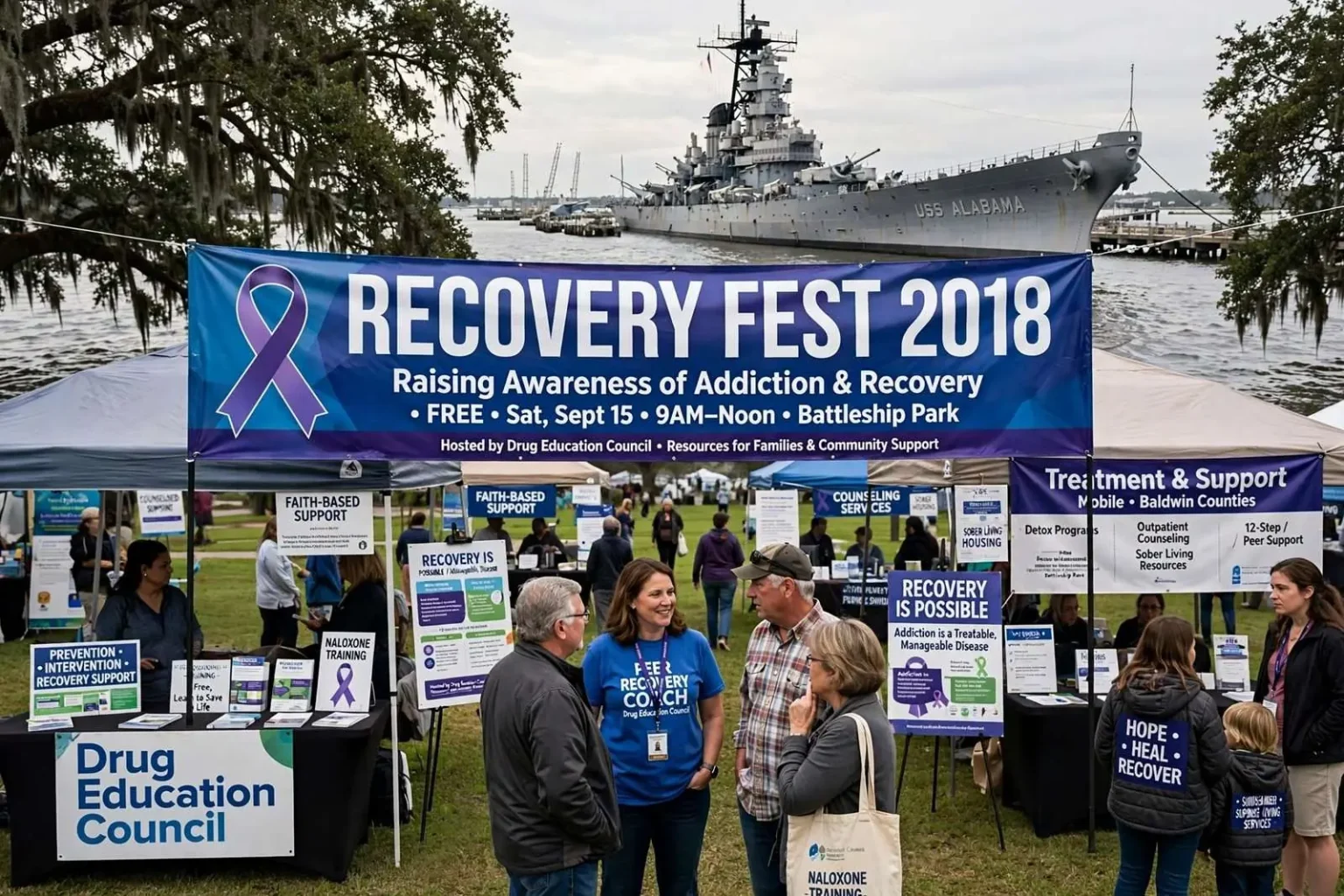
A Mobile event this weekend will spotlight recovery from drug addiction and the resources available to local families. Kristy Wells of Baldwin County knows the toll of addiction firsthand. She built an extensive collection of mug shots from crimes she committed to support a pain-pill habit that reached 70 pills a day and cost her roughly half a million dollars — but she says losing the trust of the people she loves hurt far more.
“I had three children. I lost my marriage. I lost my mother. I mean no one believed anything I had to say because, like other people who are alcoholics and addicts, we are the biggest liars and manipulators on the face of the earth,” Wells said. Her mug shot collection — one photograph for each arrest along the way — became a visual ledger of a dependency that grew from prescription pain pills into a life organized entirely around the next supply.
Her story follows a pattern familiar to treatment professionals across the Gulf Coast. What often begins with a legitimate prescription after an injury or surgery can escalate as tolerance builds, and when the prescriptions stop, the street market fills the gap. The costs stack up in every direction: money spent, crimes committed to keep supply flowing, families fractured by broken promises, and arrests that turn a private struggle into a public record. By the time many people in active addiction reach treatment, they have accumulated years of damage to repair.
Facing prison, she hit rock bottom and sought inpatient treatment. Wells has now been sober for more than 12 years and stays active helping others through the Drug Education Council and other agencies. “That’s now sort of the purpose of my life, is to speak to people in a conversational way and help them understand that this is a treatable, manageable disease,” she said.
The number she reached — 70 pills a day — illustrates how far a dependency can climb once it takes hold. Tolerance builds incrementally, and people in active addiction often recalibrate around each new level until the daily count, and the daily cost, reaches figures that outsiders find hard to believe. The half-million dollars she estimates losing represents, in practical terms, a house, a retirement account, her children’s stability — the ordinary wealth of an ordinary family, converted one prescription at a time into an addiction that gave nothing back.
Her path through the criminal justice system is typical of the era’s prescription-pill cases. Arrests for theft, fraud and forgery built up on the record as the supply grew more expensive, and the mug shots multiplied. Prosecutors in Baldwin County and across the state saw their dockets fill with similar files, and the courts have since struggled to balance punishment with treatment — a balance that has slowly tilted toward drug courts and diversion programs that offer treatment in place of, or alongside, sentences.
That framing — addiction as a treatable, manageable disease rather than a moral failure — is the message organizers want the community to hear. Medical and public health authorities describe addiction as a chronic condition that changes brain circuits involved in reward, stress and self-control, and one that responds to treatment much the way diabetes or hypertension does: with medication, counseling, support networks and long-term management. The alternative view, which treats relapse as simple weakness, is one of the main reasons people in trouble delay seeking help until the damage is severe.
Recovery Fest 2018 is set for Saturday, Sept. 15, at Battleship Park from 9 a.m. until noon. The free event will include dozens of vendors and agencies with resources for families. For more information, contact the Drug Education Council.
The venue is one of the region’s most familiar. Battleship Park, the grounds around the USS Alabama on Mobile Bay beside the causeway, hosts veterans’ gatherings, festivals and community events throughout the year, and its open lawns and easy access from both Mobile and Baldwin counties make it a practical site for an event meant to draw a wide cross-section of the public. The morning schedule — starting at 9 a.m. and closing by noon — is designed for families, with the event done before the heat of the September afternoon settles over the bay.
The Drug Education Council, the Mobile nonprofit behind the event, has served the Gulf Coast for decades as a hub for prevention education, intervention referrals and recovery support. The agency works with schools, courts, employers and families across southwest Alabama, and events like Recovery Fest are part of its public-facing mission: putting treatment providers, support groups and community organizations in one place where a family in crisis can find them all at once.
That kind of gathering matters because the first call for help is often the hardest to make. A parent who suspects a child is using, a spouse deciding whether an intervention is possible, a person in active addiction contemplating treatment — all of them face a maze of phone numbers, eligibility rules and waiting lists. Events that gather detox programs, outpatient clinics, faith-based ministries, counseling services and peer support groups in a single accessible place compress that maze into a morning walk among booths, where conversations can start face to face.
The agencies that set up booths at events like Recovery Fest represent the layers of a system that has grown considerably in the past decade. Detoxification programs manage the medical first days; residential treatment centers provide the structured weeks that follow; intensive outpatient programs let people keep jobs while they recover; sober living houses offer stable housing for the transition; and 12-step and faith-based groups supply the long-term community that sustains sobriety after formal treatment ends. Recovery coaches — peers with their own recovery time who help others navigate the system — have become an increasingly visible part of that network along the Gulf Coast.
Naloxone, the overdose-reversal drug that has become a staple of public health response, is also part of the landscape such events now inhabit. Training sessions at community gatherings teach family members to recognize an overdose and administer the drug, giving households a tool that did not exist in past decades. For families supporting a loved one still in active use, that knowledge can be the difference between a scare and a funeral.
The opioid crisis that shadows events like this one has hit Alabama especially hard. The state has ranked among the highest in the nation for opioid prescriptions per capita, and the tide of pain pills that swept through communities in the 2000s and 2010s left behind the kind of dependency Wells describes. Baldwin and Mobile counties have seen the consequences in emergency rooms, court dockets and foster care caseloads, and the recovery community that has grown in response — treatment centers, sober living houses, peer recovery coaches — represents a region adapting to a long-term challenge.
Why speakers like Wells matter
Organizers put people like Wells at the microphone because recovery stories do something statistics cannot. A room of strangers can hear the numbers — the overdose counts, the prescription rates, the treatment gaps — and remain unmoved. Hearing a woman describe losing her marriage, her mother and her children’s trust, then describe rebuilding all of it over 12 sober years, makes the possibility of recovery concrete. Peer testimony has become a formal part of the treatment system for that reason, with certified peer support specialists now working alongside clinicians in programs across Alabama.
Wells’ willingness to show her mug shots is a deliberate choice with a purpose. Each photograph represents a moment when addiction controlled her decisions, and displaying them publicly strips away the shame that keeps many people from seeking help. The message to the families in the audience is that the person in the photograph and the person standing at the podium are the same human being — and that the distance between them is what treatment can cover.
Her emphasis on trust reflects a truth the treatment community knows well: the deepest losses in addiction are relational, and recovery means earning back what was broken. For the families attending Recovery Fest, that part of the story often resonates most. Parents and spouses hear that their anger and disbelief are normal, that boundaries are part of helping, and that the person they love can re-emerge from the disease that took over — slowly, on recovery’s timeline rather than the family’s.
The September event closes with the same invitation Wells carries into every talk: addiction is treatable, recovery is local, and the first step is a conversation. With dozens of agencies gathered on the battleship’s lawn and survivors circulating through the crowd, Recovery Fest 2018 is designed to make that conversation easy to start — between 9 a.m. and noon, on the Mobile Bay waterfront, free to anyone who walks up.


