Reid State Breaks Ground on Submarine Trades Training as the Navy Projects a Need for 140,000 Workers
Reid State Community College in Evergreen has launched its portion of a $30 million U.S. Navy Submarine Industrial Base initiative awarded to four Alabama Community College System schools, adding shipfitting and pipefitting programs.
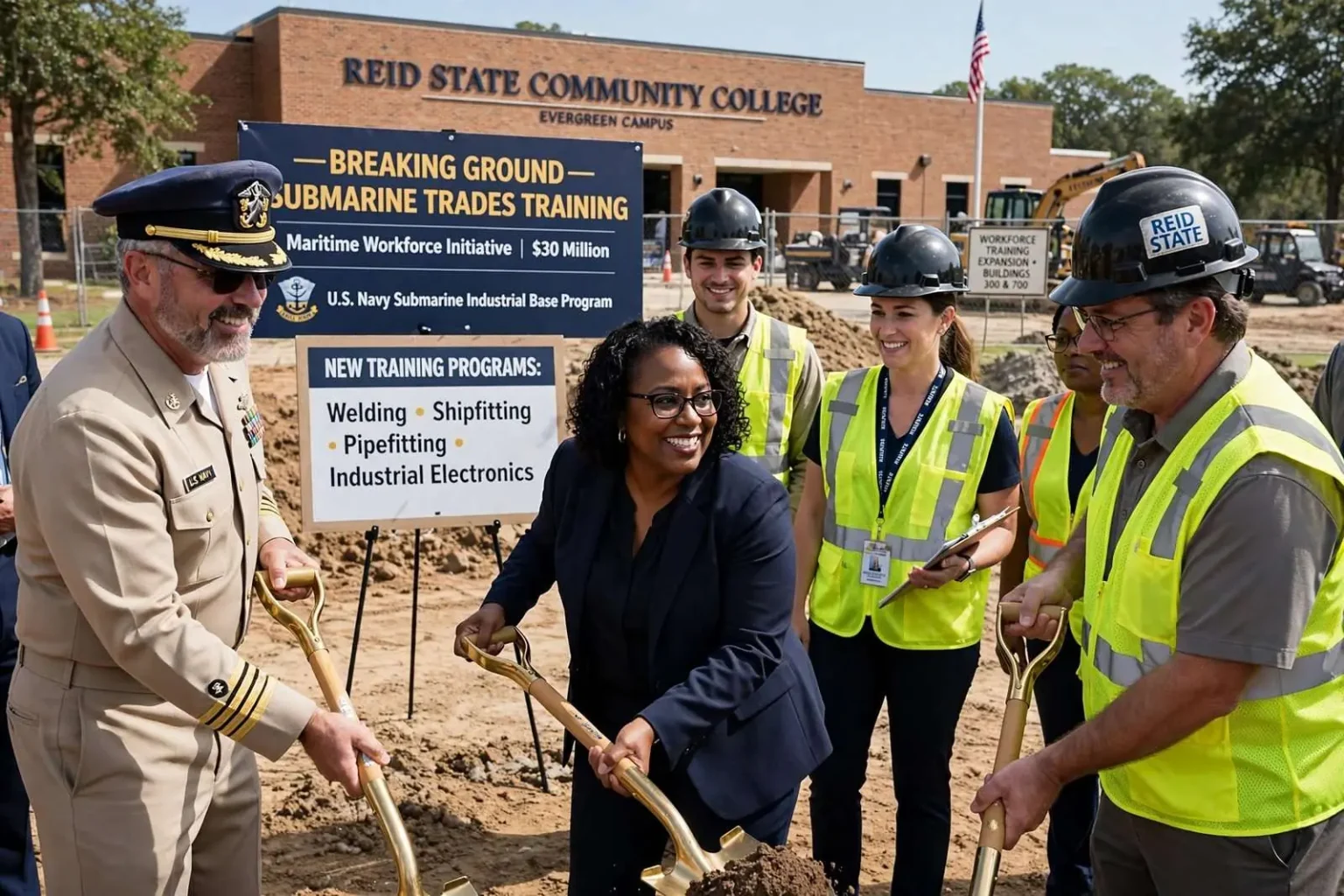
EVERGREEN, Ala. — Reid State Community College has broken ground on its portion of a $30 million maritime workforce initiative with the U.S. Navy’s Submarine Industrial Base Program Office, a project that will let the Evergreen campus train welders, shipfitters and pipefitters for submarine construction work.
The investment was awarded to four Alabama Community College System schools to modernize and expand maritime workforce training across the state. The others are Bishop State Community College in Mobile, Coastal Alabama Community College in Bay Minette, and Lurleen B. Wallace Community College in Opp.
“This project represents a generational shift for our communities,” said Dr. Coretta Boykin, president of Reid State Community College. “Today’s groundbreaking highlights our commitment to delivering accessible, high-quality technical education while connecting our students to critical career pathways that support our nation’s defense infrastructure.”
What Is Being Built
The initiative includes a new shipfitting and pipefitting program at Reid State, alongside an expansion of the college’s pipe and structural welding and industrial electronics programs.
Buildings 300 and 700 on campus are being renovated and expanded to accommodate the programs. The upgraded facilities will offer instruction in welding, industrial electricity and maintenance technology.
Why All Four Colleges Now Teach Everything
The most consequential structural change in this initiative is easy to overlook in the funding figure.
Before the Navy contract, the four colleges had specialized by default. Reid State and Lurleen B. Wallace taught only structural welding. Bishop State had the only shipfitting program. Coastal Alabama had the only pipefitting program, according to the Alabama Community College System.
Now all four will have the capacity to train for all marine welding programs.
That matters because of geography. A student in Conecuh County who wanted shipfitting training previously had to reach Mobile. For someone without reliable transportation, or with a job and a family in Evergreen, a program two hours away does not exist in any practical sense.
Community colleges serve a commuting population by design. Replicating the full program set at each campus converts a regional training capacity into a local one, and it is the difference between a program a student could theoretically attend and one they will actually enroll in.
The Trades Involved
The specific skills being taught are worth distinguishing, because they are not interchangeable.
Structural welding joins the steel that forms a vessel’s hull and framing. It is the foundation trade of shipbuilding, and the standards for submarine work are among the most demanding anywhere — welds must hold under pressures that leave no margin.
Shipfitting is the layout and assembly work that precedes and accompanies welding: reading drawings, cutting and shaping steel plate and structural members, and positioning components so they fit within tolerance. A shipfitter determines where things go; a welder makes them stay.
Pipefitting covers the piping systems that run through a vessel — propulsion, hydraulic, ventilation, fluid handling. On a submarine, those systems are packed into an extremely confined volume, and the fitting work is correspondingly precise.
Industrial electronics and maintenance technology cover the control and electrical systems that operate everything else.
These are skilled trades requiring training and certification, and they carry wages substantially above regional averages in the areas these colleges serve.
The Number Behind the Investment
The Submarine Industrial Base estimates a need for approximately 140,000 skilled workers across submarine construction and sustainment over the next 10 years.
That figure explains the entire program. The constraint on American submarine production is not funding or design; it is people. The workforce that built the fleet has aged, the trades pipeline narrowed over decades in which vocational education was deemphasized, and the industry now needs to recruit and train at a scale it has not attempted in a generation.
The demand has intensified under AUKUS, the trilateral security arrangement under which Australia is to acquire nuclear-powered submarines — a commitment that depends on American production capacity being sufficient to serve two navies rather than one.
Investing in community college programs is a direct response to that constraint. A community college can move a student from no experience to employable in months rather than years, at a cost far below a four-year degree, and it draws from the local population rather than requiring relocation.
Building the Pipeline Earlier
Reid State will also offer non-credit training, expand dual enrollment options for high school students, and launch new middle school outreach programs to build early awareness of maritime careers.
The middle school component is the most forward-looking piece and addresses a real problem in trades recruitment.
Career expectations form early. A student who has never encountered welding or shipfitting as a possibility, and who has absorbed a message that a four-year degree is the only respectable path, does not consider these fields when course selection begins in high school. By the time a college program markets to graduating seniors, many have already ruled it out without knowing what they were ruling out.
Dual enrollment addresses the same problem from the other end, letting high school students accumulate credentials before graduation. A student who finishes high school with a welding certification can enter the workforce immediately or continue with substantial progress already made.
Reid State and Conecuh County
Reid State Community College is located in Evergreen, in Conecuh County, in a part of south Alabama where economic opportunity has been limited and where population has declined over decades.
For a college serving that area, a program connected to defense industrial demand offers something rare: training tied to employment that exists, at wages that support a household, in an industry with a decade-long stated need.
Boykin’s description of a “generational shift” reflects that. In communities where young people have left for opportunity elsewhere, a credential program leading to skilled trade employment changes the calculation for families deciding whether to stay.
Reid State has been active on several fronts recently, including a grant to strengthen its rural workforce pipeline and designation of its Evergreen campus as an official ACT testing site.
The Regional Picture
The four-college distribution — Evergreen, Mobile, Bay Minette and Opp — covers a wide swath of south Alabama, and it reflects where the work is.
Austal USA in Mobile employs more than 3,000 people building vessels for the Navy, with expansions in progress that could push that number past 5,000. The company’s submarine module work has been cited as strategically significant, including in the context of competing acquisition bids for the shipyard.
A worker trained in Evergreen can reach Mobile. The training investment and the employment are in the same region, which is what makes a workforce program a workforce program rather than an export of trained labor.