Renowned SETI Astronomer to Speak at Mobile’s Gulf Coast Exploreum
SETI Institute senior astronomer Seth Shostak will speak at Mobile's Gulf Coast Exploreum on Thursday, discussing the decades-long search for extraterrestrial signals ahead of a screening of "Close Encounters of the Third Kind."
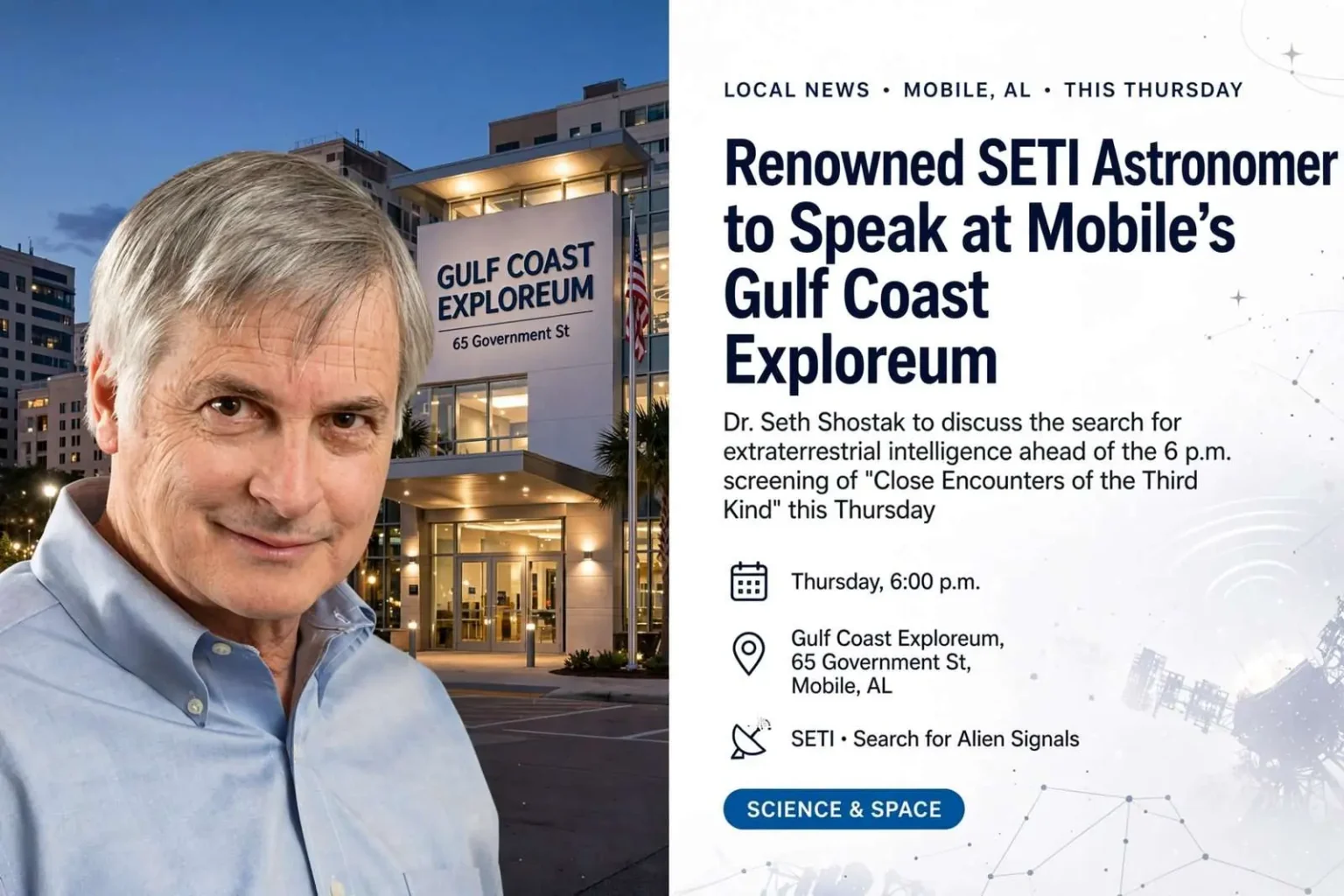
A scientist who has spent more than two decades scanning the cosmos for signs of intelligent life beyond Earth is set to visit downtown Mobile this week, bringing his search for alien signals to the Gulf Coast Exploreum. Dr. Seth Shostak, senior astronomer and former director of the SETI (Search for Extraterrestrial Intelligence) Institute, will appear at the hands-on science center at 65 Government St. on Thursday for a day of programming culminating in an evening talk.
His remarks are scheduled to begin at 6 p.m., ahead of a screening of Steven Spielberg’s 1977 film “Close Encounters of the Third Kind,” which was filmed in part in Mobile.
Shostak’s career has centered on a deceptively simple question: if intelligent civilizations exist elsewhere in the galaxy, how would we ever detect them? His answer, developed over decades of research, points to electromagnetic radiation as the most likely medium of contact. “No matter what else aliens might be doing, it’s hard for me to think they would not use electromagnetic radiation for communication purposes,” Shostak said. “We use it every day, all over the place, because it happens at the speed of light, it’s very inexpensive and simple to build the technology.”
That premise underlies the entire mission of the SETI Institute, headquartered in Mountain View, California, and founded with support from NASA in the 1970s. The organization’s primary instrument is the Allen Telescope Array, a cluster of radio dishes located roughly 300 miles northeast of San Francisco, supplemented by optical telescopes stationed around the world.
Anyone who has seen the 1997 film “Contact,” which opens with a depiction of Earth’s television and radio signals rushing outward into the galaxy, has a sense of the scale SETI researchers are working with.
Among the most talked-about moments in the search’s history is the 1977 “Wow! Signal,” named for a handwritten annotation on a data printout after an unusually strong, unexplained burst was detected from the direction of the constellation Sagittarius. A theory floated in recent years suggested the signal may have actually come from a passing comet, but Shostak said the explanation does not hold up.
“To begin with, that comet wasn’t even in the right place in the sky,” Shostak said, before turning to the signal’s characteristics. “No one’s ever seen a signal like this from any other comet.”
A second receiver on the telescope, built in as a redundancy check, scanned the same position about 70 seconds later and found nothing, a detail Shostak said is more consistent with an artificial source than a natural one.
“That might be compatible with an intermittent signal by aliens. They just kicked off the transmitter after a minute and went to lunch,” Shostak said. “But it certainly isn’t a comet that was making a signal and then suddenly switched off in a minute.” Comets, he noted, also do not move quickly enough relative to Earth to account for the signal disappearing so abruptly.
The search for habitable worlds beyond our solar system has accelerated dramatically since SETI’s founding. Astronomers have now confirmed more than 4,400 planets orbiting other stars, with more than 2,200 of those discoveries credited to NASA’s Kepler Space Telescope since 2009. The James Webb Space Telescope, which offers far greater resolution and sensitivity than its predecessors, is expected to expand that catalog further and give scientists new tools for studying the atmospheres of distant planets.
Spectral analysis performed by instruments like Webb can identify chemical signatures in a planet’s atmosphere, information that could point researchers toward the most promising targets in the search for life. “That tells you there’s photosynthesis or bacteria or something else,” Shostak said. “That would be relevant and you’d immediately swing your SETI antennas in the direction of those planets, to see if there’s more than bacteria on those planets.”
Astrobiology has become a major focus at the SETI Institute, according to Shostak, with nearly all of its roughly 80 scientists engaged in research, experimentation or grant writing related to the search for life beyond Earth. Several bodies within our own solar system are considered plausible candidates for microbial life, including Mars, Saturn’s moons Titan and Enceladus, and Jupiter’s moons Ganymede, Callisto and Europa.
“That would tell you there’s biology everywhere,” Shostak said. “That’s a big step because you have warm worlds with liquid water and atmospheres and all that stuff and there are tens of billions of them in the galaxy. If you find biology somewhere else in our solar system you can say it’s probably not an accident. It’s happened at least twice so that means it’s happened a lot of times.”
Shostak has said he expects definitive evidence of extraterrestrial life to be found within the next two decades, citing the rapid growth of computing power and observational technology as key drivers of that timeline.
The search has not been without its skeptics. Shostak addressed criticism of SETI’s scientific value in a 2009 TEDx talk, arguing that the effort has broader benefits, including boosting public interest in science and technology, regardless of whether a signal is ever confirmed.
Beyond the science, Shostak frames the search as part of a much longer human tradition of exploration, one he argues carries real stakes for civilization’s future. Finding evidence of another advanced civilization, he has said, would suggest that self-destruction is not an inevitable outcome for intelligent species, and that sustained contact could help humanity advance more quickly by learning from another society’s experience.
“It’s exploration,” Shostak said. “You can look back through history at societies that weren’t interested in exploration and they were subsumed by other societies. Ancient Egypt wasn’t interested in exploration but the Romans were, and as a result Egypt came under Rome’s grasp eventually.”
Thursday’s event is open to the public. For more information on Shostak’s visit to the Gulf Coast Exploreum, call 251-208-6893 or visit exploreum.com.
About the Signal and the Film
The “Wow!” signal was picked up on Aug. 15, 1977, by Ohio State University’s Big Ear radio telescope. Astronomer Jerry Ehman circled the reading on a computer printout and wrote “Wow!” in the margin. The signal has never been detected again.
Much of “Close Encounters of the Third Kind” was shot inside a former hangar at Brookley Air Force Base in Mobile, where the film’s large interior sets were built.