
Report: Mobile ranks seventh among fattest cities in the U.S.
A WalletHub analysis ranked Mobile the seventh most overweight and obese city in the U.S., and first for obesity-related health consequences.
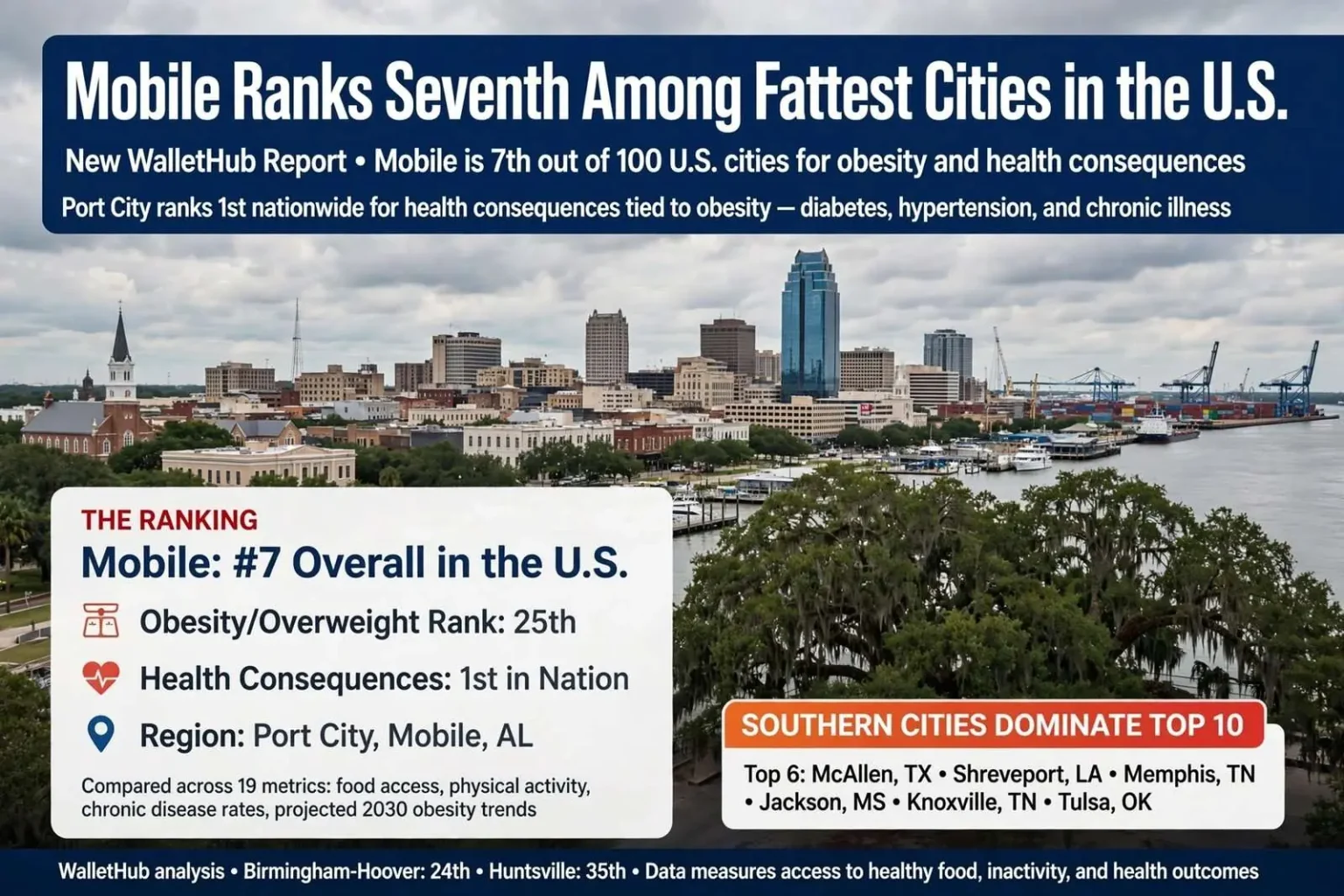
A new analysis has ranked Mobile as the seventh most overweight and obese city in the United States, a finding that places the Port City among a familiar cluster of Southern metros at the top of the list. The ranking comes from WalletHub, the personal finance website that periodically grades cities on everything from credit scores to energy costs, and this time the company compared 100 U.S. cities across 19 metrics related to weight and health.
The metrics paint a broad picture of how residents eat, move and access care. Among the measures WalletHub weighed were access to healthy food, the share of physically inactive adults and projected 2030 obesity rates, along with the underlying health data that typically tracks with those factors.
Mobile’s overall position tells only part of the story. The city finished 25th for its obesity and overweight ranking, a middle-of-the-pack showing on the metrics that measure weight directly. But the city placed first in the nation for health consequences tied to obesity — the category that captures conditions such as diabetes, hypertension and other chronic illnesses that follow from excess weight. That first-place finish in health consequences is what pulled Mobile’s composite score all the way to seventh overall.
Other Alabama cities did not fare dramatically better. Huntsville came in at No. 35, while the Birmingham-Hoover area landed at No. 24, just ahead of Mobile’s overall ranking. The Birmingham-Hoover area also ranked fourth in the country for the highest percentage of adults with high blood pressure, underscoring that the issues WalletHub measured are statewide rather than confined to one metro.
How the rankings break down
The cities ahead of Mobile at the top of the list form a distinct regional pattern. McAllen, Texas, took the No. 1 spot, followed by Shreveport, Louisiana; Memphis, Tennessee; Jackson, Mississippi; Knoxville, Tennessee; and Tulsa, Oklahoma — all ranking ahead of Mobile. Nashville, Tennessee; Columbia, South Carolina; and Lafayette, Louisiana rounded out the top 10, meaning the entire upper tier of the ranking comes from the South and its border states.
That regional concentration is consistent with long-running public health data showing that Southern states carry some of the nation’s highest rates of obesity, diabetes and cardiovascular disease. Health researchers have pointed to a mix of contributing factors, including dietary patterns, lower rates of physical activity, gaps in preventive care and the economics of food access in both urban neighborhoods and rural areas.
WalletHub’s method also explains why a city can rank modestly on weight itself yet land near the top overall. The 19 metrics are grouped into categories, and the health consequences category measures the medical fallout of obesity rather than obesity alone. Mobile’s first-place finish there suggests that residents who are overweight face comparatively severe health effects — or receive diagnoses and treatment at rates that surface the problem in the data.
What access to healthy food means locally
One of the metrics WalletHub examined, access to healthy food, has been a persistent issue in Mobile and cities like it across the Gulf Coast. Public health advocates use the term “food desert” to describe neighborhoods where full-service grocery stores are scarce and residents rely on convenience stores and fast food for daily meals. In such areas, fresh produce and lean proteins can be harder to find and more expensive, while calorie-dense processed foods are cheap and close at hand.
The consequences of that access gap compound over time. Diets high in processed foods and low in fresh fruits and vegetables are closely associated with the very conditions WalletHub measured — obesity, diabetes, high blood pressure and heart disease. In cities where many neighborhoods lack convenient healthy options, the health consequences category can climb even when the raw obesity numbers appear moderate.
Physical inactivity, another of the 19 metrics, follows a similar pattern in Gulf Coast cities. Hot, humid summers, long commutes and neighborhoods without sidewalks or parks all make regular exercise harder, and the share of adults reporting no leisure-time physical activity tends to run higher across the South than the national average.
The road ahead for Mobile
Rankings like WalletHub’s carry no legal weight, but they matter for how a city talks about itself and where it directs attention. Public health officials across Alabama have spent years working on obesity through a combination of community programs, school wellness initiatives and healthcare outreach, and the data in reports like this one help those groups make the case for funding and focus.
For Mobile, the standout number is the first-place ranking in health consequences tied to obesity. Unlike a weight ranking, which reflects behavior and environment, the health consequences category measures outcomes — the chronic disease burden that follows when excess weight goes unaddressed. That makes it a number local healthcare providers, insurers and community organizations can act on directly, through screening, prevention programs and better management of diabetes and hypertension once diagnosed.
Local leaders have also noted that rankings like this affect economic perceptions. Companies considering relocation look at community health metrics alongside schools and infrastructure, and a high profile on a national “fattest cities” list is not the image a growing port city wants to project. The flip side is that such rankings tend to generate attention, and attention can be converted into partnerships, grants and programs.
Why the South tops the list
The regional pattern in the top 10 — Texas, Louisiana, Tennessee, Mississippi, Oklahoma, Alabama, South Carolina — mirrors decades of national health surveillance data. The Centers for Disease Control and Prevention’s state-level obesity maps have consistently shown the Deep South among the most affected regions, with rates well above the national median. WalletHub’s city-level analysis zooms that pattern in, and the result is a top tier made up almost entirely of Southern metros.
Researchers attribute the pattern to an interlocking set of causes rather than any single one. Poverty rates in the South run above the national average, and obesity tracks closely with income. Food culture plays a role as well, in a region famous for fried foods and rich cuisine. Climate matters too — long hot seasons make outdoor exercise less appealing, and the region’s car-dependent development patterns leave many residents without walkable destinations.
Healthcare access rounds out the list of factors. Parts of the South have seen rural hospital closures and physician shortages, and preventive care — the kind that catches high blood pressure and elevated blood sugar early — is used at lower rates than in other regions. WalletHub’s fourth-place finding for the Birmingham-Hoover area on high blood pressure prevalence fits squarely within that regional picture.
What residents can take from the numbers
Public health professionals generally caution against reading any single city ranking as a personal verdict, noting that city-level data blends neighborhoods, ages and populations that differ enormously. But the report’s underlying metrics — activity levels, food access, chronic disease prevalence — are the same indicators that doctors and community health workers track one patient and one neighborhood at a time.
For Mobile residents, the practical takeaways are familiar ones: regular checkups to catch hypertension and diabetes early, more movement built into daily routines, and attention to where fresh food is available. Community gardens, farmers markets and mobile markets have all been used in Gulf Coast cities to close the access gap the study measured, and school-based wellness programs aim to reach children before the patterns become permanent.
Whether Mobile climbs or falls in next year’s edition of the ranking will depend on those slow-moving numbers: obesity rates, activity levels and the chronic disease burden that made the Port City first in the nation on health consequences. For now, the city sits seventh among America’s 100 largest cities on the composite score — with a first-place finding that local health leaders would give almost anything to lose.
A familiar ranking with real stakes
Mobile has appeared on national health rankings before, and each edition prompts the same question: what, practically, changes because of it? The honest answer is that rankings function less as turning points and more as measuring sticks — a way for a community to see where it stands compared with its peers and to track whether the needle moves over time. WalletHub’s composite of 19 metrics is useful precisely because it bundles weight, activity, food access and health outcomes into a single comparable score.
The gap between Mobile’s 25th-place weight ranking and its seventh-place overall finish deserves a second look, because it says something important about the city’s health profile. If weight alone placed Mobile in the middle third of the country, but the consequences of that weight placed it first, then the local challenge is not only preventing obesity but treating and managing the conditions that flow from it. That distinction points toward expanded screening, better chronic disease management and closer follow-up for the residents already living with diabetes and hypertension.
It also highlights the role of local healthcare institutions. Hospitals, community clinics and county health programs see the consequences measured in the study every day — amputations, dialysis patients, stroke admissions — and prevention efforts that reach residents earlier can bend those curves. Community-based initiatives that pair exercise programs with nutrition education have shown results in comparable Southern cities, and Mobile’s own providers have made chronic disease prevention a growing priority.
None of that will change the ranking quickly. Health metrics move at the pace of years, not news cycles, and the 2030 projections WalletHub included in its analysis are a reminder that today’s choices shape the numbers a decade out. But with the Port City now seventh on a list no city wants to lead, the study gives Mobile’s health community a clear, quantified target — and a baseline against which progress, or the lack of it, can be measured when the next round of data arrives.