Residence, vehicles struck by gunfire in Fort Walton Beach; no injuries
The Okaloosa County Sheriff's Office is investigating after a residence and vehicles on Fenwick Drive were struck by gunfire with no injuries reported.
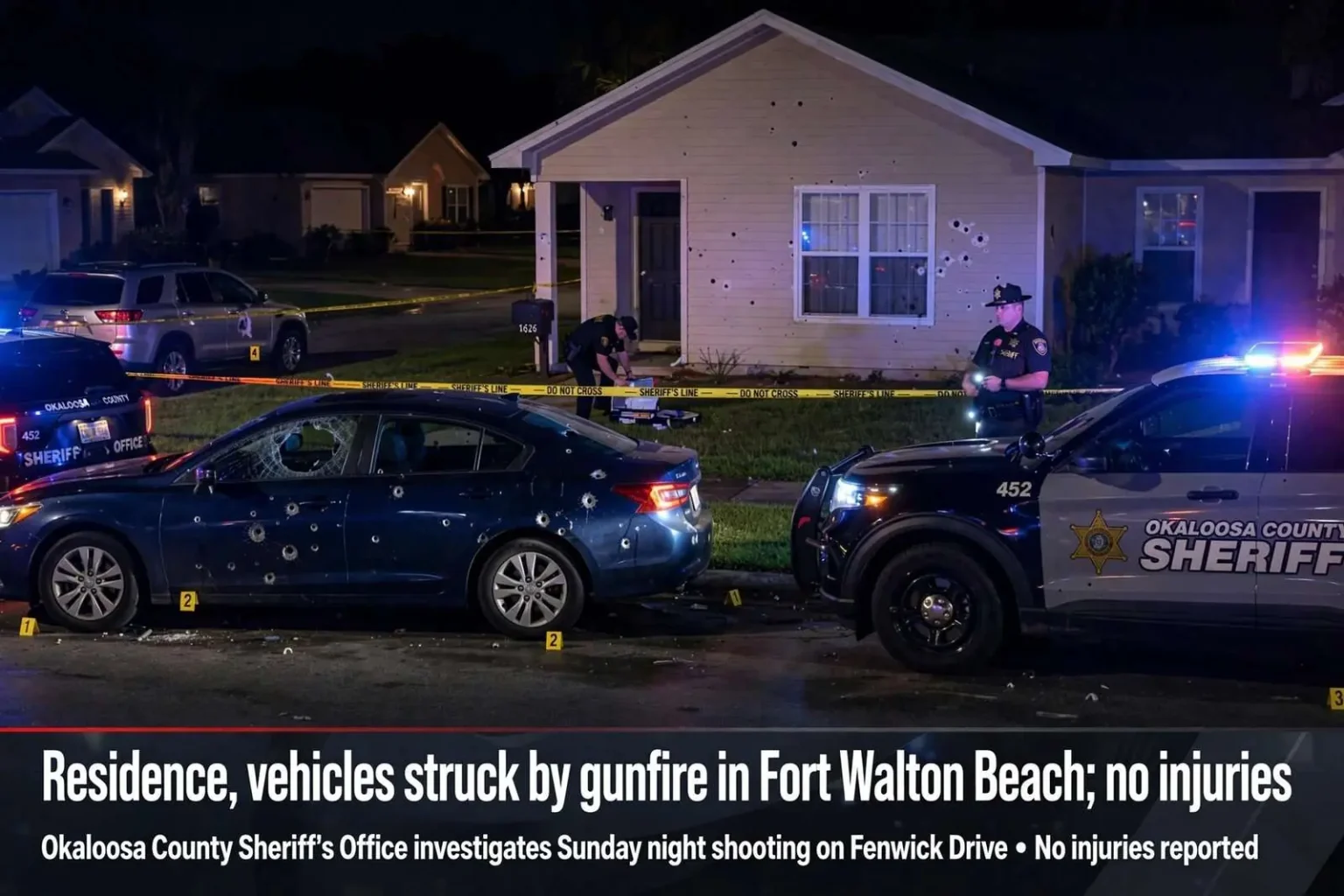
The Okaloosa County Sheriff’s Office is investigating after a residence and several vehicles were struck by bullets in Fort Walton Beach. Deputies said someone fired multiple rounds Sunday night, hitting a car and a home at 1626 Fenwick Drive. As the shooter fled, additional shots struck a vehicle parked at 1621 Fenwick Drive. No injuries were reported. The sheriff’s office asked anyone with information about the shooting to come forward as the investigation continued.
The gunfire broke a quiet Sunday night on a residential street and left behind the evidence that drive-by shootings always leave: bullet holes in a car’s body panels, damage to the walls of a home where a family or tenants were living, and a second vehicle struck across the street as the shooter sped away. No one was hurt, which investigators and residents alike recognized as a matter of fortune as much as anything, given that multiple rounds were fired at occupied structures in a neighborhood where people were home for the evening.
Deputies responded to Fenwick Drive after reports of shots fired and worked the scene into the night, documenting where each round struck and searching for casings, fragments, and any surveillance footage that captured the shooter’s vehicle. The investigation, handled by the Okaloosa County Sheriff’s Office, covers territory that includes Fort Walton Beach and the surrounding unincorporated areas of the county, and its detectives carry caseloads that span everything from property crimes to shootings like this one.
The neighborhood and the night
Fenwick Drive sits in a residential section of Fort Walton Beach, the city of roughly 20,000 people on the Emerald Coast between Eglin Air Force Base and the beaches that drive the region’s tourism economy. The area around Fenwick Drive is typical of the city’s interior neighborhoods — single-family homes on modest lots, cars in driveways and along the curb, and streets that empty early on weeknights and stay reasonably quiet even on weekends. It is the kind of neighborhood where gunfire at night draws people onto porches within seconds, and where deputies canvassing for witnesses the next morning find plenty of residents who heard the shots, even if few saw the shooter.
Fort Walton Beach itself anchors a stretch of the Gulf Coast whose character is shaped by Eglin Air Force Base, one of the largest military installations in the country, and by the tourism and service economy that runs along Highway 98 and the beach communities nearby. The city’s residential interior, away from the beach strips, houses the base’s military families, retirees, and long-term residents, and crime patterns there look more like those of any small Southern city than the resort areas a few miles south. Shooting incidents into homes and vehicles are uncommon enough to command attention when they happen, and the Okaloosa County Sheriff’s Office treats them as the serious matters they are.
Sunday-night shootings into occupied structures carry particular investigative weight. Deputies will want to establish whether the targeted home was chosen deliberately or whether the shooter struck the wrong house, a distinction that depends on witness accounts, any prior disputes connected to the address, and the pattern of the gunfire itself. The fact that shots continued to strike a vehicle across the street during the shooter’s flight suggests rapid, possibly indiscriminate firing, which investigators will weigh alongside everything else they learn.
How shooting investigations unfold
The first hours after a shooting like this belong to scene work. Deputies and crime scene technicians walk the street searching for cartridge casings, which mark where the shooter stood and how many shots came from that position; for bullet fragments and struck surfaces, which indicate the angles of fire; and for any physical evidence left behind. Modern investigations lean heavily on cameras — doorbell cameras, home security systems, and traffic cameras along nearby corridors — because a single frame of the shooter’s vehicle, its direction of travel, or its plate can break a case open.
Witness canvassing follows, and in residential neighborhoods it happens door to door. Deputies ask who was awake, who heard the shots, who saw a vehicle leave and in which direction. People who hesitate to come forward on the night often call in details the next day, and investigators keep the case open to those late tips. The sheriff’s office asked anyone with information to come forward, the standard appeal in cases where the shooter is not immediately identified, and tips can be submitted anonymously through the agency’s tip channels and Crime Stoppers programs serving the Panhandle.
Ballistics, when casings are recovered, can connect a shooting to a specific firearm — and through federal and state databases, sometimes to other shootings. That forensic thread is slow work, but it matters in cases like this, where establishing the weapon can corroborate witness accounts or link a suspect’s gun to the scene. Investigators will also work the background of the targeted addresses, checking for prior calls for service, reports of disputes, or connections that explain why these homes and cars were hit.
The cost of gunfire in a neighborhood
The geography of Okaloosa County’s law enforcement also shapes how a case like this proceeds. The sheriff’s office covers the county’s unincorporated areas and provides major-case support across the region, while Fort Walton Beach’s own police department handles municipal calls inside city limits — and jurisdiction in any given incident depends on precisely where the trigger was pulled. Shootings that cross municipal boundaries, or that connect to incidents in neighboring Okaloosa communities such as Mary Esther, Valparaiso, or Crestview, draw the agencies into joint work, and the Panhandle’s departments have long-standing habits of sharing information when gunfire touches more than one jurisdiction.
Nighttime shootings also test the region’s emergency communications in ways residents rarely see. Calls reporting shots fired arrive in clusters, from callers offering fragments — a direction of travel, a sound like firecrackers, a vehicle’s color. Dispatchers piece those fragments together to build the first picture of the incident while deputies are still en route, and the quality of that early picture shapes everything that follows: where deputies search, which way they drive, and how quickly they find a spent car or a shell casing still warm on the pavement.
Even with no injuries, a shooting like Sunday night’s imposes real costs on the people who live there. A home struck by bullets needs repairs that insurance may or may not cover cleanly, and the owners of the damaged vehicles face the same paperwork and the same questions about whether the damage exceeds their deductible. More lasting is the psychological effect: residents of a street where rounds came through walls at night lie awake differently afterward, and neighborhood watch activity, camera purchases, and calls for increased patrols typically follow.
Property damage from shootings also raises questions many homeowners have never considered. Standard homeowner policies generally cover bullet damage to the dwelling, but vehicle damage from gunfire falls under a car’s comprehensive coverage — which owners who carry only liability insurance do not have. That gap leaves some victims of shootings paying out of pocket for repairs to cars they did nothing to put in harm’s way, a frustration investigators hear about regularly in canvassing.
For the wider community, the appeal for information is the practical center of the case. Shootings into occupied structures are solved, when they are solved, overwhelmingly through tips — a neighbor’s camera, a passenger’s confession to a friend, a detail someone mentions days later. Okaloosa County residents have multiple ways to pass along what they know, including direct lines to the sheriff’s office and anonymous Crime Stoppers channels, and reward programs sometimes attach to cases where shooters remain at large.
What comes next
As the investigation continued, deputies had not announced a suspect, a motive, or arrests, and the pace of the case now depends on what the scene evidence and tips produce. If a suspect emerges, charges in a shooting of this kind can range from aggravated assault to discharging a firearm into an occupied dwelling — offenses that Florida law treats with particular severity because of the risk to people inside. If the shooter struck the wrong house, the same charges would apply, since the act, not the intent, defines the danger.
In the meantime, the practical advice that follows any such incident applies on Fenwick Drive: residents who find bullet damage or casings should leave them untouched and call the sheriff’s office rather than cleaning up, since every fragment is evidence; anyone with cameras should preserve their footage before it loops over; and anyone who knows anything should weigh that knowledge against the reality that the next round fired this recklessly might not miss.
The Sunday-night shooting on Fenwick Drive ended without injuries, but it stripped away the ordinary comfort of a quiet street. The holes in a car and a house will be repaired, the casings collected, and the reports filed. What the neighborhood will be watching for — and what the Okaloosa County Sheriff’s Office has committed to finding — is who fired, and why.