Review: Jason Isbell and Josh Ritter Light Up the Mobile Saenger Theater
Review: Jason Isbell and Josh Ritter Light Up the Mobile Saenger Theater — a South Alabama News report on Mobile, Mobile County, Jason Isbell, Josh Ritter.
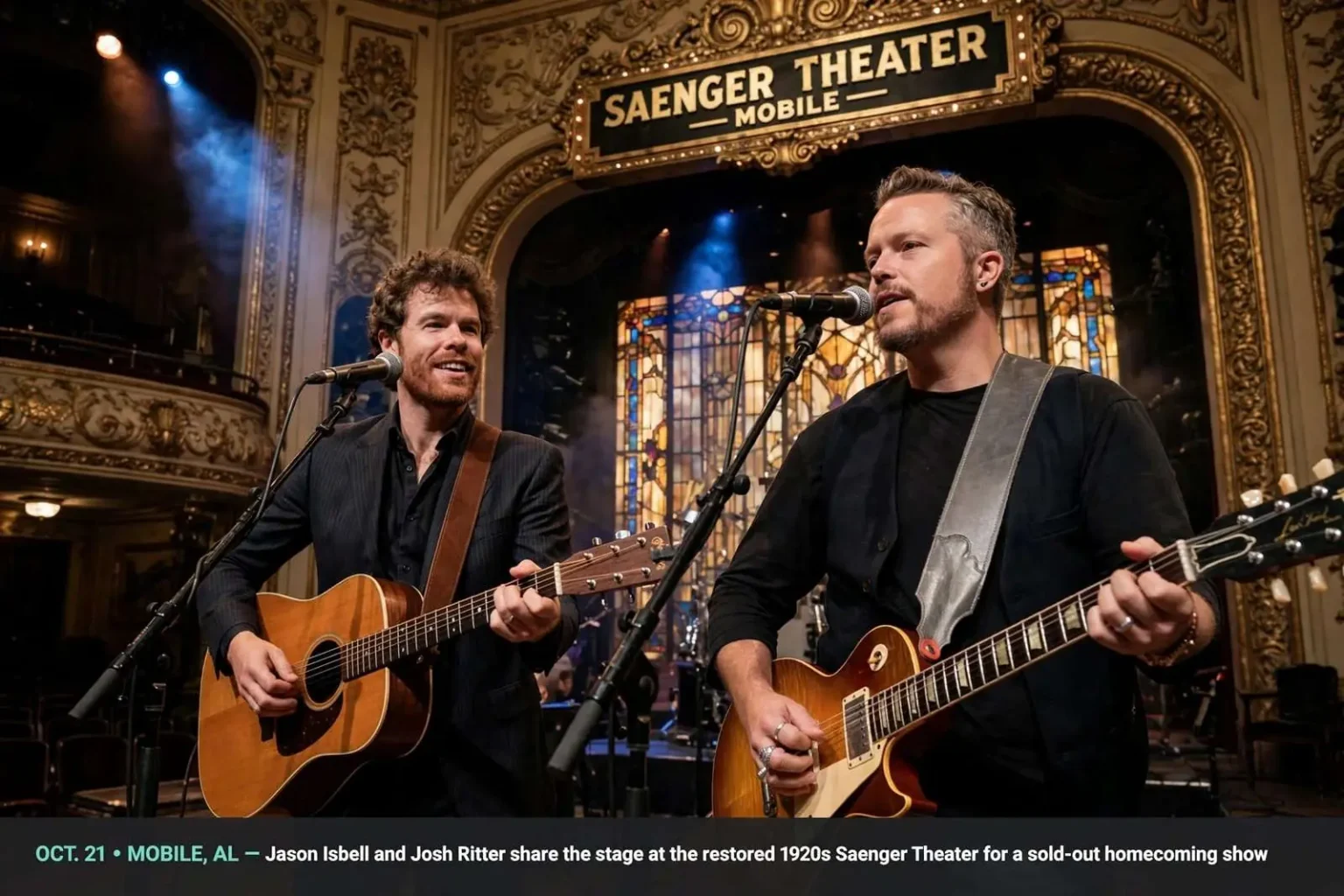
Alabama native Jason Isbell has traveled a long road from his first publishing deal at FAME Studios in Muscle Shoals to Grammy wins for Something More Than Free, and when he brought that journey home, Mobile turned out in force. Isbell played the Saenger Theater on Oct. 21, presented by Huka Entertainment, with Idaho-born tour mate Josh Ritter warming the crowd for one of the most anticipated Gulf Coast shows of the season. The venue — the restored 1920s movie palace on Joachim Street downtown — filled with fans who had watched Isbell’s rise from Alabama clubs to arena-level acclaim.
Isbell opened with a stained-glass backdrop and launched into Southeastern rock with The 400 Unit, his longtime backing band, setting the tone for a night that moved between full-throttle guitar work and the quiet, devastating songcraft that has made him one of the most decorated songwriters of his generation. “24 Frames,” winner of the Best American Roots Song Grammy, drew huge cheers, and the Mobile fanbase’s fervor was plain from the first notes.
From Muscle Shoals to the Grammys
The distance between Isbell’s start and his current standing is one of the great recent stories in American music. He grew up in Green Hill, near Muscle Shoals, in a family connected to the region’s musical culture, and his first publishing deal came at FAME Studios — the historic Shoals facility where Aretha Franklin, Wilson Pickett, and Otis Redding cut some of the defining records of American soul. A childhood spent around the studio where the Muscle Shoals sound was invented shaped a writer who treats regional detail as universal material.
His tenure with the Drive-By Truckers, joining as a young guitarist-singer in the early 2000s, established his reputation before a departure led to solo work that nearly foundered before the sobriety and the songwriting breakthrough of Southeastern changed everything. Since then, the awards have accumulated: Grammy wins including Something More Than Free, recognized as the year’s best Americana album, and “24 Frames” taking Best American Roots Song. For an Alabama audience, watching a Shoals kid collect that hardware carries a particular pride — the state’s musical inheritance, born in Muscle Shoals and the Shoals’ recording era, still producing artists of the first rank.
The homecoming feeling
Between songs, Isbell noted, “I’m glad we got to come so near to home,” prompting shouts of “You are home!” from the crowd — an exchange that captured the night’s mood. Mobile sits in the corner of the state that claims him by geography and temperament, and the Saenger audience responded to the show less like a concert than a family reunion with exceptional musicianship. The fervor of the Mobile fanbase has been evident across Isbell’s Gulf Coast appearances, and this night matched it.
The Saenger Theater itself deserves mention in any account of the show. Opened in 1927 as a movie palace and restored after Hurricane Katrina damaged the downtown district, the venue pairs a grand, ornate interior with acoustics that flatter an act like Isbell’s, which depends on lyrics landing clearly. The stained-glass backdrop that framed the band on Oct. 21 played off the theater’s own period detailing, making the staging feel native to the room rather than traveling in from elsewhere.
The set: career-spanning and Truckers-deep
The set included “Speed Trap Town,” “Elephant,” “Alabama Pines” and “Cover Me Up,” a selection that reached across the catalogs that define him. “Elephant,” the portrait of a dying friend from Southeastern, has become one of the most affecting songs in his repertoire, and it landed in the Saenger with the hushed attention it demands. “Cover Me Up,” the love song that opens that same album, has taken on a second life in the wider culture, and its appearance drew one of the night’s biggest responses. “Alabama Pines,” from earlier in his solo career, speaks directly to the experience of coming back to a home state that never quite lets go of you — a theme that resonated in the room.
“Speed Trap Town,” a small-town narrative from Something More Than Free, carried the album’s Grammys into the set, and the band’s Southeastern rock arrangements gave the quieter material momentum without overwhelming it. The 400 Unit — anchored by Isbell’s marriage-and-music partnership with violinist and keyboardist Amanda Shires and guitarist Sadler Vaden’s contributions to the band’s heavier edges — has become one of American roots-rock’s most reliable live units, capable of both the bar-band crunch of Isbell’s early material and the restraint his recent records demand.
The Drive-By Truckers chapters of his catalog were not ignored. The set included Truckers cuts “Outfit” and “Never Gonna Change,” songs from his early-twenties tenure with the band that remain crowd standards wherever he plays. “Outfit” — the young man’s-road-map song built on a father’s advice about life on the road — retains its hold on Southern audiences two decades on, and hearing it in a Mobile theater, sung back by an audience that grew up on it, linked the night explicitly to his origins.
Josh Ritter’s opening set
Josh Ritter, the Idaho-born songwriter touring in support, warmed the crowd with a set that showcased why he has remained a fixture of the American singer-songwriter circuit for two decades. Ritter’s catalog — literary, warm, and built on plainspoken storytelling — shares with Isbell’s an insistence that songs can carry narratives worth following to the end. His presence on the bill gave the evening the structure of a full songwriters’ showcase rather than a single headliner’s production.
The collaboration continued past the encore’s start. A trio encore with Ritter on John Prine’s “Storm Windows” closed the night, a fitting choice in a year when Prine’s influence on two generations of American songwriters was being celebrated widely. Covering Prine — the towering figure of the American folk-songwriting tradition — with his tour mate at his side, Isbell ended the Mobile show by pointing at the lineage he belongs to rather than at his own accomplishments.
Huka Entertainment and Mobile’s live-music economy
The show’s presentation by Huka Entertainment placed it in the context of Mobile’s growing concert economy. Huka, a Gulf Coast-based promotion company with deep ties to the region’s festival and venue scene, has been a consistent force in bringing national touring acts to the central Gulf Coast, including its role in the region’s outdoor festival market. For downtown Mobile, an act of Isbell’s stature at the Saenger on a week the city’s restaurants and bars were full of concertgoers represents the kind of economic activity city leaders have chased since the downtown revitalization began — visitors drawn from across the central Gulf Coast for a single night.
The Saenger dates from an era when downtown theaters anchored the entertainment economy of cities like Mobile, and its survival through closure, decay, and storm damage into the present concert circuit is part of why a night like Oct. 21 is possible. The theater’s management books a range of touring acts through the year, and a sold-out Isbell show ranks among the bookings that affirm the investment in the old movie palace.
What the night said about Southeastern music
If the Saenger show is any sign, Southeastern music is alive and well. That phrase means more than geography: it points to a tradition running from Muscle Shoals soul through Southern rock, country songwriting, and the Americana revival, carried by artists who never left the region’s subject matter even as their audiences went national. Isbell’s Mobile crowd — chanting “You are home!” at a Grammy winner from Green Hill — demonstrated that the connection runs both ways, and that Gulf Coast audiences treat his success as partly their own.
Josh Ritter’s contribution to the night reinforced the point from the other direction. An Idaho songwriter built a career on the same conviction — that American regional stories deserve first-rate songs — and his willingness to join Isbell for Prine’s “Storm Windows” turned the encore into a statement about the continuity of the tradition they both work in. Two writers, one from the Shoals and one from the Rockies, closing a Mobile night with a song by the late Illinois folk giant, in a 1927 theater on Joachim Street: the Southeastern tradition, it turns out, welcomes the whole country in — and sends its own songs out to meet it. The tradition holds because rooms like this one keep filling with people who care whether a song is true.
The set’s blend of Grammys-era material, Truckers nostalgia, and Prine’s ghost left the Saenger crowd with the sense of an artist entirely at ease with his own history. For Mobile, the homecoming was brief but complete — a near-home show by the region’s most decorated living songwriter, played in the best room downtown, with the fanbase’s fervor making the point that Isbell really was home.