Road Construction to Watch This Week in the Pensacola Area
A rundown of the road construction and lane closures drivers in Escambia and Santa Rosa counties should expect this week, from I-10 resurfacing to bridge maintenance over the Yellow River.
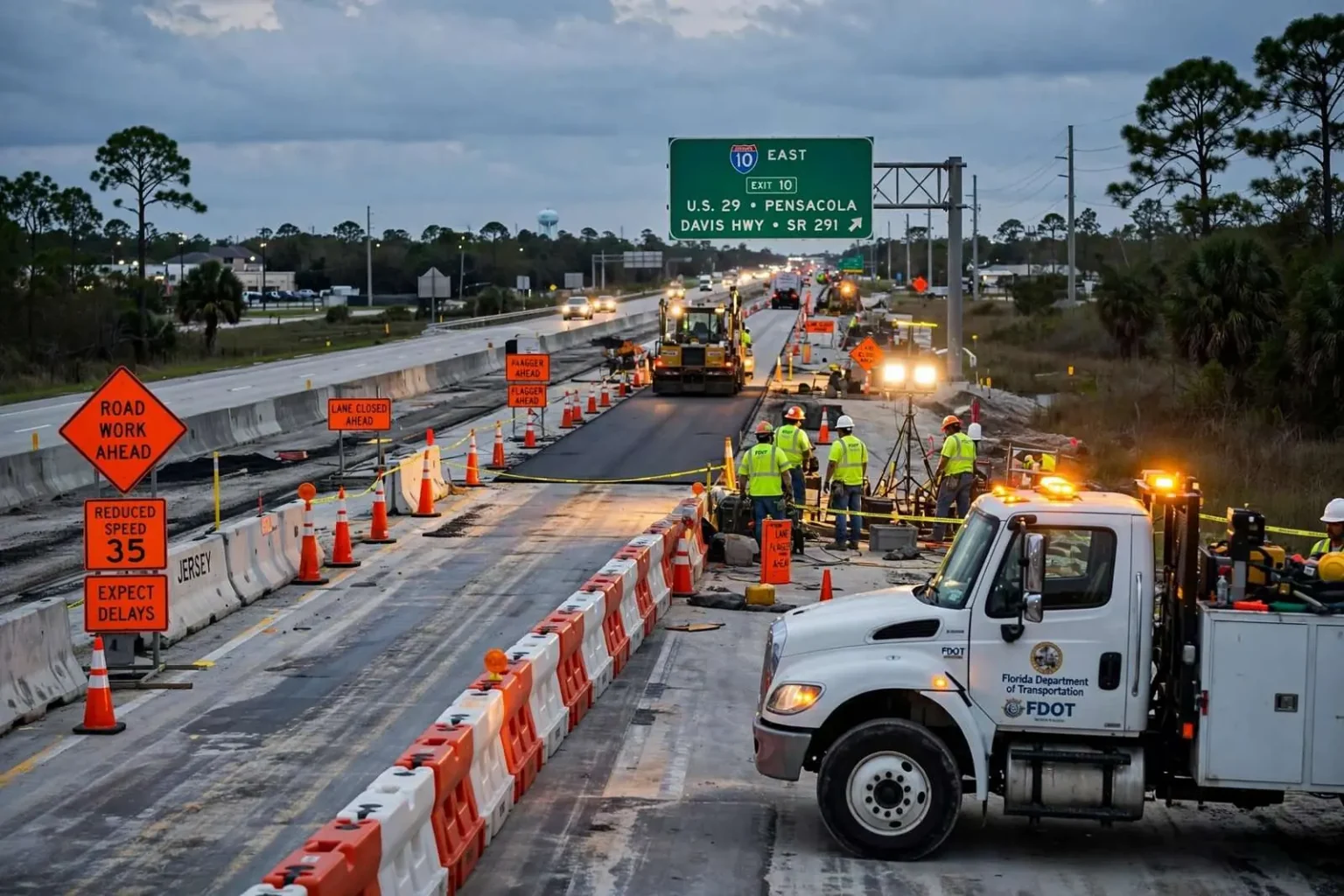
Drivers in Escambia and Santa Rosa counties should expect traffic disruptions this week as crews continue construction and maintenance work on several major roads, according to state transportation officials.
It is a full slate for the Florida Department of Transportation’s Pensacola-area crews: resurfacing on the interstate and three state roads, stormwater work in the Garden Street corridor, interchange construction at two I-10 exits and bridge maintenance over the Yellow River. Most of the overnight work runs from 8 p.m. to 6 a.m., while daytime projects carry reduced speed limits and flagger-controlled lanes. All work is weather dependent and may be delayed or rescheduled if conditions don’t cooperate.
Escambia County
Interstate 10 Resurfacing — From east of U.S. 29 to east of Davis Highway (S.R. 291), drivers may hit intermittent lane closures, traffic shifts and periodic ramp closures between mile markers 11 and 14. The work is scheduled Sunday, Aug. 16 through Thursday, Aug. 20, from 8 p.m. to 6 a.m., for paving and roadway construction.
That stretch of I-10 carries some of the heaviest traffic in the Panhandle, mixing long-haul freight with commuters moving between Pensacola and the Alabama line. Overnight closures keep the impact off the peak hours, but drivers traveling late should expect cones, narrowed lanes and the possibility of a closed ramp forcing a short detour.
S.R. 292 (Gulf Beach Highway) — Crews will have intermittent lane closures from east of Bauer Road (C.R. 293) to Manchester Street, between 8 p.m. and 6 a.m. this week. Median devices are in place near Patton Drive and Mills Avenue, and the speed limit through the work zone has been reduced to 35 mph.
Gulf Beach Highway is the coastal artery serving the Pensacola Beach approach and the southwest corner of the county, and the 35 mph limit through the work zone is a significant drop for a road that ordinarily moves at highway speed. The median devices near Patton Drive and Mills Avenue channel traffic away from the work areas and restrict some turns, so drivers planning left turns onto or off the highway should watch for the revised patterns.
U.S. 90A (West Nine Mile Road) Resurfacing — Between the Perdido River Bridge and S.R. 99 (Beulah Road), drivers will see intermittent eastbound lane closures near the U.S. 90 weigh station, with flaggers directing traffic. Inside lanes are also closed between Western Way Drive and Tower Ridge Road.
The Nine Mile Road corridor serves the fast-growing northwestern edge of Pensacola, where residential development has outpaced the roadway for years. Resurfacing between the Perdido River Bridge — the crossing at the Alabama state line — and Beulah Road will ease a stretch that has grown rough with heavy truck traffic from the weigh station and the freight route between the two states.
Business U.S. 98 (Garden Street) Construction — A temporary westbound lane closure near North D Street is planned Monday, Aug. 17, from 8 p.m. to 6 a.m., for stormwater drainage work. Garden Street between Pace Boulevard and North Donelson Street remains reduced to one lane in each direction as crews work on the north side of the street, a configuration expected to last through late 2026. Side streets north of Garden Street will see closures with detours at C Street and D Street for stormwater drainage reconstruction, and on-street parking remains closed on Garden Street between A Street and L Street.
The Garden Street project is the longest-running disruption on the list. Stormwater drainage reconstruction is slow, dig-after-dig work, and closing the side streets north of the road forces neighborhood traffic through the C Street and D Street detours. Drivers who use on-street parking along the corridor should plan for alternate parking between A Street and L Street for the remainder of the project.
The interstate interchanges
I-110 Resurfacing — Between I-10 and U.S. 98, drivers may encounter intermittent lane closures, traffic shifts and periodic ramp closures Sunday, Aug. 16 through Thursday, Aug. 20, from 8 p.m. to 6 a.m., for paving operations.
I-110 is Pensacola’s downtown spine, the short freeway that carries I-10 traffic into the city center and onto the beaches route. Resurfacing its full run between I-10 and U.S. 98 means overnight drivers through the heart of the city should expect shifting patterns from one night to the next.
I-10 at Nine Mile Road Interchange (Exit 5) — Intermittent westbound lane closures are expected near the interchange this week, between 8 p.m. and 6 a.m. Nine Mile Road itself will be down to one lane in each direction between the I-10 ramps from Sunday, Aug. 16 through Saturday, Aug. 22, with law enforcement and signage directing traffic. A temporary reconfiguration of the I-10 westbound on-ramp will remain in place through late 2026.
The Exit 5 work pairs this week’s closures with a long-term change: the on-ramp reconfiguration that will stay through late 2026. Drivers who enter I-10 westbound from Nine Mile Road should expect the new ramp geometry to hold through the fall, and the single-lane condition on the surface road between the ramps will slow the busiest commute in the county’s northwest for the full week.
I-10 at U.S. 29 Interchange (Exit 10) — The I-10 eastbound lanes remain shifted north near the U.S. 29 interchange, a configuration expected to stay in place through late 2026, and I-10 remains down to two lanes in each direction between U.S. 29 and I-110. The U.S. 29 southbound access to the I-10 eastbound on-ramp has been reduced, and the U.S. 29 northbound ramp to I-10 eastbound is closed — northbound drivers are being detoured to make a U-turn at Broad Street to reach I-10 eastbound.
The Exit 10 configuration is the one to plan around. A U-turn at Broad Street adds minutes to a routine commute, and with I-10 already down to two lanes each way between U.S. 29 and I-110, the merged traffic will stack through the construction zone at peak hours. Drivers who can time their trips outside the morning and evening rushes will notice the difference most.
S.R. 97 (Atmore Highway) Resurfacing — From U.S. 29 to the Alabama state line, drivers should expect intermittent lane and shoulder closures Monday, Aug. 17 through Friday, Aug. 21, from 7 a.m. to 5 p.m., along with lane closures at S.R. 95 and S.R. 97 during the same hours.
Unlike most of the week’s work, this is daytime — 7 a.m. to 5 p.m. — on the rural highway that runs north from U.S. 29 toward Atmore, Alabama, a route used by commuters crossing the state line for work in both directions. Shoulder closures and lane closures on a two-lane rural road mean brief waits behind flagging operations, and drivers should budget extra time through the week rather than at a single hour.
Santa Rosa County
U.S. 98 Widening — From Bayshore Road to Portside Drive, drivers will see median and turn lane closures between Bayshore Road and Tiger Lake Drive, plus intermittent lane and additional median closures Sunday, Aug. 16 through Saturday, Aug. 22, from 7 p.m. to 5:30 a.m., for paving operations.
The U.S. 98 widening is the marquee project in Santa Rosa County — a long-running effort to expand the highway that connects Pensacola Beach communities with the rapidly growing neighborhoods along the Santa Rosa Sound and north of it. Median and turn lane closures change how drivers enter and exit businesses and subdivisions along the corridor, and the overnight paving schedule leaves the road narrowed from early evening through the pre-dawn hours all week.
U.S. 90 Resurfacing — Between the Escambia River Bridge and east of Woodbine Road (C.R. 197A), intermittent lane closures are expected Sunday, Aug. 16 through Thursday, Aug. 20, from 7 p.m. to 5:30 a.m., with the speed limit reduced to 45 mph through the work zone.
This stretch of U.S. 90 is the historic east-west corridor through Milton and the communities along the Escambia River’s east bank. The 45 mph limit will be enforced through the work zone, and overnight drivers between Pensacola and Milton should expect single-lane passage for much of the week.
S.R. 87 Bridge Maintenance — Over the Yellow River, drivers may hit intermittent southbound lane closures Monday, Aug. 17, from 9 a.m. to 2 p.m., for routine bridge maintenance.
The Yellow River crossing on S.R. 87 is a midday-only disruption, but the road is a main route between Milton and the communities to the south, so drivers making the trip Monday midday should plan around a possible brief single-lane hold at the bridge.
How drivers can plan around the work
The week’s schedule follows the pattern the Florida Department of Transportation uses across Northwest Florida: interstate and arterial paving at night, when volumes are lowest; long-term corridor projects, like the Garden Street drainage reconstruction and the U.S. 98 widening, in configurations that hold for months; and routine maintenance, like the S.R. 87 bridge work, in short midday windows. Drivers can save the most time by knowing which kind of project they are passing.
For overnight interstate work on I-10 and I-110, the practical advice is to expect lane shifts that change from night to night and to use the exits that remain open rather than assuming a ramp is available. For the long-term projects, the slower configurations — one lane each way on Garden Street, the shifted lanes at Exit 10, the reconfigured ramp at Exit 5 — are the ones to build into daily commutes until they end late in the year.
Speed limits inside every work zone are reduced and enforced, and the flagger operations on U.S. 90A and S.R. 97 require a full stop when directed. The department’s standard guidance applies throughout: workers and equipment can be within a few feet of an open lane, conditions change overnight, and the schedule moves only when weather allows. Drivers with flexibility should route around the heaviest zones — the Exit 10 detour and the Nine Mile Road single-lane condition — during peak hours, and everyone should re-check conditions before evening travel, since any of the overnight schedules can shift with a storm.
The week ends with the same reminder the schedule began with: all of it is weather dependent, and the safest plan is the one that assumes a closure will be there when you arrive.