Robby Kee and Invent Room Pop Bring Experimental Art to Mobile’s Industry Bar
Curator Robby Kee brought Invent Room Pop, with Marlee Mincher and Adam Taylor, to Mobile's Industry Bar for an evening of experimental art.
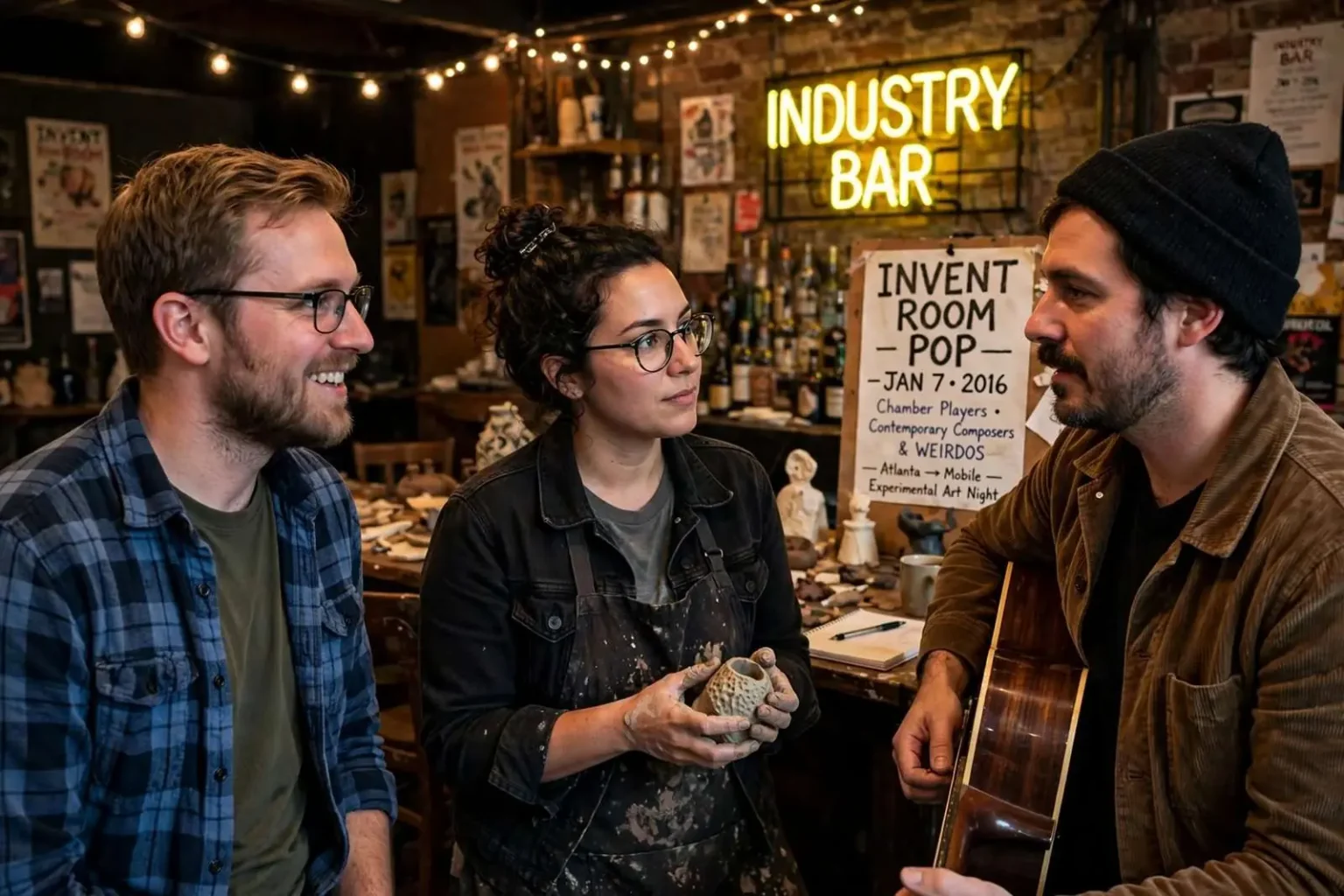
Atlanta experimental curator Robby Kee brought Invent Room Pop to Mobile’s Industry Bar on Jan. 7, 2016, a monthly event for chamber players, contemporary composers and “weirdos.” The Mobile edition of the series folded the city into a rotating cast of Atlanta’s experimental art community, and it gave local audiences the kind of evening that rarely finds its way into conventional venues: performance that refuses to sit still in any one category, presented in a bar rather than a gallery or a concert hall.
Kee was joined by Atlanta ceramicist and multimedia artist Marlee Mincher and Mobile-area singer-songwriter Adam Taylor. The three artists shared an evening of interdisciplinary work with a Mobile audience — a pairing deliberately built to put three distinct practices in the same room and see what happens at the seams.
Three distinct voices
Kee curates Invent Room Pop at Beep Beep Gallery, pairing chamber players and contemporary composers in unexpected combinations. The series has made its name on juxtaposition: classically trained instrumentalists beside electronic experimenters, composers beside performers of unclassifiable work, each event assembled to force unfamiliar neighbors. The Industry Bar edition carried that curatorial logic south, transplanting an Atlanta institution — even temporarily — into a Mobile room suited to its informality. The phrase that describes the series’ constituency, chamber players, contemporary composers and “weirdos,” is a fair summary of its bookings, which treat the avant-garde and the merely unusual as parts of one continuous spectrum.
Mincher, an Atlanta-based ceramicist whose work explores memory, forgetting and impermanence, had shown at Roswell Art Center West and formerly worked in arts administration at Harvard and the School of the Museum of Fine Arts in Boston. Her practice sits at the intersection of object-making and performance: ceramics is an art of physical presence and fragility, and the themes she pursues — what is remembered, what is lost, what breaks — translate naturally into multimedia work that moves beyond the pedestal. Her background in arts administration at two of Boston’s most storied art institutions gave her a view of the art world from both sides, as maker and as organizer, that informs how she presents work to audiences.
Taylor is a Mobile-area songwriter who performs everything from noise experiments to evocative personal folk songs tracing a lineage to the blues. That range made him a natural fit for an Invent Room Pop bill: an artist comfortable at the extremes of the local scene, able to move between the confrontational textures of noise and the direct emotional address of a personal song. His presence on the bill also anchored the evening locally — a Mobile artist sharing a stage with visitors from Atlanta’s scene, which is precisely the kind of exchange the series exists to create.
On art and performance
In a conversation ahead of the show, Kee reflected on the role of personality in art and whether every live show is performance art. “Any live show is a performance, but performance art requires engaging with that and developing a consciousness about the relationship between the performer and the audience,” he said. The distinction he drew is the series’ founding idea: that the difference between a concert and a performance lies not in the material but in awareness — in an artist’s deliberate attention to what happens between the stage and the room.
That question — where the performance ends and the person begins — runs through every format Invent Room Pop books. A chamber player performing a contemporary score is performing in the ordinary sense; a curator who stages the same musician inside a ceramicist’s installation, in a bar, with the audience circled around the wreckage of expectations, is asking the audience to think about the act of watching itself. Kee’s curatorial practice treats that awareness as content rather than garnish, and the Mobile show was assembled with it in mind.
Asked about playing Mobile for the first time, Kee said he looked forward to new people and places. For a curator whose method is built on unexpected combinations, an unfamiliar city is not an obstacle but an ingredient: new audiences bring new expectations, new rooms reshape the work, and every first-time venue extends the series’ experiment to listeners who have never seen it before.
The venue and the scene
Industry Bar, the host venue, is part of a network of small Mobile rooms that sustain the city’s independent art and music scenes. Venues of this kind occupy a specific niche: neither gallery nor concert hall, they offer the flexibility that experimental work requires — no box office gatekeeping, no acoustic formality, and an audience that arrived expecting something other than a standard show. For a monthly series that mixes chamber music with the unclassifiable, a bar room is not a compromise; it is the natural habitat.
The Jan. 7, 2016, date placed the event in the middle of Mobile’s winter season, a time when touring experimental artists pass through the Southeast’s club circuit and local scenes are most dependent on their own institutions to generate programming. An event like Invent Room Pop gave Mobile’s adventurous listeners something the city’s regular offerings did not: contemporary performance presented without apology, at the boundary between visual art and music, with artists who treat genre lines as suggestions.
What experimental touring means for a city like Mobile
Events of this kind play a role in a city’s cultural economy that is easy to undervalue. A metropolitan area’s art scene is usually described by its institutions — the museums, the symphony, the established galleries — but the experimental fringe functions as the scene’s research and development wing. It is where younger artists develop practices before institutions take notice, where visiting artists form the connections that bring them back, and where audiences learn to look and listen in ways that eventually reshape what the mainstream offers. A one-night event in a bar can register, over time, in ways its audience never fully sees.
Mobile has a long history of that exchange. Its independent music scene has produced artists who tour nationally, its visual artists show in Atlanta and New Orleans and beyond, and the corridors between Mobile and Atlanta — like the one Kee and Mincher traveled — carry artists in both directions constantly. A Mobile-area songwriter like Taylor appearing on an Atlanta-curated bill, and Atlanta artists presenting work in a Mobile bar, is the small-scale cultural trade on which regional scenes depend. Each exchange builds the relationships that make the next one possible.
The evening’s shape
An Invent Room Pop event resists summary precisely because of its design. An audience arriving at Industry Bar on Jan. 7 encountered a bill that moved between disciplines: a ceramicist and multimedia artist whose work considers memory and impermanence, a songwriter moving from noise to blues-rooted folk, and a curator whose own practice interrogates the performer-audience relationship itself. The connective tissue was not a genre but an attitude — a willingness to let the evening be strange, to present work in combinations no single tradition would authorize, and to trust the room to meet it.
For the artists, the value of such nights is professional as much as artistic. Interdisciplinary bills put practitioners in front of audiences and colleagues they would not otherwise reach; a ceramicist gains listeners, a songwriter gains viewers, a curator tests his format in a new market. The networks that experimental art depends on are built exactly this way — one modestly attended weeknight show at a time, sustained by curators willing to organize them and venues willing to host them.
For Mobile, the evening added a line to the record of a scene that has long punched above its weight in experimental and independent work. The city’s small venues, its homegrown songwriters and its openness to visiting curators are the conditions that let a night like Invent Room Pop happen at all — and the fact that Kee’s first Mobile visit brought Atlanta’s ceramicists, composers and self-described weirdos to an Industry Bar stage says something about the city’s place in the region’s creative map: far enough from the centers to be worth the trip, familiar enough with the strange to make it a home.
The persona question Kee raised in his pre-show conversation also found its answer over the course of the evening. Every act on the bill engaged, in its own medium, with the problem he named: what it means for a person to stand in front of strangers and call it art. Mincher’s multimedia work made the performer’s presence an object among objects; Taylor’s songs moved between self-erasure in noise and self-revelation in folk; Kee’s own contributions framed the room’s attention as part of the work. Whatever else the audience took from the night, they left having watched three artists think, in public, about the act they were in the middle of performing — which is, by Kee’s own definition, exactly what separates performance art from a show.