
Rock and Roll Hall of Famer Leon Russell Brings Five Decades of Music to the Mobile Saenger Theatre
Rock and Roll Hall of Famer Leon Russell brought five decades of classics to the Mobile Saenger Theatre Feb. 22, 2011, with Grayson Capps opening.
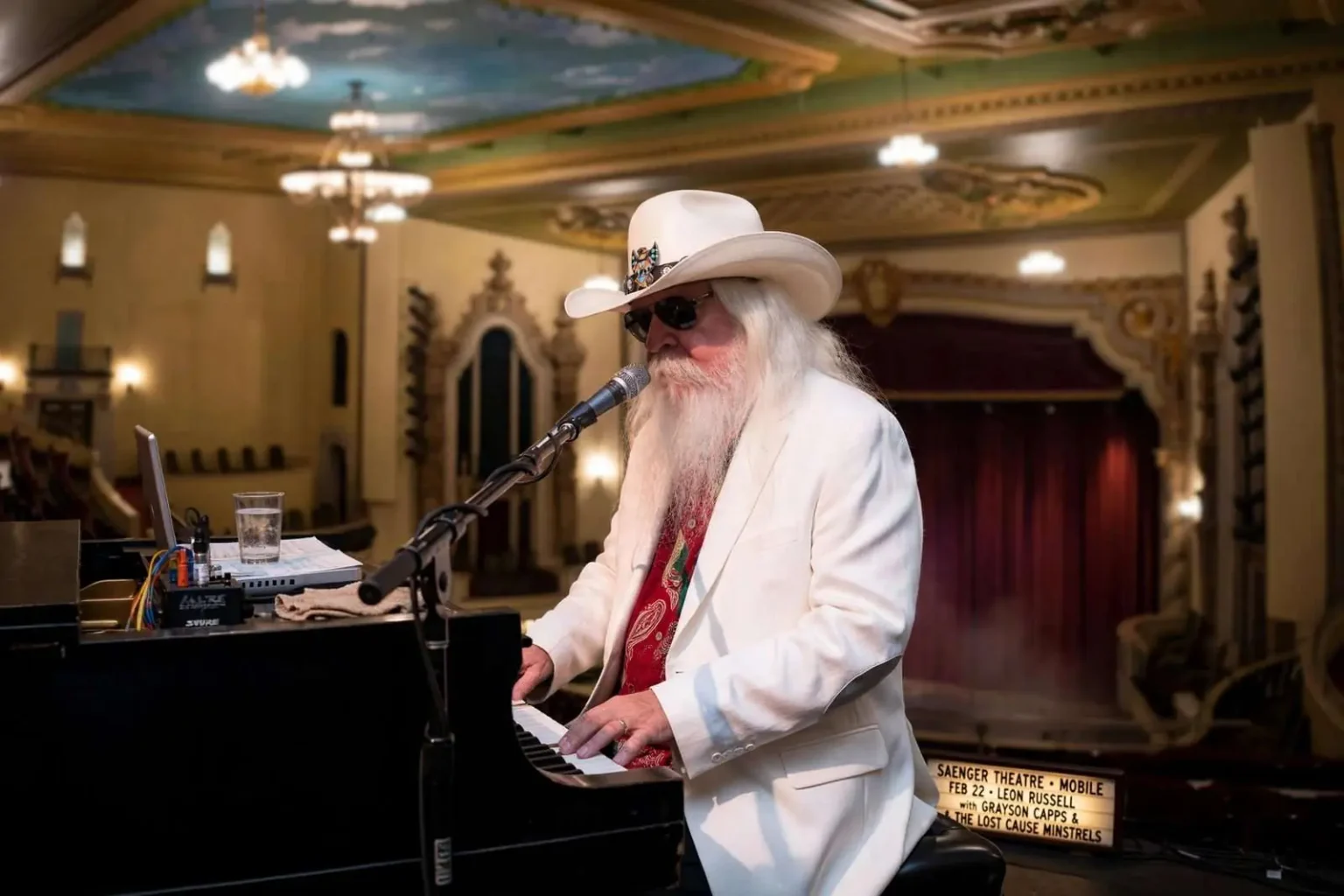
Leon Russell — the 2011 Rock and Roll Hall of Fame inductee often called “The Master of Space and Time” — brought his legendary catalog to Mobile’s Saenger Theatre on Tuesday, Feb. 22, with Fairhope’s own Grayson Capps and The Lost Cause Minstrels on the bill. Tickets ran $25 and $55 plus service charges, with the premium seats in very limited supply. The pairing gave south Alabama audiences two Gulf Coast-connected acts on one stage: the Oklahoma-born session legend whose songs have been covered by generations of stars, and the Fairhope songwriter whose own career runs through Nashville and New Orleans.
Few musicians could match Russell’s reach across popular music. Over a 50-year career he played on, arranged, wrote and produced records spanning pop, rock, blues, country, gospel and surf — collaborating with Glen Campbell, Willie Nelson, George Harrison, Eric Clapton, Bob Dylan, Ringo Starr, B.B. King, Frank Sinatra, Aretha Franklin and hundreds more. The list reads like a map of twentieth-century American music, and Russell appears on it not as a guest but as a working musician who was in the room when much of it was made.
He broke through as a session player on hundreds of 1960s hits, joined the house band of ABC’s “Shindig!” in 1964, then co-produced and played multiple instruments on Joe Cocker’s 1969 album “Joe Cocker!” The Shindig! residency put him in front of national television audiences weekly at an age when most sidemen were still working club dates, and the Cocker album — on which Russell played bass, guitar and piano while co-producing — launched one of the most distinctive voices of the era with Russell’s arrangements underneath it.
A Resume Unlike Anyone Else’s
In 1970 he founded Shelter Records and released a solo debut stacked with Clapton, Winwood, Harrison and members of the Beatles and Stones, featuring “A Song For You,” “Hummingbird” and “Delta Lady.” The self-titled album established the persona that carried him through the decade — top hat, long hair, beard, and a piano style that moved between gospel thunder and country restraint — and “Delta Lady,” written for Rita Coolidge, became one of the era’s signature songs. Shelter, the label he co-founded in Tulsa, gave other Oklahoma and Texas artists a national outlet from its base.
His songs became hits for others: the Carpenters took “Superstar,” which he wrote with Bonnie Bramlett, to No. 2; Ray Charles recorded “A Song For You”; and George Benson’s cover of “This Masquerade” won the 1976 Grammy for Record of the Year while topping the jazz, pop and R&B charts simultaneously — a first in music history. The songwriter’s paradox defined Russell’s commercial standing: for stretches of the 1970s his own records sold steadily, but his compositions, sung by others, filled radio across formats that his own gravel-voiced delivery never fully cracked.
Russell joined Harrison for the 1971 Concert for Bangladesh at Madison Square Garden, where his “Jumpin’ Jack Flash/Youngblood” medley was considered a highlight of the Grammy-winning album. The benefit concerts, staged before the modern charity-telethon playbook existed, brought the ex-Beatle together with Dylan, Clapton and Russell at the height of their powers, and the live recording preserved Russell’s medley — stitching a Rolling Stones rave-up to a Don Gibson country ballad — as one of the event’s most talked-about moments.
His 1972 “Carney” was his best seller, Billboard named him the top concert attraction of 1973, and his duet era with Willie Nelson produced “One For The Road,” whose “Heartbreak Hotel” won a 1980 Grammy. The Nelson partnership, cut live across a string of shows, captured two road veterans trading verses at full stride, and the pairing’s easy rapport — gospel piano meeting Nelson’s guitar — carried Russell into the country market that his Tulsa roots had always pointed toward.
A Late-Career Resurgence
The Saenger date came amid a remarkable resurgence: Russell performed at the 2010 Grammys with the Zac Brown Band, honored Neil Young at MusiCares alongside Elton John, and had just released “The Union,” a duet album with John produced by T-Bone Burnett. For Gulf Coast fans, the chance to see a living architect of rock history — with Capps opening — made for one of the season’s most anticipated nights.
The revival had begun in earnest when Elton John, a lifelong admirer, sought Russell out for the duet project. “The Union” reunited the two pianists — John had opened for Russell’s bands early in his American touring career — and the album drew some of the strongest reviews of Russell’s late career, putting him back on festival stages and theater circuits nationwide. The Mobile stop sat squarely on that renewed routing, bringing the full catalog to a theater built for exactly this kind of show.
The Saenger itself is part of the draw. The 1927 movie palace on Joachim Street reopened after an extensive restoration and has since served as downtown Mobile’s premier concert hall, hosting touring legends in a room whose acoustics flatter a grand piano. For a performer of Russell’s generation, the venue is the right size — a few thousand seats, close enough that the audience can watch the hands — and longtime Mobile concertgoers have learned that national acts book the Saenger when the music, not the spectacle, is the point.
Grayson Capps and the Gulf Coast Connection
Grayson Capps and The Lost Cause Minstrels brought their own Gulf Coast following to the bill. Capps, a Fairhope native, built his reputation on songwriting that blends blues, country and Southern gothic storytelling, and his sets run on the same raw electric guitar-and-vocals engine that has made him a fixture at venues from the Eastern Shore to New Orleans, where he lived and worked for years. Opening for Russell placed the Minstrels in front of the kind of multigenerational theater crowd that local touring acts rarely see, and the hometown billing — Fairhope’s own opening for one of rock’s architects — gave the night a distinctly Gulf Coast flavor.
The $25 ticket price put the show within reach of the sort of broad audience the Saenger draws for heritage acts, while the $55 premium tier, limited in supply, served the fans who wanted the closest view of the piano. Service charges aside, the range covered students who knew Russell’s songs through covers and older fans who bought his records the first time around — an overlap that has defined his audiences for decades.
Russell’s catalog gave the Mobile audience a set list drawn from six decades: the Shelter-era staples, the Cocker associations, the Nelson duets, and the songwriter’s standards that other artists made famous. For listeners who came of age on “A Song For You” or discovered “Delta Lady” through its endless covers, hearing the originals from the man who wrote them — in a restored 1927 theater on a Tuesday night in February — is the kind of appointment south Alabama audiences rarely get twice.
The Session Man Behind the Hits
To understand Russell’s standing among musicians, it helps to start before the fame, in the studios of 1960s Los Angeles. The session players who anchored the era’s records worked at a pace modern listeners can barely imagine — song after song, genre after genre, in a single day — and Russell moved through that world as one of its most versatile hires. He could read, arrange, and play multiple instruments on the same session, which is why producers called him for surf records, country sessions and pop dates alike, and why “hundreds of 1960s hits” is not an exaggeration of his discography but a fair count of it.
The Tulsa-to-Los Angeles path also explains the range. Russell came up in Oklahoma’s music scene, where western swing, gospel and rock and roll shared stages, and his early work there — including time in a teen band with future stars — taught him the standards of every style before California’s studios put the range to work. When he finally stepped out front as a bandleader, the persona audiences saw was built on that apprenticeship: a musician who could follow a song anywhere it went.
That versatility is what made the collaborations possible. Harrison, Dylan and Clapton did not invite hired hands to sit in at the Concert for Bangladesh; they invited peers. Sinatra and Aretha Franklin did not lend their voices to songs by casual acquaintances. By the time Russell reached mid-career, his phone list read as a who’s-who of American music, and the Mobile audience on Feb. 22 was hearing the output of exactly that career — a body of work assembled at keyboards and mixing consoles across five decades.
Why the Master’s Legend Endures
The Hall of Fame induction in 2011 put a formal cap on the reputation that musicians had granted decades earlier. Inductions of that kind usually arrive after a critical reappraisal, and Russell’s followed a period in which younger artists had begun citing him as a foundational influence — rediscovering the Shelter records, covering the songs, and crediting the arrangements they had grown up hearing secondhand. The resurgence that brought him back to theaters like the Saenger was built by that generation as much as by the original fans.
The nickname attached to him — “The Master of Space and Time” — came from the musicians who worked with him, and it describes the range rather than the showmanship. A Russell performance moved from blues to gospel to country within a single set, led from the piano bench, with the bandleader deciding in real time where each song would go. For audiences in Mobile, that meant a Tuesday night show that would not resemble any other date on the tour, delivered by a man who had spent half a century refusing to stay in one genre.
Tickets for the Feb. 22 date were available through the Saenger box office and its usual outlets, and the premium $55 seats were described as very limited in supply — the expected pattern for a heritage act in a theater the size of the Saenger. The show joined a winter schedule that has made downtown Mobile a regular stop for touring legends, with the Saenger’s restored house offering the kind of room that keeps such bookings coming back to the Gulf Coast.


