
‘Rockstars of Chamber Music’: Diotima String Quartet Performs at the University of South Alabama
France's acclaimed Diotima String Quartet brought contemporary and classical chamber music to the University of South Alabama on Jan. 30, 2011.
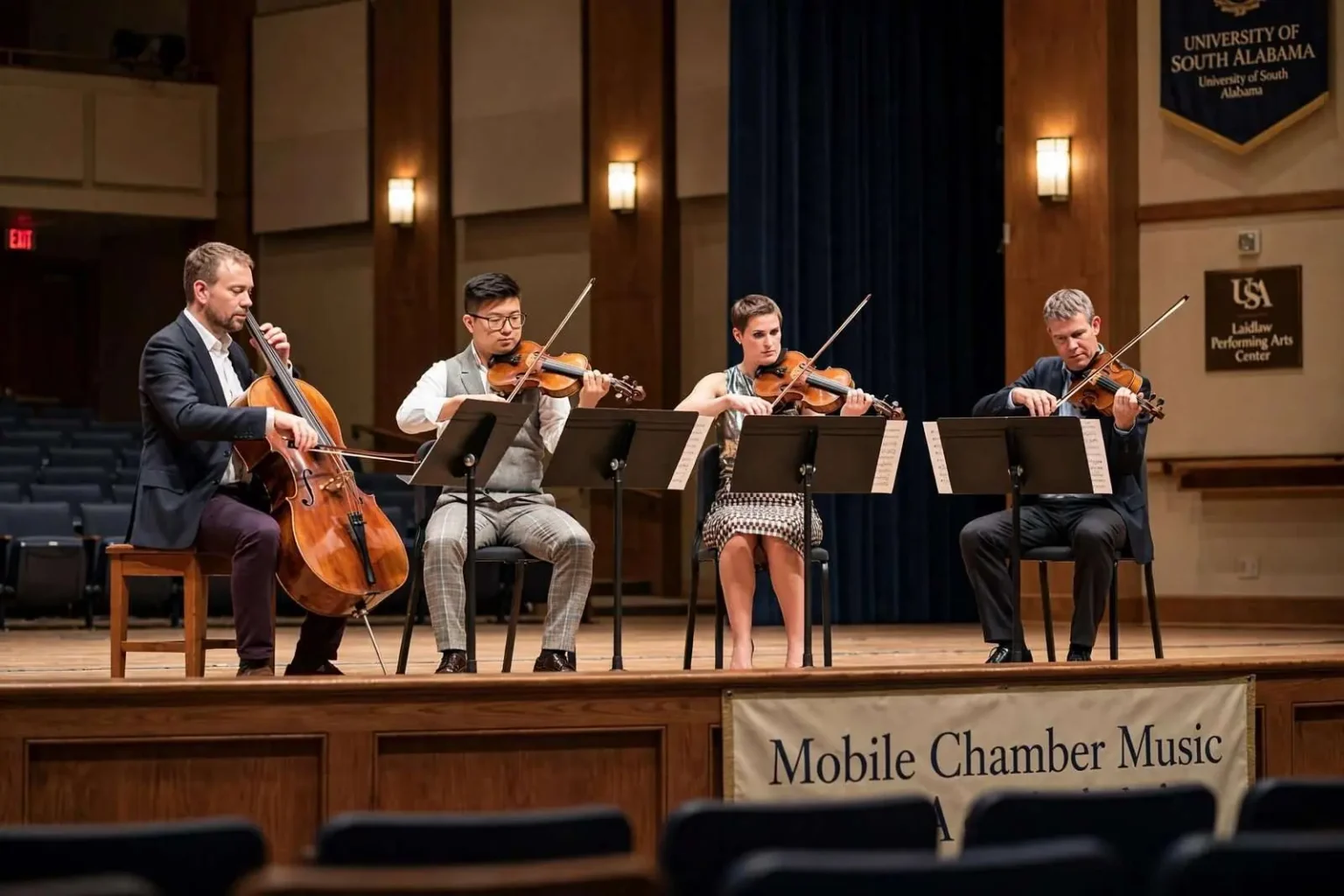
The Diotima String Quartet, a Paris-based ensemble hailed by the French newspaper Le Figaro as “the most serious hope for chamber music in France,” performed at the University of South Alabama’s Laidlaw Performing Arts Center on Sunday, Jan. 30, 2011, at 3 p.m. The concert was a presentation of Mobile Chamber Music, which has long made touring ensembles of international standing a regular part of the Gulf Coast’s cultural calendar. For Mobile audiences, the Sunday-afternoon program offered a rare chance to hear a group that French critics consider among the finest string quartets of its generation, in a hall small enough to hear every internal voice of the ensemble clearly.
France’s most promising quartet
On a Mobile stage built from graduates of the Paris and Lyon Conservatories, Diotima has made its name by pairing contemporary music with the classical and romantic string quartet canon. That pairing is not a marketing gimmick but a stated mission: to perform the music of our time in context rather than in isolation. The quartet’s founders, violinists Gianluca Caglioti and Luc-Marie Aguera, came together in 1996 with a generation of young French-trained players determined to treat new scores with the same interpretive seriousness that audiences expect of Haydn, Beethoven or Brahms. The ensemble took its name from the ancient Greek concept of diotime, the dialogue of love that Plato placed at the center of philosophical life, and that spirit of conversation — between player and player, and between old and new music — has defined its work ever since.
French critics have been unusually emphatic about the ensemble’s stature. Le Monde put it plainly: good quartets are swarming in France, “but the Diotima Quartet is probably one of the best and the most promising.” Coming from a national paper that reviews dozens of young ensembles each season in a country with one of the world’s deepest chamber music traditions, the assessment carried weight. Le Figaro’s phrase — the most serious hope for chamber music in France — reflected a similar judgment: that among the many capable quartets emerging from French conservatories, Diotima was the one with the combination of technical command, repertoire ambition and interpretive personality to matter on the world stage.
The quartet’s rise tracked a broader revival of the string quartet as a living art form in Europe. Where earlier generations sometimes treated the medium as a museum of classic repertoire, the French school of the 1990s and 2000s deliberately commissioned, championed and recorded new work while maintaining a rigorous command of the canon. Diotima became one of the leading exponents of that approach, and its recordings spanned a striking range, pairing central works of the repertoire with major contemporary scores. The group’s recording activity earned significant critical notice in Europe and helped build the international reputation that brought it across the Atlantic.
Because the ensemble’s base is Paris, American audiences see it far less often than European ones, and appearances in the southeastern United States are rarer still. That context made the Laidlaw engagement notable for serious chamber music listeners in the region: a chance to hear, without traveling to New York or Chicago, an ensemble whose name appears regularly in the European press and whose schedule is anchored by the continent’s most important rooms.
A touring resume that reads like a map of Europe’s great halls
The group’s touring resume reads like a map of Europe’s great halls. Diotima has performed in the Philharmonie and the Konzerthaus in Berlin, at Madrid’s Museo Reina Sofia, at the Cité de la Musique and the Opéra Bastille in Paris, and at London’s Wigmore Hall — a venue whose history as a shrine to chamber music makes an invitation there a marker of international standing for any quartet. The ensemble has also appeared at most of the continent’s major festivals, the competitive circuit of summer and seasonal programming where presenters from around the world scout the groups they will book in future seasons.
Touring at that level requires more than critical praise. A quartet that sustains engagements in Berlin, Madrid, Paris and London must maintain a repertoire deep enough to satisfy sophisticated subscribers in each city while remaining fresh for the players themselves. Diotima’s answer has been its signature breadth: programs that set a contemporary score beside a late Beethoven or a Schubert, so that each illuminates the other. The approach has also made the quartet a sought-after collaborator for living composers, who value performers capable of learning difficult new music quickly and presenting it persuasively to audiences who may never have heard it before.
For American presenters, booking a European quartet of this standing involves considerable logistics, and performances outside the largest markets are correspondingly scarce. Mobile Chamber Music’s ability to present Diotima reflected both the organization’s standing in the national presenting network and the value it places on giving local audiences direct contact with world-class interpreters rather than recordings of them.
What the engagement meant for Mobile audiences
The Laidlaw Performing Arts Center, home to USA’s Department of Music, was designed with chamber performance in mind. Its concert hall places listeners close to the stage, and its acoustics favor the clarity that string quartets depend on: the ability to hear the second violin’s inner lines, the viola’s low colors and the cello’s bass foundation as distinct contributors to a single conversation. An ensemble that plays the Philharmonie in Berlin before thousands adjusts naturally to rooms of a few hundred, and many chamber musicians argue that smaller halls suit the repertoire best, restoring the intimacy for which the quartet literature was written.
Mobile Chamber Music, the presenting organization, has operated for decades as a volunteer-driven fixture of the city’s cultural life, bringing professional ensembles to the Gulf Coast season after season. Its series has historically drawn a devoted audience of subscribers — listeners who attend the full season rather than single concerts — along with students and faculty from the university community. Presentations like the Diotima concert serve both constituencies: subscribers hear a group they might otherwise know only through recordings, while students at USA encounter working international artists at close range, an experience university music programs regard as an essential complement to studio instruction.
The Sunday-afternoon timing reflected the presenter’s long-standing format, which keeps the concerts accessible to families, retirees and out-of-town visitors alike. An afternoon start also suits visiting ensembles, which typically fly out the same evening or continue to the next city on the tour, making Mobile one stop on a regional run that may include university series and chamber societies across the Southeast.
Part of an ongoing series on the Gulf Coast
The Diotima performance was part of USA’s ongoing effort to bring world-class chamber music to the Gulf Coast, a commitment that has made the university a partner to independent presenting organizations and a resource for the wider community. Universities along the Gulf Coast have increasingly taken on that role, since their halls, faculty and student bodies give touring artists both a venue and an audience, while the surrounding communities gain cultural offerings that a city of Mobile’s size might not otherwise attract.
The value of such visits extends beyond the concert itself. Chamber music depends on the kind of concentrated, face-to-face listening that recordings approximate only partially, and presenters in mid-sized cities argue that every opportunity to host a major ensemble builds the local audience for the art form. A student who hears a quartet of international reputation in person experiences the genre differently than one who encounters it only in class or on a streaming service — the physical presence of four players communicating in real time is, for many listeners, the moment chamber music stops being an abstraction.
For the region’s amateur and professional musicians, meanwhile, a visit from an ensemble like Diotima functions as informal professional development. String players in school and community orchestras along the Gulf Coast study the same repertoire the visitors perform, and observing how a touring quartet rehearses, balances dynamics and shapes phrases offers instruction no textbook provides. Music educators in the area have long argued that the health of local orchestras and school programs depends in part on students seeing the highest level of the art live.
The Jan. 30, 2011, concert also fit a broader pattern in the way Mobile’s cultural institutions operate. The city supports a network of presenting organizations — in classical music, jazz and the visual arts — that rely on partnerships with the university and on season subscribers to keep world-class programming economically viable. Each successful engagement strengthens the case for the next, and a critically celebrated ensemble’s appearance in Mobile signals to other artists and their managements that the Gulf Coast is a market worth including on future tours.
For the quartet itself, the stop offered the opportunity to carry its mission — contemporary music heard in the company of the classics — to an audience likely hearing it for the first time. That evangelical aspect of touring is one of the reasons ensembles of Diotima’s standing accept engagements outside the major capitals: the music’s future depends on listeners who have never been to the Cité de la Musique as much as on the subscribers of Berlin and Paris. On a Sunday afternoon in Mobile, in a hall built for exactly this kind of listening, the conversation between four Paris-trained string players and a Gulf Coast audience was the continuation of a tradition that has sustained chamber music for more than two centuries — four instruments, no conductor, and a room full of people hearing what happens when the repertoire of the past and the music of the present are placed side by side and asked to speak to one another.


