
Rumor Union Launches The Hive, a Shared Art Studio in Downtown Mobile
Rumor Union opened The Hive, a shared community art studio in downtown Mobile, offering affordable workspace and a bicycle co-op.
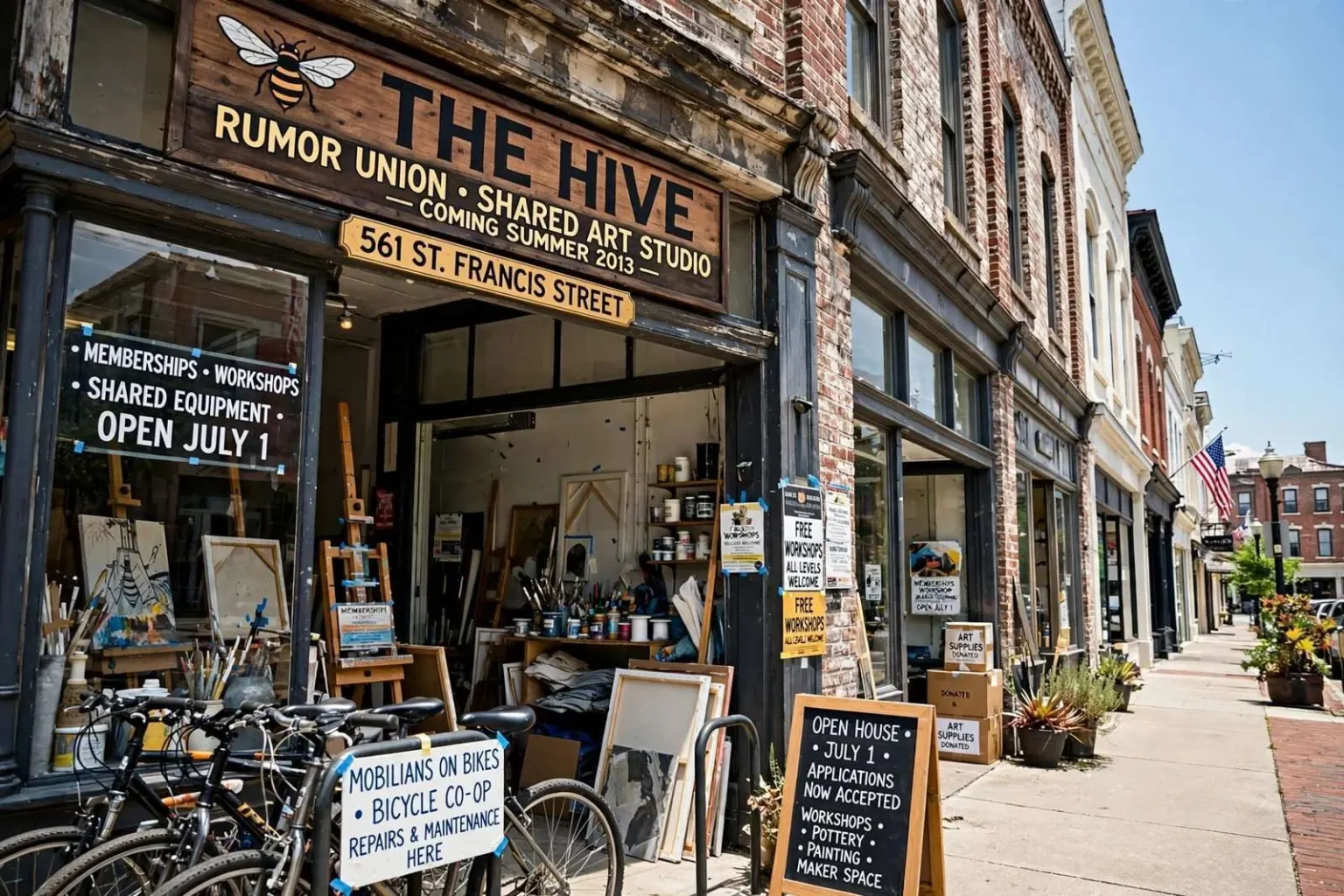
A new creative hub was taking shape in downtown Mobile in the summer of 2013, as the arts organization Rumor Union announced plans to open The Hive, a community art studio at 561 St. Francis Street. The announcement added a dedicated artists’ workspace to the blocks around St. Francis Street, where the city’s historic core was beginning to accumulate exactly the kind of creative infrastructure that downtown advocates had spent years calling for.
The Hive was designed as an interdisciplinary workspace where artists of all backgrounds could work side by side in a supportive, collaborative environment. The model — one building, many disciplines — reflected a nationwide trend in which shared studios replaced the isolated artist’s garret, putting painters, makers and craftspeople at adjacent tables where ideas cross-pollinate as a matter of proximity.
Rather than simply offering studio space, the concept aimed to foster a creative community where members could experiment, share ideas, and learn from one another across artistic disciplines. That distinction — community first, square footage second — was the organizing principle behind the project and the reason its founders sought a location in the middle of downtown rather than in cheaper space on the outskirts.
Membership and what it included
Membership in The Hive included access to shared materials and equipment, free educational workshops, and secure parking in the downtown area — amenities intended to remove common barriers that working artists often face when trying to maintain a dedicated studio practice. Each element addressed a specific obstacle: the cost of tools that an individual artist rarely uses often enough to justify buying, the price of continuing education, and the practical difficulty of parking near a downtown workplace.
The shared-equipment approach meant that a member could work with tools and materials far beyond what a solo studio budget would allow, while the workshop schedule promised ongoing skill-building without tuition. For artists who had been working out of spare bedrooms and garages across the city, the package represented a genuine upgrade in both resources and professional environment.
Secure parking, an unglamorous amenity, was a pointed choice for a downtown Mobile address. Artists hauling canvases, clay, tools and finished work need to load and unload near their workspace, and the inclusion of parking in the membership acknowledged the logistical realities that often decide whether a downtown studio is practical at all.
Partnerships Broaden the Offering
Rumor Union also announced partnerships with other local organizations to expand what The Hive could offer its members. The group teamed up with Mobilians on Bikes to incorporate a bicycle co-op at the St. Francis Street location, reflecting the growing cycling culture in downtown Mobile at the time. The co-op gave members and neighbors a place to maintain and repair bicycles, aligning the art space with the transportation and lifestyle movement gaining ground among young Mobilians.
Additionally, a collaboration with Portal Studios gave ceramicists access to specialized pottery and ceramic facilities, rounding out the range of artistic disciplines the space could support. Ceramics requires kilns, wheels and dedicated workspace that a general studio cannot easily accommodate, and the partnership let The Hive offer that capability without building it from scratch.
Affordable Access for Working Artists
Organizers emphasized that membership pricing was structured to be accessible for working artists, with applications set to open on July 1, 2013. The pricing decision flowed from the project’s premise: a studio that only established artists could afford would not build the kind of mixed community the founders described, so the rate structure had to work for artists early in their careers and working on modest incomes.
The emphasis on affordability placed The Hive alongside the artist-run spaces that had begun appearing in downtown Mobile, from galleries in renovated storefronts to pop-up exhibitions in vacant buildings. Those efforts shared a diagnosis — that the city’s creative talent was producing work without adequate space to make and show it — and a prescription: cheap, central space run by and for artists themselves.
Applications opening July 1 gave Mobile’s artists a concrete date to act on, and the summer launch positioned The Hive to be operating as the city’s arts calendar moved into its fall season, when gallery nights and cultural events draw the crowds that a new studio needs to introduce itself.
Creative placemaking in downtown Mobile
The initiative represented part of a broader trend of creative placemaking in downtown Mobile, as artists and arts organizations sought affordable spaces in the city center to build community and sustain their practices. Creative placemaking — the practice of anchoring neighborhood revitalization in arts and cultural activity — had become a national talking point by 2013, and downtown Mobile’s mix of historic buildings and available space made it fertile ground for the approach.
The St. Francis Street corridor, steps from Bienville Square and the heart of the central business district, offered the walkable, mixed-use setting that such projects depend on. Every new tenant of the kind The Hive represented added foot traffic and activity to blocks that had seen too little of both after business hours, which is why downtown advocates tracked each such opening as a marker of progress.
Rumor Union, the arts organization behind the project, positioned The Hive as infrastructure rather than a one-off event — a permanent place where the city’s creative energy could accumulate instead of dispersing. The distinction mattered for a local arts scene that had plenty of energy but, until then, too few places to concentrate it.
What a shared studio changes for an artist’s practice
For working artists, the difference between a kitchen table and a dedicated studio is often the difference between a hobby and a practice. A fixed workspace allows larger projects, messier materials and the kind of continuity that making serious work requires, and the surroundings matter as much as the space itself: artists who work alongside others report more finished projects, more experimentation and more exhibitions than those who work alone.
The Hive’s interdisciplinary design leaned into that dynamic. A ceramicist working beside a painter, or a maker learning welding from the artist at the next table, picks up techniques and standards that formal education charges tuition to teach. The free workshops built into the membership formalized that exchange, giving members a scheduled way to learn while the day-to-day proximity did the same work informally.
The shared materials and equipment pool also flattened one of the starkest barriers in the arts: startup cost. Equipment that sits idle most of the week for one artist serves many when it is shared, and the collective buying power of a membership lowers the cost of materials for everyone. The model has proven effective in cities across the country, and Mobile’s version brought it to a downtown address at a moment when the city’s creative community was actively organizing.
The bicycle co-op and the culture around it
The inclusion of a bicycle co-op through Mobilians on Bikes said as much about the community The Hive hoped to build as any studio amenity. Cycling had been growing in downtown Mobile, with advocates pushing for better infrastructure and a culture that treated the bicycle as transportation rather than recreation alone. A co-op gives riders the tools, stands and shared knowledge to maintain their own bikes, and it draws the same do-it-yourself crowd that community studios do.
Placing the co-op inside an art building reflected the mixed-use instincts of the generation behind the project: one space serving work, transport and community at once, rather than single-purpose venues that sit empty most of the week. For The Hive’s founders, the co-op made the St. Francis Street address a destination for more than artists alone.
A summer launch for a longer project
With applications opening July 1, 2013, Rumor Union gave The Hive a launch window that preceded Mobile’s busiest cultural months. The fall season brings gallery nights, performances and the beginnings of the social calendar that runs through Mardi Gras, and a new studio entering that cycle with members already at work would have the chance to show its output to the audiences those events gather.
The project’s success would be measured, in the end, by the simplest metrics: whether artists applied, whether they stayed, and whether the space at 561 St. Francis Street became part of the routine of downtown’s creative life. The plan — affordable rates, shared resources, workshops and partnerships — was built to make those outcomes likely, and its announcement in the summer of 2013 marked one of the clearest statements yet that Mobile’s artists intended to build their own infrastructure downtown.
Downtown Mobile in 2013 was still assembling the pieces that would define its next decade, and The Hive arrived as one of the first purpose-built answers to a question the city’s artists had been asking for years: where were they supposed to work? The answer, announced that summer, was 561 St. Francis Street — a place to make, learn and belong in the heart of the city.


