
Rumor Union’s ‘Freelance Auction’ Puts Mobile Talent on the Block at The Blind Mule
Mobile's Rumor Union auctions skilled labor from local artists and tradespeople at The Blind Mule in LoDa on Tuesday, October 11, 2011.
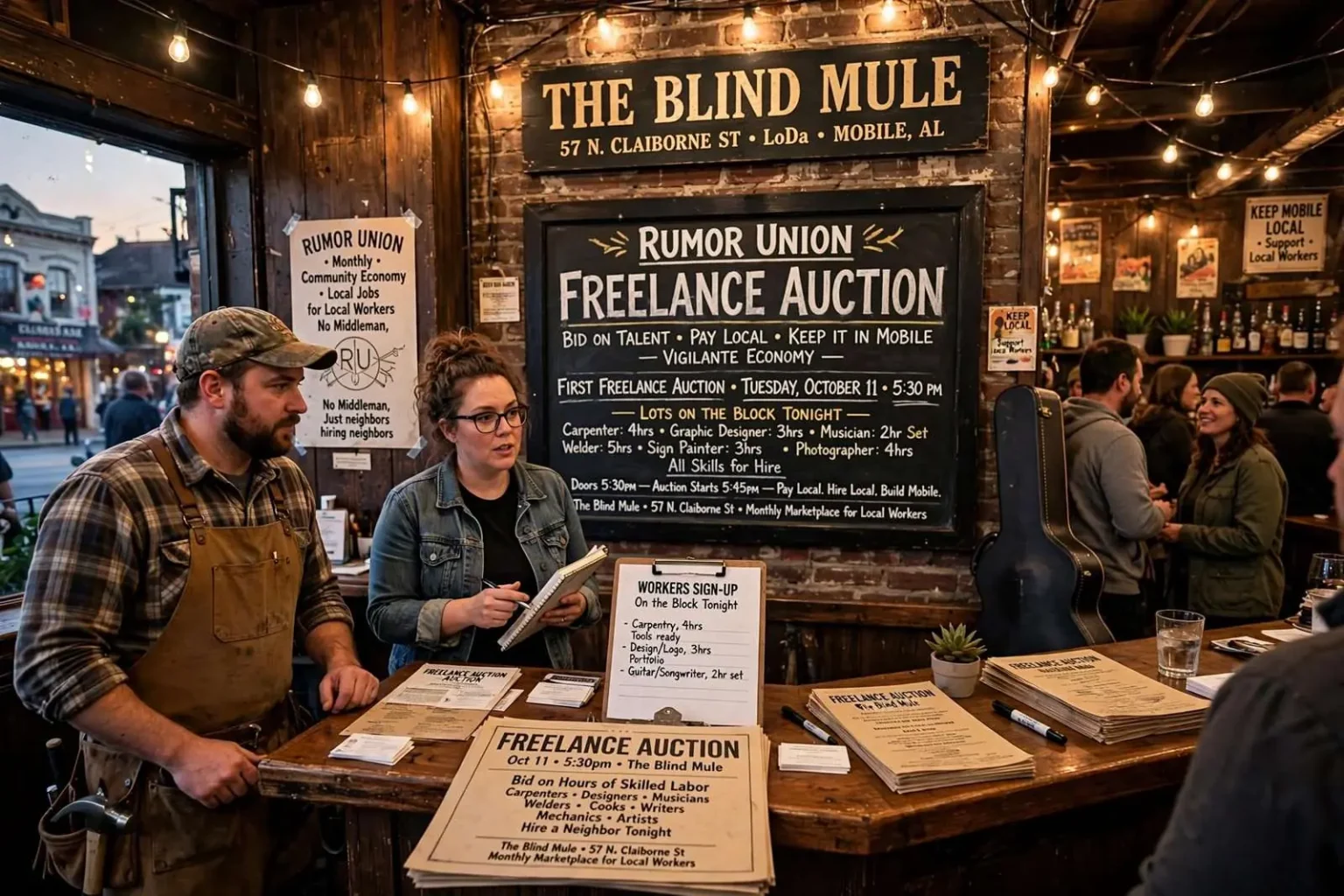
The Rumor Union, the Mobile arts collective behind this summer’s Dance-Off, plans a different kind of auction: one where the lots are hours of skilled labor from the city’s craftspeople, artists and trades workers. The first Freelance Auction is set for Tuesday, October 11, at 5:30 p.m. at The Blind Mule, 57 N. Claiborne St., in the LoDa district. Organizers describe it as a monthly networking event meant to bind together Mobile’s locally owned and homegrown community — what they call an act of “vigilante economy” in a waning economic climate marked by budget cuts at cultural institutions and jobs migrating overseas or to automation.
The premise is simple but pointed. Instead of an auction where bidders walk away with antiques or artwork, attendees at the Freelance Auction bid on the time and talent of the people in the room — a carpenter’s hours, a designer’s eye, a musician’s set. Winning a bid means hiring a neighbor, and being on the block means picking up work from people who live and spend in the same city. Organizers are pitching the evening as the antithesis of the standard business-card exchange: rather than collecting contacts and hoping something comes of them, participants can put money in a local worker’s pocket before the night is over.
The concept works both directions, and that symmetry is central to how the Rumor Union frames it. Skilled workers get what organizers call insta-cash for insta-capable people — immediate payment for demonstrated ability, with no application forms, temp agencies, or waiting periods in between. Local business owners, meanwhile, build relationships with the talent pool doing the bidding. A restaurant owner who hires a sign painter on the spot, or a shop owner who books a musician for the weekend, has converted a networking event into a working arrangement in a single evening. The auction format forces both sides to be concrete about what they need and what they can do, which organizers argue makes it more productive than the typical mixer.
A Collective With a Track Record
The Freelance Auction arrives with momentum behind it. The Rumor Union already made its mark on Mobile’s summer calendar with the Dance-Off, the kind of participatory, low-cost event the collective has specialized in — gatherings that turn empty or underused venues into destinations and give the city’s creative class a reason to show up together. That track record matters for an event like this one, since an auction is only as good as its crowd. A collective that can reliably fill a room with artists, makers, and the business owners who hire them has solved the hardest part of the problem before the first lot is called.
The choice of venue reinforces the local-first message. The Blind Mule, on North Claiborne Street in the LoDa district, is part of the fabric of downtown Mobile’s arts and entertainment corridor, a neighborhood whose name — short for Lower Dauphin — has become shorthand for the city’s galleries, music venues, and locally owned bars and restaurants. Holding the auction in a homegrown business, on a Tuesday night when venues are otherwise quiet, fits the collective’s pattern of programming that supports the establishments willing to host it. Attendees who come for the auction end up buying drinks and food from another independent local operation, extending the evening’s keep-it-local logic one step further.
The Economics Behind the Idea
Organizers are explicit that the event is a response to hard economic conditions. The “vigilante economy” language they use is a self-aware joke with a serious core: when institutional funding shrinks and stable jobs disappear, the community’s answer is to take economic development into its own hands, one direct hire at a time. Budget cuts at cultural institutions hit artists and arts workers first, and the migration of manufacturing and service work overseas or to automation has narrowed the options for skilled trades people across the Gulf Coast. An event that converts social connections into paid gigs, the collective argues, is one practical counterweight to forces no single worker can control.
The timing also reflects the rhythm of Mobile’s fall season. October brings a full slate of festivals, art walks, and holiday-season preparation, when businesses of every size need extra hands — decorators, performers, caterers, carpenters, designers — and when freelancers are looking to line up work before the end of the year. A Tuesday, October 11 event sits early enough in the month for hires made that night to turn into real work before the season peaks. For owners of small shops and restaurants, the ability to meet, evaluate, and book talent in one evening can save weeks of scattered phone calls and half-remembered introductions.
The skill sets expected on the block are as varied as Mobile’s creative workforce. A carpenter and a designer were the examples organizers reached for first, but the logic extends to photographers, tailors, mechanics, welders, writers, web builders, cooks, and anyone whose craft can be bought by the hour. That breadth is deliberate: the collective’s aim is to represent the whole homegrown economy, not just the arts scene it grew out of. An attendee might arrive looking for a musician for a wedding and leave having also booked a fence repair, with both deals made face to face among neighbors rather than through anonymous listings.
Built to Last Beyond One Night
Organizers say the event aspires to be a recurring monthly fixture, part of a fall slate of Rumor Union programming aimed at sustaining Mobile’s creative workforce. That ambition sets the Freelance Auction apart from a one-off fundraiser or party. A monthly cadence gives the local economy something it rarely gets: a dependable, recurring marketplace where supply and demand meet on a schedule. Workers who pick up gigs in October can return in November with a reputation; business owners who made a good hire can come back for more. Over time, the organizers hope, the auction functions less like an event and more like an institution — a standing demonstration that Mobile’s local talent can support itself without waiting on outside investment.
The underlying bet is that proximity and trust are economic assets. National studies of local spending have long shown that dollars paid to local workers and owners circulate through the community at higher rates than dollars sent to distant corporations, and Mobile’s own LoDa revival — built largely by independent gallery owners, restaurateurs, and musicians taking chances on downtown space — is a local case study in the same principle. The Freelance Auction is designed to accelerate that circulation at street level, where it is easiest to see: a bid, a handshake, a job done, and a paycheck that stays in town.
For the Rumor Union, the evening at The Blind Mule is also a statement about what the collective is for. The Dance-Off proved the group could mobilize the city’s creative community for a night of spectacle; the Freelance Auction tests whether that same community can mobilize for each other’s livelihoods. If the first edition fills the room on October 11 and the hires made there turn into repeat work, the collective will have a model that other Gulf Coast cities have tried in various forms — and Mobile will have one more reason its locally owned scene punches above its weight.
How the auction itself will run reflects the casual, fast-moving spirit of the event. Unlike a formal charity auction with numbered paddles and an auctioneer calling minimum bids, a freelance auction lives or dies on how quickly attendees can hear what a worker offers, judge whether they need it, and bid accordingly. The hours on offer are flexible — a winning bid is essentially a deposit on a working relationship, with the details of when and where the job gets done settled between the parties directly. That informality lowers the stakes for first-time bidders, who can try the format with a small bid on a service they already know they need, and it keeps the evening’s pace quick enough to put a long list of workers on the block in a single sitting.
The event also arrives at a moment when Mobile’s independent venues and cultural groups have had to get creative about survival. With institutional funding tightened across the board, the organizations and businesses that make up the city’s arts economy increasingly rely on earned income — ticket sales, table service, commissions, and freelance work — rather than grants. Events that put paying customers in front of working artists serve everyone in that chain: the venue gets a Tuesday-night crowd, the workers get booked, and the collective builds the mailing list and goodwill it needs to keep programming through the winter. The Freelance Auction is that cycle compressed into one evening.
Admission details for the October 11 event follow the collective’s usual low-barrier approach, with the doors at The Blind Mule opening for the 5:30 p.m. start. Workers who want to be auctioned are encouraged to come ready to describe what they can do and roughly how many hours they can offer, while buyers should arrive with a short list of jobs they have been meaning to fill. Organizers have stressed that no one needs to be a member of the collective to take part — the auction is open to the whole community, on the theory that the more people in the room, the more likely it is that every worker on the block goes home with work.


