Sandy Stimpson Pens Final Message to Mobile as 12-Year Mayoral Tenure Ends
Outgoing Mobile Mayor Sandy Stimpson reflects on 12 years in office, citing crime reduction, debt payoff and major projects.
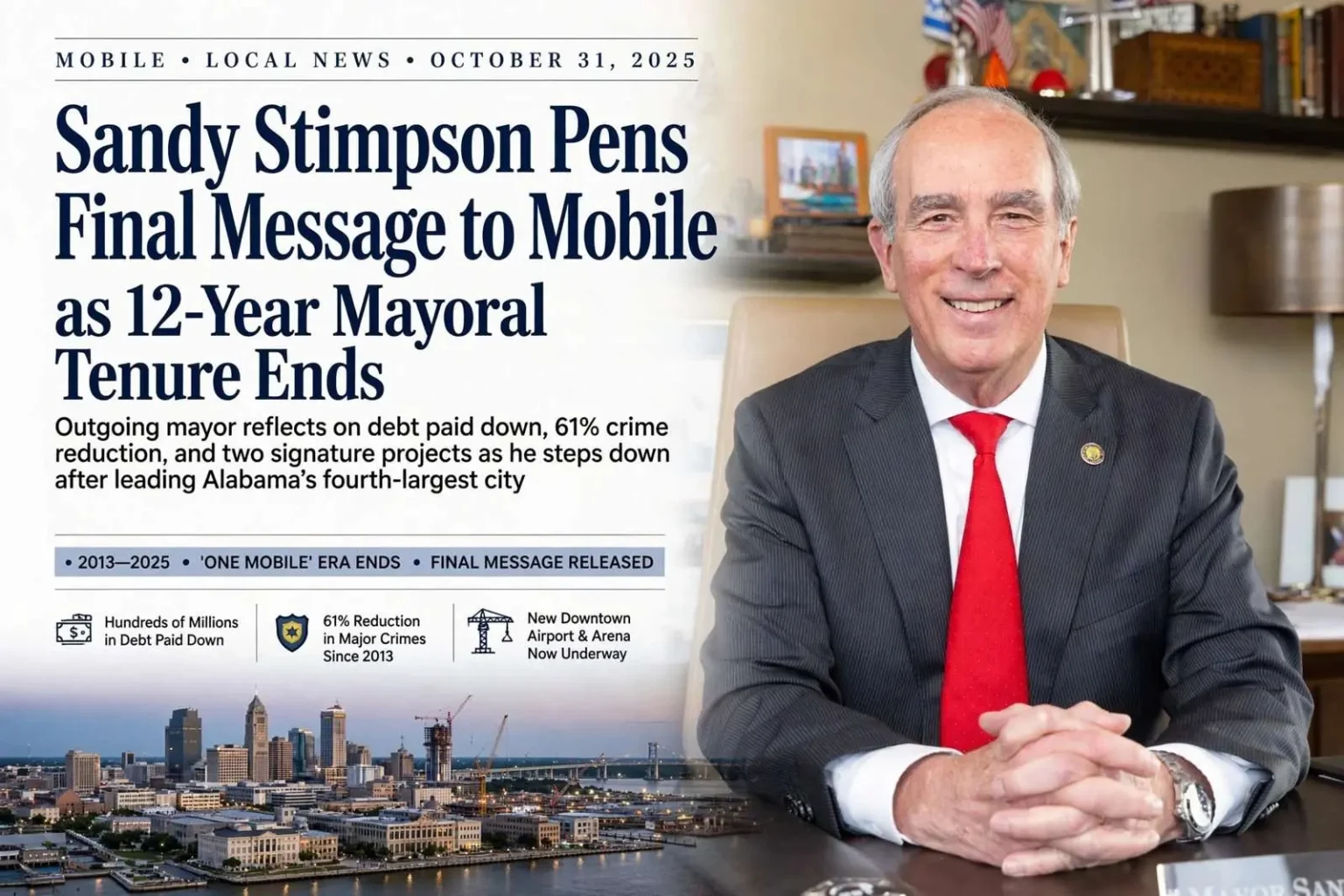
Sandy Stimpson’s run leading the City of Mobile came to a close at the end of October, and the night before his final day in office, the two-term mayor used his newsletter to reflect on a dozen years of running Alabama’s fourth-largest city. The message — part goodbye, part ledger — walked readers through the city he inherited in 2013 and the city he leaves behind, written in the plain, workmanlike voice that has defined his public career.
In the farewell message, Stimpson thanked his staff, his family, and — repeatedly — his faith, saying he often prayed for the people and resources needed to transform Mobile. The gratitude was not perfunctory. Mayors of big cities rarely govern alone, and Stimpson’s tenure was built on a administration of department heads, engineers, and career employees who carried out the long, unglamorous work of turning around a city’s finances and infrastructure. His closing reflections framed the last twelve years as a shared effort, carried out with what he described as a conviction that the job required help beyond City Hall’s walls.
Stimpson, a civil engineer by training who entered politics late after a business career, first took office in 2013 on a “One Mobile” platform aimed at making the city safer and more business- and family-friendly. He won re-election in 2017 and again in 2021, making him one of the longer-serving mayors in modern Mobile history. The platform’s themes — unity across neighborhoods, fiscal repair, and a customer-service orientation toward city government — remained the through-lines of his three terms, and his farewell letter returned to them one last time.
A ledger of accomplishments
Stimpson pointed to a list of markers from his tenure: stabilized city finances, hundreds of millions of dollars in debt paid off, modernized city processes, and what he described as a 61-percent reduction in major crimes. Each of those numbers tells a story. When Stimpson took office, Mobile was carrying heavy debt accumulated over decades and a reputation for fiscal strain; the paydown of hundreds of millions in debt restored the city’s balance sheet and, with it, its ability to borrow for capital projects at reasonable cost.
The crime statistic stands as the most human of the markers. A 61-percent reduction in major crimes over a dozen years, if sustained, represents thousands of fewer robberies, burglaries, and assaults — fewer victims, fewer funerals, fewer neighborhoods held hostage. Mayors have limited direct control over crime rates, which depend on economics, policing strategy, prosecution, and community trust all at once. Stimpson’s administration invested in technology, policing capacity, and blight removal, arguing that a city that looks cared-for is harder to prey upon.
The modernization of city processes, meanwhile, was the least visible but perhaps the most durable change. Permitting, procurement, and payment systems rebuilt around the resident rather than the bureaucracy have a way of outliving any one administration. Businesses that once waited weeks for permits found faster timelines, and residents interacting with city government encountered systems designed to answer questions rather than route them.
Two projects that will define what comes next
He also cited two signature projects now underway — relocating Mobile’s airport to downtown and building a new entertainment arena. Both were set in motion on his watch and will reach completion under his successor, which gives his farewell a forward-looking edge: the argument that his administration planted trees whose shade the next government will enjoy. The airport relocation, moving commercial air service from the west-side field toward the city’s core, is intended to put arriving visitors minutes from downtown hotels, restaurants, and the waterfront — a bet on Mobile’s urban future. The arena, planned downtown, is designed to give the city a modern venue for concerts, events, and the minor-league hockey team that has outgrown its current rink, and to anchor a new wave of private investment around it.
Both projects carry risk as well as promise, and Stimpson’s letter acknowledged implicitly that their success now belongs to others. But their existence — funded, sited, and underway — is the kind of legacy that outlasts a mayor’s term. Infrastructure of that scale takes a decade to conceive and build, and the officials who start it rarely get to cut the ribbon.
Accredited across the board
He highlighted the city’s workforce as well, noting Mobile is one of only two cities in the country with fully accredited police, fire, parks, public works, and finance departments. The claim is a credentialed one: national accreditation bodies evaluate departments against rigorous professional standards — training, equipment, response times, financial controls — and require ongoing review to maintain. Achieving full accreditation across five departments simultaneously is rare precisely because it requires sustained investment in every corner of city government at once, without letting any of them slip.
For residents, accreditation is mostly invisible — until the moment it matters, when the fire crew arriving at a house fire or the public works crew rebuilding a flooded street performs to a national standard rather than a local improvisation. Stimpson’s emphasis on the statistic reflected his engineer’s instinct that systems, and not just personalities, are what make a city function.
A personal goodbye
Stimpson closed with thanks to his wife Jean, his children, grandchildren, and siblings for shouldering the demands of life in public office. The personal note was among the letter’s most revealing passages. Twelve years of mayoral service means twelve years of missed dinners, public scrutiny of family members, and the constant weight of being the city’s most recognizable face. For the family that shared him with the city, the end of his term is their retirement as well.
His departure closes a distinctive chapter in Mobile’s civic history: a mayor who arrived promising to run the city like a business and leave it fiscally sound, and who exits pointing to the balance sheet, the crime numbers, and the cranes over downtown as evidence. The evaluation of that record will continue in the years ahead — as the arena rises, as the airport plan matures, and as the city tests whether the habits of a dozen years have taken permanent root. What is certain is the shape of the goodbye itself: a letter written at night, on the eve of a handover, by a mayor thanking God, his staff, and his family for the chance to do the work.
For Mobile, the transition now belongs to a new administration inheriting a stabilized budget, an ambitious construction pipeline, and the same fourth-largest-city ambitions that brought Sandy Stimpson to City Hall in the first place. The “One Mobile” banner he campaigned under passes on with him — and the test of his twelve years begins now.
The city he inherited in 2013
To understand the ledger, it helps to remember the starting point. The Mobile of 2013 that Stimpson campaigned to lead was a city with strained finances, aging infrastructure, and a downtown that emptied out after five o’clock — a city whose potential along Mobile Bay and the Gulf seemed persistently unfulfilled. City government had grown comfortable with practices that rewarded incumbency over performance, and the business community’s frustration with permitting and city services had become a recurring theme of local elections. Stimpson, running as an outsider with an engineer’s spreadsheets, promised to run the city with the discipline of a private enterprise: measure everything, fix the fundamentals, and let the private sector respond to a government that worked.
The “One Mobile” slogan carried a second meaning as well. Mobile’s politics had long run through neighborhood rivalries and divisions between downtown and west Mobile, between the peninsula communities and the suburbs. A campaign built on one city — rather than one faction — was itself a statement about how the new mayor intended to govern, and it was reflected in the administrations he assembled and the projects he prioritized in every part of the city.
The downtown revival record
Over three terms, the visible evidence of that approach accumulated downtown and beyond. New hotels opened around the convention center corridor, restaurants multiplied along Dauphin Street, and the long-delayed restoration of Mobile’s historic waterfront gained momentum with the city’s riverfront and park investments. Private investment followed public confidence — the pattern urban economists describe when a city demonstrates that its government will maintain what it builds. Stimpson’s administration courted that pattern deliberately, treating every announcement of a new business or project as confirmation that the turnaround was real.
The city’s cultural and recreational amenities grew alongside the commercial ones — new trails, park upgrades, and the steady reopening of historic spaces that had sat unused for years. None of those projects carried the headline weight of an airport or an arena, but together they shaped the daily experience of living in Mobile, which is where most residents grade their city government.
What remains unfinished
The farewell letter is, by its nature, a highlights reel — and every mayoral legacy carries unfinished business that the next administration inherits alongside the accomplishments. Mobile’s remaining challenges include neighborhoods that have not shared in the downtown revival, infrastructure needs that a decade of catch-up has not exhausted, and the perennial question of how a mid-sized Gulf city keeps and grows its young talent. Stimpson’s successors will also steer the two signature projects through the difficult middle years of construction, when budgets tighten and public patience is tested.
Stimpson’s letter did not dwell on those gaps, but his description of the work as transformation rather than completion was an acknowledgment that the job remains. The farewell framed his tenure as the foundation — finances, credibility, accredited departments — on which the next decade of city building will stand.