Historical community report, published from archived local news coverage.
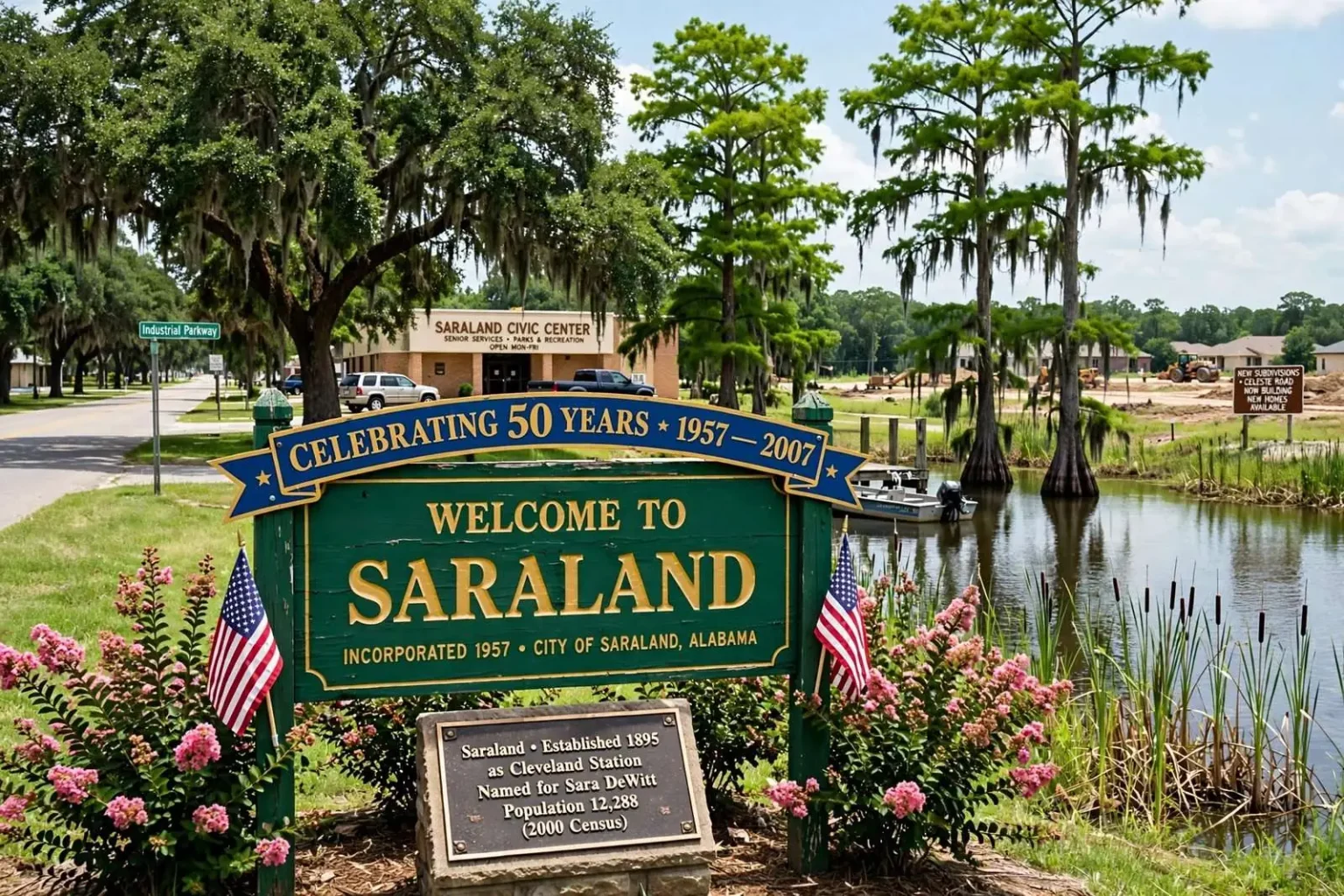
An archived local community feature from 2007 captured Saraland as it marked its 50th anniversary and prepared for continued growth. The city, tucked into the northern edge of Mobile County between Prichard and Satsuma, had spent half a century growing from a small railroad-and-highway settlement into one of the fastest-developing suburbs in the Mobile metropolitan area, and the 2007 tour of the city found a community balancing pride in its small-town roots with an unmistakable appetite for expansion. Readers were taken through new subdivisions, city parks and civic buildings, and introduced to a mayor with an ambitious agenda.
The report highlighted the city’s 15 parks, a striking number for a community of Saraland’s size and a point of civic pride that residents pointed to when describing what made the city different. Ball fields, playgrounds and green spaces scattered across the city gave the parks system a neighborhood feel rather than a single centralized showpiece, and the network reflected the city’s long-running habit of investing in quality-of-life amenities ahead of its population growth rather than after it.
Growth Along Celeste Road
New subdivisions along Celeste Road were among the most visible signs of the city’s momentum. The corridor, in the western reaches of the city, had become one of Saraland’s prime residential frontiers, with subdivisions springing up on land that had recently been farmland and woodland. Families moving into those new neighborhoods were part of a familiar Gulf Coast pattern: buyers drawn north out of Mobile by newer houses, larger lots and the perception of quieter streets, while staying within an easy commute of jobs in the city and along the I-65 corridor.
The report found that the small-town atmosphere was what residents said drew families to the community. In 2007, that atmosphere still meant things Saraland had preserved through five decades of growth — an annual civic calendar heavy with festivals and youth sports, churches and schools that anchored social life, and a city government close enough to its residents that complaints could reach the mayor by phone. At the same time, the population growth along corridors like Celeste Road and U.S. 43 was straining that identity, and the feature captured residents and officials who were conscious that growth, once invited, is difficult to steer.
The Mayor’s Agenda
Mayor Ken Williams said at the time that the city was working on three annexations. Expansion through annexation had been a recurring theme in Saraland’s history — the city had grown its boundaries steadily since incorporation, adding populated pockets and commercial frontage along U.S. 43 and the roads feeding into it — and the three simultaneous efforts signaled that the city intended to keep pace with the development pushing outward from its edges. Annexation in the unincorporated areas around Saraland carried the same calculus it does everywhere in Alabama: new taxpayers and service responsibilities arriving together, and neighbors who had to be persuaded that city government was a benefit rather than a burden.
The station also reported plans for a separate Saraland school district. The prospect was the single most consequential item on the city’s agenda, and the most discussed. Saraland’s schools had been part of the Mobile County Public School System, one of the largest districts in the state, and a series of school closings and attendance-line decisions in the 2000s had convinced many Saraland parents and city leaders that the community would be better served by running its own system. Breaking away from a countywide district is an enormous undertaking in Alabama — requiring the city to fund and build a full school system, staff it, and win state approval — and the announcement that the city was moving toward separation told readers how seriously Saraland took its identity as a community apart from Mobile.
Alongside the school plans came a new high school near I-65 and Industrial Parkway. The location, in the western part of the city near the interstate that carries commuters between Mobile and the growing northern suburbs, put the future campus at the center of the city’s newest development, close to the subdivisions filling in along Celeste Road and the industrial and commercial activity along the I-65 interchanges. A new high school built in a growth corridor serves double duty: it relieves pressure on older campuses and it becomes an anchor that draws more families to the neighborhoods around it, accelerating exactly the kind of growth the city was already experiencing.
A Civic Center and Senior Services
The feature also noted a civic center that included senior services. For a community with deep generational roots — many Saraland families had lived in the city since its earliest decades — the emphasis on services for older residents was more than an amenity. The civic center served as a gathering place for the kinds of programming that small cities across Alabama use to hold their communities together: senior meals and activities, civic club meetings, elections, and the public events that give a city its calendar. Its inclusion in the 2007 tour signaled a city government that saw itself as a community-builder, not just a provider of roads and police.
The feature noted Bayou Sara’s fishing and boating opportunities as well. The bayou, which winds through the city and ties Saraland to the Mobile-Tensaw delta system to the south, has always been part of the city’s geography of everyday life — a place for fishing, small-boating and the water access that defines so much of south Alabama. Preserving public access to the waterway even as subdivisions spread across the uplands was part of the challenge the city faced as it grew.
The Story Behind the Name
The feature recounted a local account of the city’s name, a story that has been part of Saraland’s identity since its founding days. Like many Alabama communities, Saraland carries a name with a human story attached to it — one that residents repeat with pride and that city histories keep alive across generations. The 2007 tour treated the naming story not as trivia but as part of what made the city feel like a place rather than a suburb, an acknowledgment that Saraland’s sense of itself rested on remembered origins as much as on present-day growth.
Place-name lore matters more in communities like Saraland than newcomers might expect. A city incorporated mid-century, built on land settled by farming families and threaded through by bayous and rail lines, has fewer monumental landmarks to anchor its memory than an old port city does — so the story a community tells about its own name does the work that courthouses and monuments do elsewhere. When the 2007 feature paused on that story during a tour otherwise full of subdivisions and construction plans, it was making a quiet argument: that the past the city was celebrating at 50 was still present under the new growth.
The city’s half-century milestone gave the feature its framing. Saraland had incorporated in the 1950s, part of the postwar wave of suburban incorporation around Mobile, and by 2007 it had outgrown nearly every prediction made at its founding. The transformation from a stop along the highway north of Mobile to a self-conscious city with its own school ambitions, its own annexation strategy and its own civic infrastructure was the arc the 2007 story traced — an arc that many Mobile County communities attempted but few pursued as deliberately.
Looking Back at the Tour Itself
Community features of this kind are a specific genre of local television journalism — the driving tour guided by city officials, the camera lingering on ball fields and bayou banks — and they rarely survive in public view for long. Republishing this one restores a snapshot of a city at a hinge point: old enough to celebrate fifty years, new enough that its most defining institutions were still under construction or still only plans.
What Came After
This is a historical portrait of Saraland in 2007; plans and population figures may have changed. Indeed, the years that followed the feature bore out the direction it documented: the city’s push for a separate school system moved forward, changing the educational landscape of northern Mobile County and becoming a model other communities studied; subdivisions continued to fill in along Celeste Road and the city’s western corridors; and Saraland’s population kept climbing as it absorbed growth that once flowed elsewhere. Readers revisiting the 2007 account today will find a city that looks different in its details but recognizably continuous in its trajectory — a community that knew what it wanted to become and, in large measure, went and became it.
What the archived tour captured best, though, was neither the annexations nor the school plans but the self-image residents offered: a small town that happened to be growing fast, determined to keep its parks, its waterway, its festivals and its neighborly habits intact while the new roofs went up. That tension — growth against character — is the story of every successful suburb in south Alabama, and Saraland’s 2007 moment preserved it in fine detail.