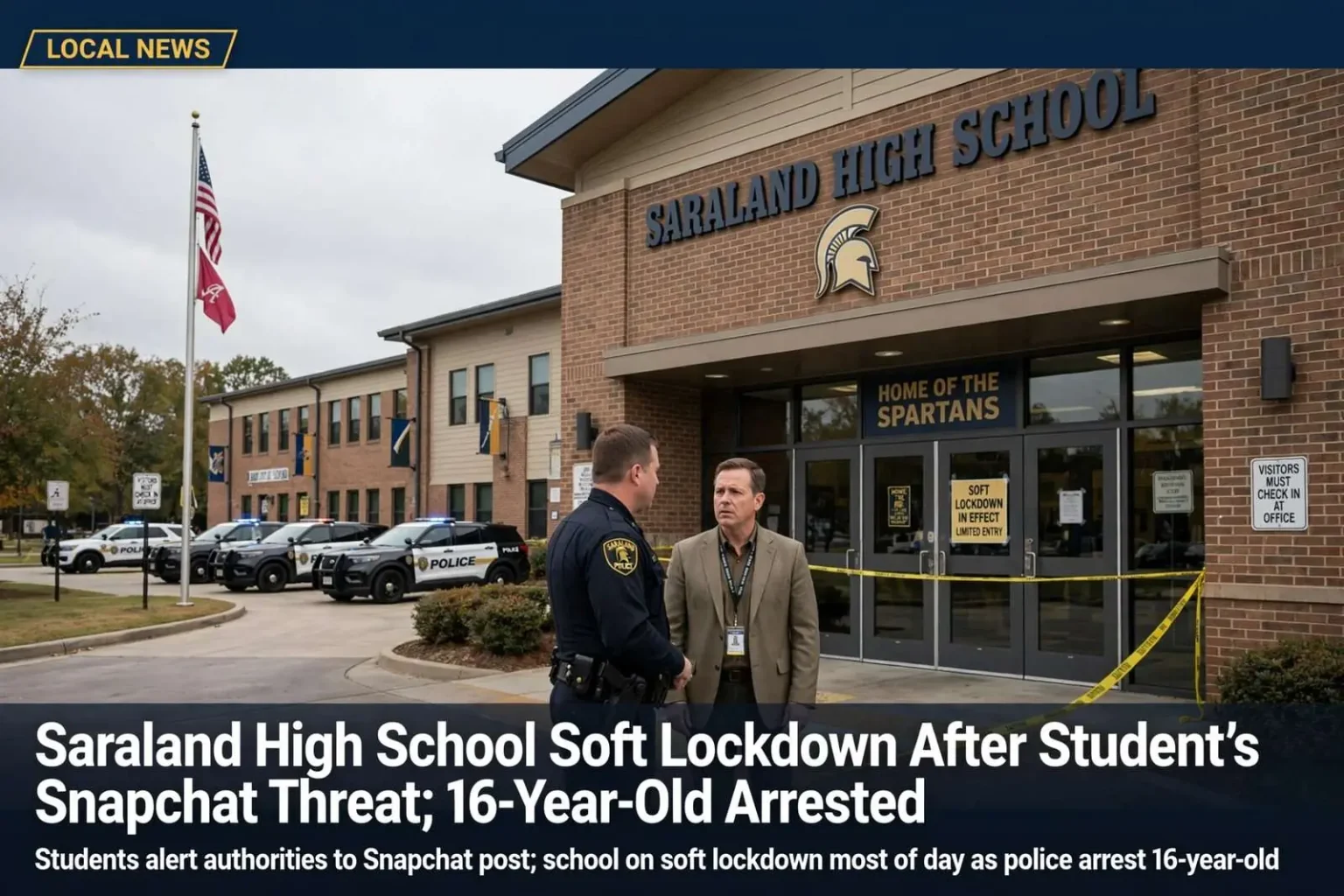
There were tense moments at Saraland High School on Tuesday after staff were notified of a possible threat posted on social media, prompting a soft lockdown that lasted most of the school day. Saraland Police said a 16-year-old boy was taken into custody for making a terrorist threat, and school district officials credited students for their quick thinking in bringing the post to administrators’ attention before anything could happen.
“We had several students come to us, come to our administration and tell us about it,” said Dr. Aaron Milner, superintendent of Saraland City Schools, praising the students for reporting the threat out of concern for their fellow students and their school.
How it unfolded
The threat was made on Snapchat, the messaging platform whose disappearing posts have made it a recurring vehicle for school threats across the country, and Saraland High School students alerted school officials first thing Tuesday morning. Rather than letting the post circulate or assuming it was a joke, students went directly to administrators, giving the district and police a head start on the school day.
The school entered a soft lockdown shortly afterward. Under that protocol, the day proceeded as normally as possible — classes continued, instruction carried on — but exterior doors were locked and movement through the building was limited, with police officers on campus as a precaution. The soft lockdown lasted most of the school day as officers investigated and worked to identify the person behind the post.
By the end of the day, police had taken a 16-year-old into custody in connection with the threat. According to police, the boy made vague threats on Snapchat to cause some type of physical harm or damage to the school. No violence occurred, and no injuries were reported.
Why students reporting mattered
The outcome Tuesday is the textbook case for the “see something, say something” approach that schools across Alabama and the country have drilled for years. In the vast majority of school threat cases investigated nationally, someone other than the suspect knew about the plan or the post beforehand — and whether that knowledge reaches an adult in time determines everything.
Dr. Milner’s message to students was direct: the people who reported the Snapchat post did exactly the right thing. District officials emphasized that reporting a threat is not snitching or overreacting; it is the single most effective tool schools have, and the alternative — assuming someone else will report it, or that it is not serious — is precisely the failure mode that has ended badly in other communities.
Saraland schools have leaned into that culture. The district, which broke away from the Mobile County Public School System to form its own city system in 2009 and has grown rapidly along with the city itself, has invested in safety planning across its campuses, and administrators have consistently encouraged students to route concerns to teachers, coaches and administrators directly.
What a soft lockdown means
The distinction between a soft lockdown and a hard lockdown is one parents often ask about. A hard lockdown is the most restrictive posture — students secured in classrooms, lights off, doors locked, no movement — used when a threat is believed to be inside or immediately outside the building. A soft lockdown, as used Tuesday, secures the building’s perimeter and restricts movement while allowing the school day to continue, and it is the standard response when a threat is credible enough to take seriously but not tied to an imminent danger on campus.
For parents, the day produced anxious hours. A parent of a student at the school said she was happy with the school’s response, and the district’s decision to keep the day running under the softer protocol meant students remained supervised and in routine for the bulk of the day while police handled the investigation.
The legal stakes for the student
The 16-year-old was arrested for making a terrorist threat, a charge Alabama law treats with severity precisely because of the disruption and fear such threats cause, regardless of whether the person making them ever intended to act. A threat against a school — even one described by police as vague, and even one posted to a platform where messages are designed to disappear — sets off responses that cost a district its normal school day, puts officers on campus and spreads fear through hundreds of families.
Because the suspect is a juvenile, his case proceeds through the juvenile justice system, where proceedings are confidential and his name has not been released. Juveniles charged with threatening offenses face detention hearings, potential probation or placement, and school discipline independent of the criminal case, up to and including expulsion under district policy. Prosecutors and courts across the state have taken an increasingly firm line on school threats in recent years, and law enforcement agencies routinely announce arrests to underscore that posting a threat is a crime, not a prank.
School districts in the Mobile area, as elsewhere, now treat social media threats as incidents requiring a full coordinated response — police investigation, district communication with parents, and lockdown decisions made with responders — no matter how implausible the post might appear on its face.
Snapchat and the challenge of disappearing posts
The platform involved in Tuesday’s incident is a familiar one for school administrators. Snapchat’s core design — photos and messages that vanish after being viewed — has repeatedly complicated threat investigations, because posts can disappear before officials screenshot them. In practice, however, almost nothing online truly disappears: recipients take screenshots, the platform retains records reachable through legal process, and investigators have become practiced at tracing accounts.
The company itself operates a law enforcement process and has encouraged users to report threatening content through in-app tools, but in cases like Tuesday’s the fastest path ran through the students themselves, who saw the post and brought it to the adults in the building within minutes of the school day starting.
School safety officials across Alabama continue to urge students and parents to report threatening posts immediately — by telling a school administrator, calling police, or using the state’s tip lines — rather than sharing, replying to or forwarding the content, which spreads the post without adding anything to the investigation.
Communication with parents
Saraland City Schools communicates with families during such incidents, and the district’s handling of Tuesday’s event drew a positive reaction from parents despite the day’s tension. The parent who praised the response reflected a broader sentiment: the system worked as designed. Students reported, administrators acted, police investigated and arrested a suspect, and everyone went home safe.
District officials used the episode to reinforce the message to students that reporting works. The several students who came to administration on Tuesday morning did not just protect their school; they provided the model that Milner and his staff hope every student follows the next time a threatening post crosses a phone screen.
The context: school safety in a growing city
Saraland, positioned along the I-65 corridor north of Mobile, has been one of the fastest-growing cities in Mobile County, and its school system’s growth has mirrored the city’s. Since forming its own district in 2009 — the first new city school system in Alabama in decades at the time — Saraland City Schools has built a reputation for strong academics and athletic programs that has attracted families from across the region, pushing enrollment upward year after year.
That growth raises the stakes of school safety planning. Larger campuses, more students and more families mean that any disruption to a school day touches thousands of households, and districts of Saraland’s size maintain detailed protocols covering everything from severe weather to campus threats. The soft lockdown executed Tuesday is one of the tools in that playbook, and its smooth execution — school day preserved, suspect identified, no injuries — reflects repeated practice rather than improvisation.
The Saraland Police Department, which staffs and supports the district’s safety efforts, responded alongside school officials throughout the day, and its investigation produced the arrest before the day was out.
The takeaway for families across the region
For parents and students across Mobile County and the rest of the Gulf Coast, Tuesday’s events in Saraland carry a straightforward lesson. Threats posted to social media are investigated as crimes, arrests follow quickly, and the students who speak up are the reason incidents stay incidents.
School safety experts have repeated the same guidance for years: if you see a threatening post, screenshot it, do not share it, and tell an adult in a position to act — a school administrator, a parent who can call the school, or police directly. The minutes between a post appearing and an adult learning of it are where tragedies are prevented, and Saraland’s students compressed that window to almost nothing.
The 16-year-old arrested Tuesday now faces the consequences of a post made in seconds. The rest of the school community — administrators who locked down, officers who investigated, students who spoke up and a parent community that watched the system hold — got back to the routine the next morning. That outcome is exactly what the protocols are built to deliver, and Saraland’s school officials made clear they intend to keep it that way.