Saraland man identified as motorcyclist killed in Government Boulevard crash
Mobile police identified the motorcyclist killed in a Friday night crash on Government Boulevard as 24-year-old Robert Sones Jr. of Saraland.
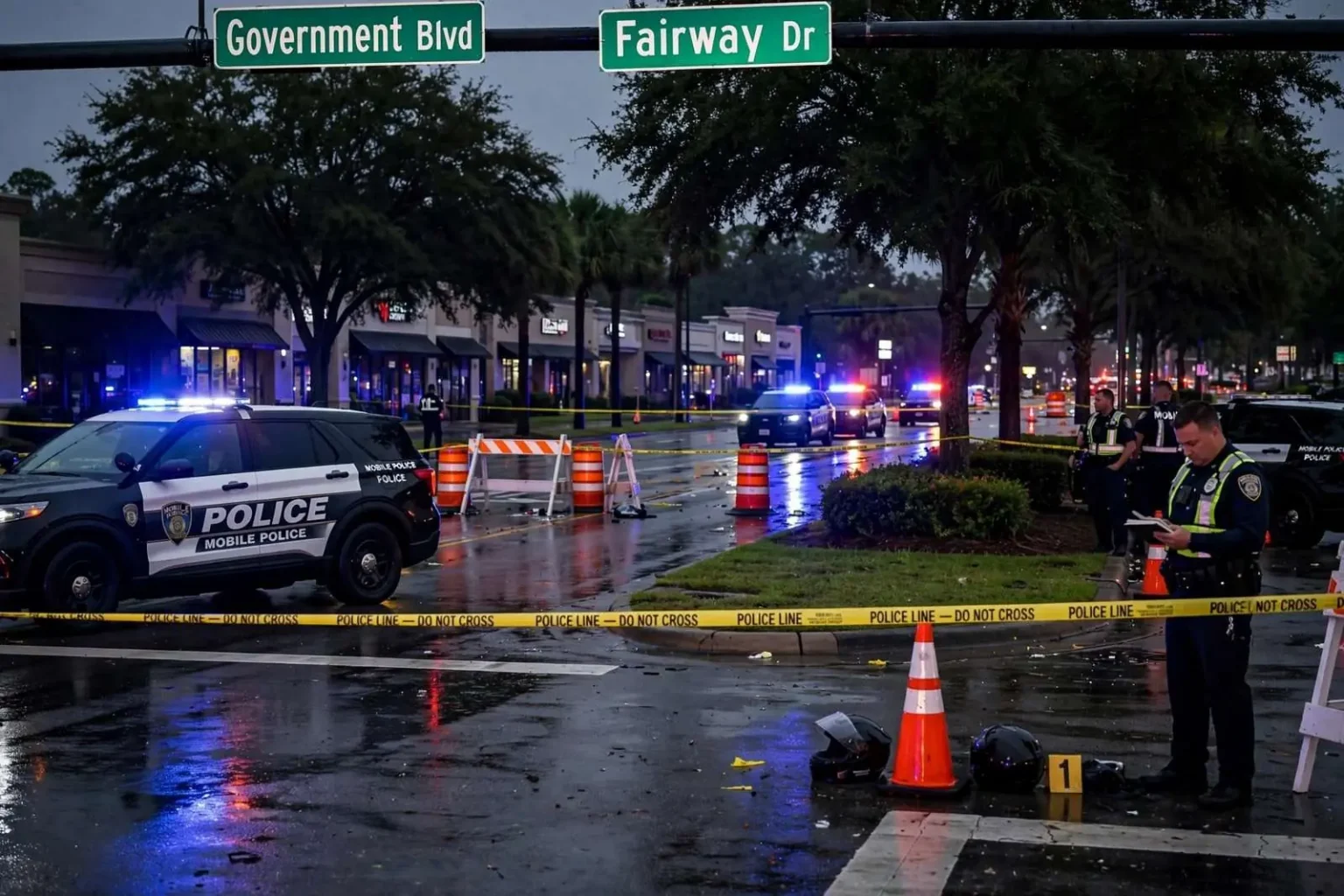
Mobile police have identified the motorcyclist killed in a Friday night crash on Government Boulevard as 24-year-old Robert Sones Jr. of Saraland, bringing the week’s traffic fatalities home to a family in one of Mobile County’s growing northern suburbs. Officers were called to the scene about 11:33 p.m. Friday, responding to Government Boulevard at Fairway Drive in reference to a traffic crash involving a motorcycle.
According to police, Sones was traveling east on Government Boulevard at a high rate of speed when another vehicle pulled onto the eastbound lanes from the median at Fairway Drive. The driver of that vehicle did not see the motorcycle until he was already on Government Boulevard, police said. The collision that followed claimed the life of the young rider at a busy west Mobile intersection long familiar to area commuters.
Government Boulevard: A Corridor With History
Government Boulevard is one of west Mobile’s principal east-west arteries, following the route of the old Bay Shore Line corridor and connecting the city’s central districts with the growing suburbs to its west. The stretch around Fairway Drive is a mixed commercial and residential zone where medians, crossovers, and frequent turning movements create the kinds of conflict points that traffic engineers watch closely. Left turns and median crossovers are consistently among the most dangerous maneuvers on multi-lane urban roads, because they place a vehicle directly in the path of traffic moving at full speed.
A motorcyclist approaches those conflict points with far less protection than a car driver. Motorcycles are smaller and harder to see, especially at night, and drivers pulling from medians and side streets frequently report that they simply did not register an approaching bike. When speed enters the equation — as police said it did here — the closing distance shrinks dramatically, leaving both the rider and the turning driver with almost no time to react.
The Crash and the Investigation
The timing, near midnight on a Friday, placed the crash at the end of one of the week’s busiest traffic periods. Police said the other vehicle was pulling onto the eastbound lanes from the median at Fairway Drive when the motorcycle, traveling east at a high rate of speed, reached the location. The driver did not see the motorcycle until he was already on the boulevard. What happens next in such cases follows a standard sequence: the roadway is closed while investigators document the scene, the motorcycle and the second vehicle are examined, and investigators determine whether any charges are warranted against either party.
Speed is a factor investigators weigh carefully in every fatal motorcycle crash, and Alabama law treats speeding-related conduct seriously in cases where it contributes to a death. At the same time, the turning driver’s obligations are equally clear under state law: a vehicle entering a roadway from a median or side street must yield to oncoming traffic, and a failure to see a motorcycle is not a legal defense if the rider had the right of way. Reconstructing exactly who had the right of way, and at what speeds, is the work that follows in the days after the scene is cleared.
Motorcycle Safety on Gulf Coast Roads
The circumstances described by police echo a pattern that motorcycle safety advocates have documented for decades: the multi-vehicle crash in which a car pulls into a motorcycle’s path. Federal crash statistics have long shown that in a large share of fatal multi-vehicle motorcycle crashes, the other driver violated the rider’s right of way — often while turning left or crossing traffic — and reported not seeing the motorcycle until impact. Rider speed compounds the danger, shortening the window in which either party can avoid the collision.
Safety campaigns across Alabama urge drivers to look twice for motorcycles at intersections and crossovers, particularly at night when headlights and single taillights are the only cues. For riders, the standard advice includes managing speed on busy corridors, positioning themselves in lanes where they are most visible, and assuming that vehicles waiting at medians may not have registered their approach. The rider is overwhelmingly the party killed or seriously injured when these collisions occur; a motorcycle offers none of the protection that shields a car’s occupants in a crash of the same severity.
Friday’s crash adds to a toll that has drawn attention across Mobile and Baldwin counties, where motorcycle traffic swells during warm months and where riders from across the Gulf Coast travel to events and scenic routes. Local law enforcement agencies periodically run motorcycle-awareness campaigns and speed enforcement details on corridors like Government Boulevard, where the mix of commercial crossovers and commuter traffic produces repeated conflicts.
A Life Cut Short in Saraland and Beyond
Robert Sones Jr. was 24 years old and lived in Saraland, a city north of Mobile that has grown rapidly in recent decades into one of the county’s largest suburbs. His death will be felt across the networks of family, friends, and coworkers that radiate from any young life lost — and it lands within a community of riders who follow each fatal motorcycle crash along the Gulf Coast with particular attention, knowing how easily any of them could have been on that stretch of boulevard.
For drivers in west Mobile, the crash is another entry in the long record of why medians and crossovers on Government Boulevard demand full attention. Pulling onto a multi-lane road at night requires checking every lane, twice, and remembering that a single headlight may be moving far faster than it appears. For riders, it is a reminder that speed limits on such corridors are set not as suggestions but as the margin that makes conflicting traffic movements survivable. The Mobile Police Department’s investigation will establish the official account of what happened at Fairway Drive on Friday night; the lessons of the intersection, sadly, are already familiar to everyone who drives it.
What Happens After a Fatal Traffic Crash
In the hours after a fatal crash, Mobile police close the roadway, notify the medical examiner, and begin documenting evidence: vehicle positions, debris fields, skid marks, and damage patterns that reconstruction specialists later use to estimate speeds and movement. Investigators will also obtain the other driver’s account, canvass for witnesses, and request any available surveillance or doorbell camera footage from the commercial properties around Fairway Drive. The findings shape whether citations or criminal charges result, and they become part of the official record available to the families involved.
The closed roadway also ripples outward through the city’s night. Government Boulevard carries substantial traffic between west Mobile neighborhoods and the city center, and a late-night closure at Fairway Drive diverts vehicles onto parallel streets for the duration of the investigation — one of the routine costs of a fatal crash that residents rarely see but always experience.
Police did not release additional details about the condition of the other driver or any potential charges as of Friday night’s report. As in any fatal crash investigation, those determinations follow the completion of the reconstruction, and updates typically come in the days and weeks afterward. What the department confirmed — the victim’s identity, the time of the call, the location, and the basic sequence of events — already tells the essential story: a 24-year-old rider from Saraland, traveling east on Government Boulevard at high speed, met a vehicle pulling from the median at Fairway Drive that never saw him coming.
It is a story that ends the same way it has too many times on Gulf Coast roads, and it is worth the attention of every driver and rider who passes that intersection: look twice for motorcycles, yield from every crossover, and remember that the seconds saved by speed are never worth the outcome that happened here.
The Intersection in Context
The Fairway Drive crossover sits in a stretch of Government Boulevard where drivers entering and exiting businesses and side streets must cross or merge with multiple lanes of traffic. Medians of this kind are designed to manage turn movements safely, but they rely entirely on drivers judging gaps correctly — and on approaching vehicles staying within expected speeds. When either assumption fails, the median becomes a conflict point rather than a safety feature, which is why intersections like this one draw repeated attention from traffic engineers and enforcement patrols alike.
For neighbors in west Mobile, Friday night’s closure and the investigation that followed were the visible surface of a longer process. Crash reconstruction work at such scenes takes place over hours, and the resulting report takes longer still. In the meantime, the intersection returns to its ordinary rhythm — commuters, delivery trucks, families heading to nearby businesses — with one more reminder, marked by flowers or simply by memory, of what can happen there at 11:33 on a Friday night when speed and a turn combine.