Saraland residents line up for sandbags after last year’s flooding brought a snake indoors
Saraland residents lined up for sandbags before the season's first tropical system, with one recalling a snake that came inside during last year's flooding.
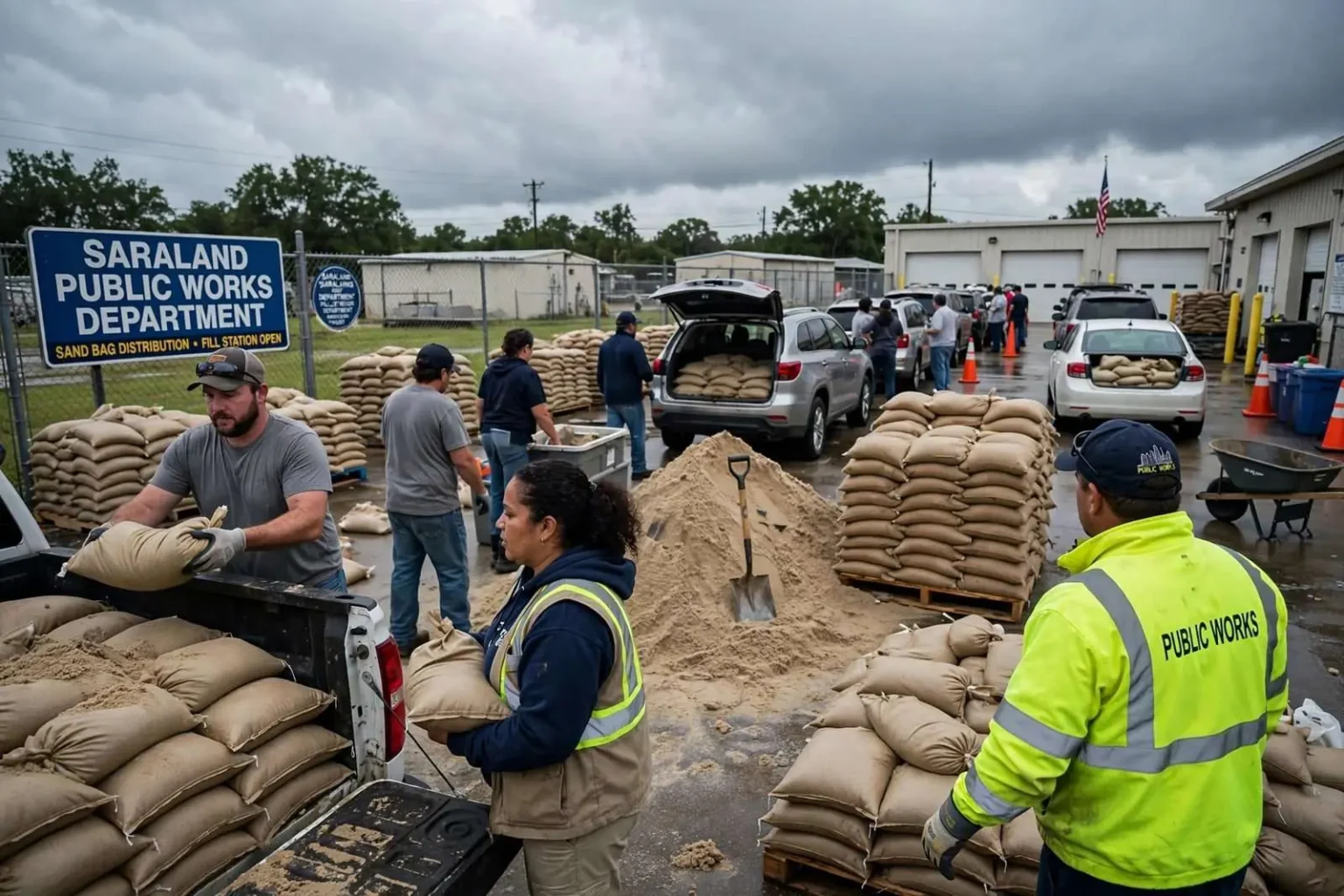
Cars moved in a steady stream through the Saraland Public Works Department as residents loaded sandbags ahead of the region’s first significant tropical weather of the season, with several saying last year’s flood damage left them unwilling to take chances. The distribution site, normally a quiet municipal yard, turned into a procession of trucks and sedans as neighbors stacked bags in truck beds and back seats and drove off to guard their doorways and garages.
Among the first-timers in line was Meach Ceeley, who was picking up sandbags for the first time. What pushed him to do it was not the water itself but what came in with it. “My living room flooded, we had a little bit of damage — but I had a 4- or 5-foot snake in my living room,” Ceeley said. “And my wife, she called me, and I had to rush home from work. I had to get him outside, he was rough.”
Ceeley’s story was not unusual at the fill station, where the line of residents swapping storm stories stretched longer than the line of vehicles. For many in Saraland, the memory of the previous year’s flooding — a historic hurricane season that repeatedly tested drainage systems across the Gulf Coast — has changed the calculus around every named storm in the forecast. Sandbags that once seemed like an optional precaution have become part of the standard preparation routine for households that flooded before and cannot afford to watch it happen again.
Bags Ready and a Fill Station on Site
Public works employees had piles of 50-pound bags staged and ready for pickup, along with a station where residents could fill additional bags on the spot if they needed more than what was already prepared. The setup allowed crews to keep the line moving: residents with modest needs grabbed pre-filled bags and left, while those protecting larger properties or multiple entrances shoveled sand into empty bags at the fill station.
City workers coordinated the flow of traffic through the yard, directing drivers to the staging area and keeping the pile of materials stocked throughout the day. The operation reflected lessons learned from past storms, when demand overwhelmed sites that were not prepared for it. Staging bags in advance and offering a self-serve fill option spreads out the workload and keeps residents from waiting in line while a storm bears down on the coast.
The turnout reflected how quickly water can rise in parts of Saraland. Flooding is a familiar problem in the city, but residents said the historic hurricane season the year before changed how seriously they treat an approaching system. “We’ve always lived here in Saraland and sometimes the water just comes up so fast, so we’re trying to stop the water,” said Jerome Smith, another Saraland resident.
That urgency is well founded. Saraland sits in the low-lying corridor north of Mobile where heavy rainfall drains slowly and street flooding can reach homes within a short window. When a slow-moving tropical system parks over Mobile County, rainfall rates can exceed what storm drains and roadside ditches can carry, pushing water out of the ditches and across yards and streets before residents have time to react.
Why Sandbags Go Fast in North Mobile County
Sandbag distribution has become a routine municipal response in the days before a tropical system arrives, giving residents a way to redirect water away from doors, garages and low thresholds. Cities across Mobile County — Saraland among them — open distribution sites once a storm’s rainfall forecast becomes clear, and supplies often run short in the final hours before rain arrives, which is why public works departments urge residents to come early rather than wait.
Sandbags will not stop deep floodwater, but public safety officials consistently note that they are effective at slowing shallow sheet flow — the kind that seeps under a door and into a living room. A properly placed line of bags across a doorway or garage entrance can buy time and deflect the slow, persistent seepage that does most of the damage inurban street flooding. That distinction matters: sandbags are not a substitute for flood insurance or evacuation planning, but for the shallow water that characterizes most residential flooding in north Mobile County, they are one of the cheapest and most effective tools a homeowner has.
City crews across Mobile County typically open distribution sites once a storm’s rainfall forecast becomes clear, and the timing matters. Residents who wait until rain is already falling often find sites closed, supplies exhausted, or conditions too dangerous to be out loading heavy bags. The pattern repeats with nearly every system: early lines are steady, midday crowds swell, and by the time the first outer bands arrive, the bags are gone.
Lessons From Last Year’s Floods
The memory driving this year’s turnout is fresh. The previous hurricane season was one for the record books across the Gulf Coast, with repeated systems hitting the region and pushing rainfall totals to historic levels. For Saraland and its neighbors in the northern part of Mobile County, the damage was not limited to coastal areas — inland neighborhoods with poor drainage saw water in homes, and in some cases repeatedly.
Those experiences explain stories like Ceeley’s. Floodwater entering a home carries more than damage to flooring and drywall; it brings debris, contamination and wildlife. A snake swimming into a flooded living room is a vivid example, but residents describe similar encounters — fire ants floating in rafts, displaced animals, and the health concerns that come with contaminated water sitting in a home.
The episode also illustrates why residents who flooded once take subsequent storms so seriously. A home that took even a little water requires cleanup, repairs and often weeks of disruption. For a household that weathered that once, a few dozen sandbags and an hour of preparation look like cheap insurance against doing it again.
How to Use Sandbags Effectively
Public works officials and emergency managers offer consistent guidance for residents who pick up bags. Sandbags work best when they are placed before water starts rising, stacked in an overlapping pattern like bricks, and filled only about half to two-thirds full so they conform to the surface beneath them. A single row of bags can deflect shallow flow; two or three rows, laid in a pyramid, offer substantially more protection for doorways and garage thresholds.
Placement matters as much as quantity. Bags should be positioned to intercept the path water actually takes — across the low point of a driveway, in front of doors that sit below street grade, or along the edge of a crawlspace vent. Residents who flooded before generally know where the water entered last time, and that experience shapes how they deploy their bags. Vents, weep holes and gaps around pipes also deserve attention, since shallow water will find the smallest opening.
Safety matters too. Filled bags are heavy — the standard 50-pound bag is awkward to lift, and residents are advised to lift with their legs and get help carrying loads rather than risk injury on the eve of a storm. Once a storm passes, used bags that contacted floodwater should be handled with gloves and disposed of properly, since waterlogged sand can hold contaminants and should not be reused for landscaping or play areas.
A Community Routine
What unfolded at the Saraland Public Works Department is now a familiar scene across the Gulf Coast each hurricane season. In the days before a system arrives, residents make the rounds — fueling vehicles, testing generators, securing loose yard items and, increasingly, collecting sandbags as a standard item on the checklist.
For the city, the distribution serves another purpose beyond individual protection: every home that keeps shallow water out is a home that does not need emergency assistance during the storm, and every resident who prepares early reduces the demands on first responders once rain begins to fall. Municipal crews cannot sandbag every door in a city; the distribution model works because residents do that part themselves.
The steady stream of vehicles at the Saraland site suggested that message has taken hold. First-timers like Ceeley are learning the routine from neighbors like Smith, who have lived through enough Gulf Coast storm seasons to know that when the forecast turns, the time to act is before the first raindrop falls — because in the low-lying neighborhoods north of Mobile, the water does not wait.
Preparing for the Rest of the Season
The first significant tropical weather of the season is often the wake-up call for Gulf Coast residents, and the response in Saraland suggests the community took it seriously. Emergency managers recommend that households use the early storms of the season to review their broader plans as well: checking insurance coverage, photographing belongings for documentation, clearing ditches and storm drains near their property, and knowing where they would go if a system intensified beyond what sandbags could handle.
Drainage maintenance is the other half of the equation. City crews work to clear ditches and culverts ahead of storm season, but residents can help by keeping yard debris, leaves and trash out of the drains near their homes. A clogged culvert that backs up during a downpour can flood a street on its own, even in a system that would otherwise have passed with minimal impact. In neighborhoods where water rises fast, every unobstructed drain matters.
For now, the residents of Saraland will do what Gulf Coast communities have always done — watch the forecast, load the truck with sandbags, stack them where the water came in last time, and hope the preparations are never truly tested. The snake in the living room made one household’s stakes unforgettable; the steady line of cars at the public works yard showed that plenty of others remember their own reasons for taking no chances this hurricane season.