Satori Coffee House Serves West Mobile a Cozy Breakfast Routine
Satori Coffee House Serves West Mobile a Cozy Breakfast Routine — local South Alabama news from southalnews.com.
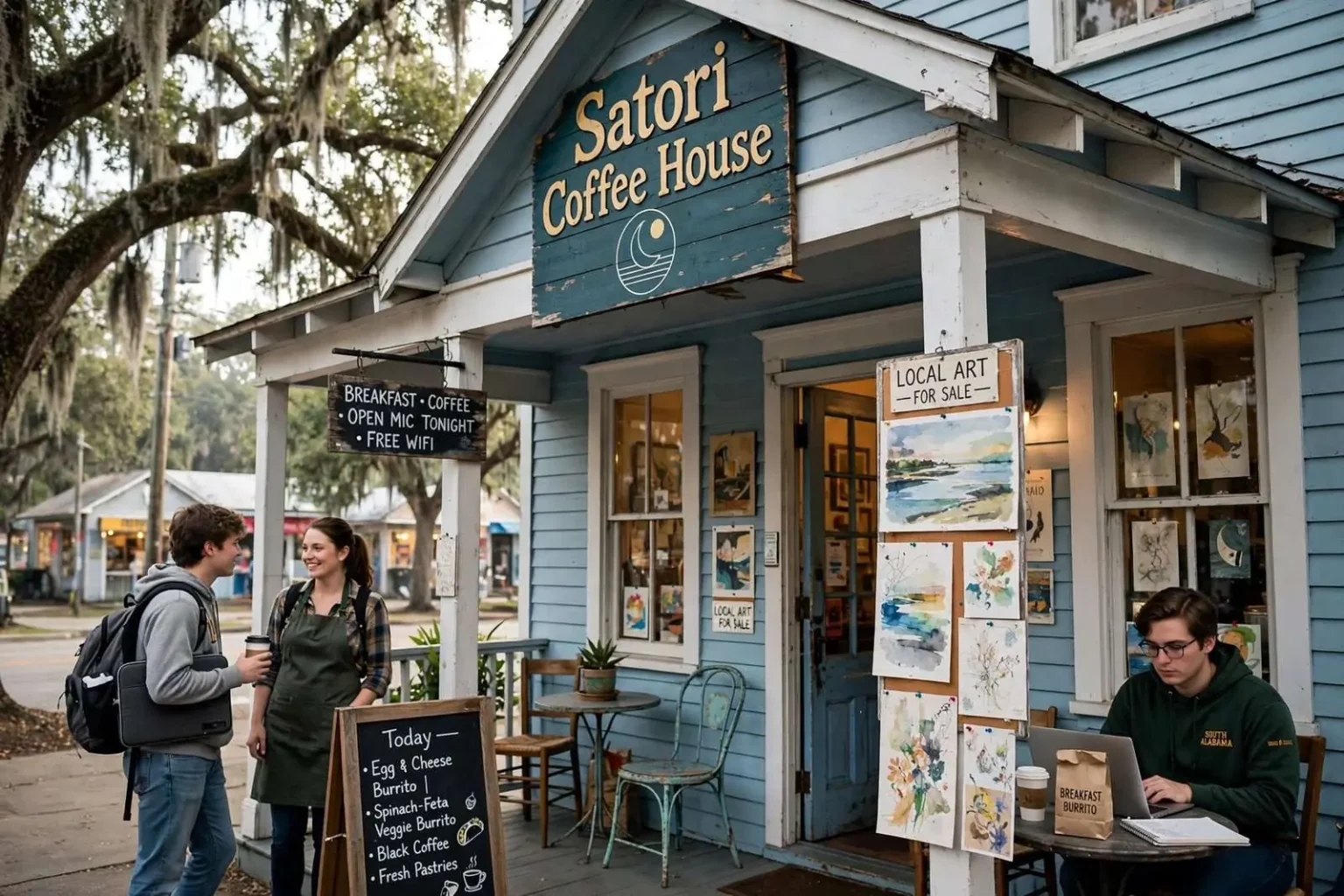
Satori Coffee House is a popular breakfast stop for University of South Alabama students and West Mobile commuters alike, a fixture of the Old Shell Road corridor where the morning routine runs on breakfast burritos, black coffee, and a pace deliberately slower than the drive-through chains down the street. The shop occupies an old baby-blue house, and the building itself announces what kind of place it is before anyone orders: mismatched furniture, local art on the walls, and none of the standardized fit-out that marks a franchise. Satori trades chain-store sameness for a comfy, independent vibe, and it has held onto that identity through new ownership — a transition longtime regulars watched closely, and one that now appears to be settling in the shop’s favor.
The setting is a working piece of Mobile’s commercial history. Old Shell Road runs east-west through the heart of West Mobile, one of the city’s oldest thoroughfares, lined with the converted houses and small storefronts that once served the neighborhoods that grew up around the university. Institutions like the University of South Alabama, established in the early 1960s and now one of the region’s largest employers and enrollments, reshaped the corridor into the student-and-commuter economy it is today — and independent businesses like Satori are what give that economy its character. Where the big intersection strip malls along nearby Schillinger Road and Airport Boulevard serve the drive-through crowd, the converted-house coffee shop serves the person who wants to sit down.
Satori’s hours have stretched to meet that audience in a second direction as well: the shop now stays open for evening open mic and poetry nights, giving the same room that fills with morning commuters a nighttime identity as a small performance venue. The addition fits the house’s layout and its clientele. Coffeehouses across the Gulf Coast have long doubled as low-stakes stages for songwriters, poets, and first-time readers, and near a university campus the supply of willing performers is bottomless. For students, the evening events turn a study spot into a social one; for the shop, they add hours of revenue on rooms that would otherwise sit empty after the breakfast rush.
The Breakfast Burritos
The kitchen’s anchor is the breakfast burrito, and founder Chuck Cox confirmed that the egg and cheese burrito is the most popular morning item — the plain, reliable order that keeps the 7:30 to 9 a.m. line moving. But the vegetarian option is the one employees point to with pride: the spinach burrito, built with spinach, tomato, feta and dressing, has become a standout on a menu where meatless breakfast options are otherwise rare along the corridor. The combination of feta’s salt and fresh spinach has made it a regular order even among customers who are not vegetarians, and it embodies the shop’s approach — simple ingredients, assembled by hand, priced for a student budget.
Employees say the 7:30 to 9 a.m. rush brings regulars in for breakfast burritos and black coffee, a concentrated hour when the old house fills with students grabbing food before class and commuters fueling up before the drive toward the city’s employment centers. The rhythm of that rush shapes the whole operation. Regulars are known by their orders; the line moves on familiarity rather than scripted service. It is the kind of customer relationship a national chain’s ordering app tries to replicate and cannot — the barista who starts a familiar burrito when a familiar face walks in is the product.
The shop’s continuity through an ownership change is the story regulars talk about most. Longtime employee Michelle, who has worked on and off at Satori for nearly 12 years, said the new ownership intends to keep everything customers love about the spot — the menu, the atmosphere, the unhurried feel that makes the place what it is. In a retail landscape where an ownership change usually means a remodel, a rebrand, and a new corporate ordering system, the promise of continuity is itself a competitive position. Independent coffeehouses that survive transitions do so precisely by convincing their regulars that nothing essential is changing.
Cox helped smooth the transition between the outgoing and incoming operators, and Michelle credits him with creating an honest, hard-working atmosphere unlike anywhere else in Mobile. That handoff — a founder staying involved long enough to pass along the culture of the place, not just the keys — is the difference between a business that survives its founder and one that doesn’t. The recipes and the burrito line can be taught in a week; the atmosphere, the tolerance for mismatched furniture and local art, the unspoken standards of how customers are treated, take years to form and can be undone in a season. Satori’s transition has so far followed the first path.
The name itself, borrowed from the Zen term for a sudden moment of awakening, hints at the shop’s original ambitions — a place apart from the rush rather than an engine of it. Mobile’s independent coffee scene has always been small relative to its chain presence, which makes survivors like Satori notable. The city’s coffee drinkers can find an espresso counter on nearly every commercial corridor, but the number of rooms that function as genuine third places — neither home nor work, where a customer is welcome to stay — remains short. Converted-house shops along Old Shell Road and in the Spring Hill and midtown districts carry most of that load, and each closure concentrates the regulars somewhere new.
An Oasis for USA Students
Free WiFi makes Satori a go-to study spot, and the shop’s daytime identity is largely academic: laptops along the tables, syllabi spread between coffee cups, and the particular quiet of a room full of people working toward deadlines. Proximity matters — the shop sits minutes from the University of South Alabama’s main campus, close enough for a between-class stop, far enough from the student union to escape its crowds. In the era when coffee shops function as satellite libraries, free internet is as essential to the business as the espresso machine, and the shop’s dependable service has made it a default destination when campus spaces fill up during exam weeks.
The relationship with the university runs deeper than convenience. Campus groups such as the Independent Music Collective host events there, using the room for shows and gatherings that need a venue small, informal, and sympathetic to original music. For student musicians, a coffeehouse stage is often the first one that pays attention — no cover charge, no bar minimum, an audience seated close enough to actually listen. Those partnerships bind the shop into campus life in ways advertising cannot buy: the students who attend a show on a Friday night become the breakfast burrito line the following Tuesday morning.
That circular economy — the shop serves the community, and the community’s patronage keeps the shop independent — is the quiet argument of Satori’s decade-plus run. National chains will always outspend a converted house on marketing, and drive-through volume will always beat a sit-down room on speed. What keeps a place like Satori alive is the accumulated decision of hundreds of regulars that the mismatched furniture and the known barista are worth the extra minutes. As the local community keeps supporting independent business, West Mobile gets to keep its own offbeat coffee shack for years to come — breakfast burritos in the morning, poetry at night, and a blue house on Old Shell Road doing exactly what it has always done.
For new customers, the practical answer to what Satori is can be given in an order and a schedule. Arrive before 9 a.m. and the room is at its busiest, the grill working through a stack of egg-and-cheese burritos with the spinach-and-feta close behind. Arrive mid-morning or early afternoon and the tables belong to students and remote workers, the WiFi doing its part while the coffee refills. Arrive on an evening when the open mic or poetry night is running and the same room becomes a small listening space, local art on the walls looking down on a new set of performers. One building, three businesses, all under the same mismatched roof.
The shop’s endurance also says something about the West Mobile retail landscape it sits in. The corridors around Old Shell Road have absorbed waves of national development — big-box anchors, fast-food rows, medical offices riding the growth that followed the university and the hospital district — and each wave made independent storefronts a little rarer. A converted house that sells breakfast burritos is an increasingly unusual holdout on a street built for turn lanes and signage. Its survival is not nostalgia for its own sake; regulars keep it because the product is good and the room works, and the economics follow from that loyalty rather than leading it.
Michelle’s dozen years behind the counter, on and off, span the shop’s maturation from a new idea to a neighborhood institution. Employees with that tenure become part of what customers are buying — the person who remembers the order, notices the new semester, and holds the standards the founder set. With the founder credited for the atmosphere, the new ownership promising to preserve it, and the staff carrying it day to day, Satori enters its next chapter with the three pieces of an independent shop’s continuity in place. In Mobile’s coffee landscape, that is rarer than any single menu item the kitchen serves — and it is the reason the baby-blue house on Old Shell Road still draws a line at 7:30 every morning.