Satsuma to Add Backup Generator at Joginell Lift Station Under FEMA Grant
FEMA has issued final notice of its intent to fund a 30-kilowatt backup generator at Satsuma's Joginell Lift Station, protecting sewer service during storm-related power outages.
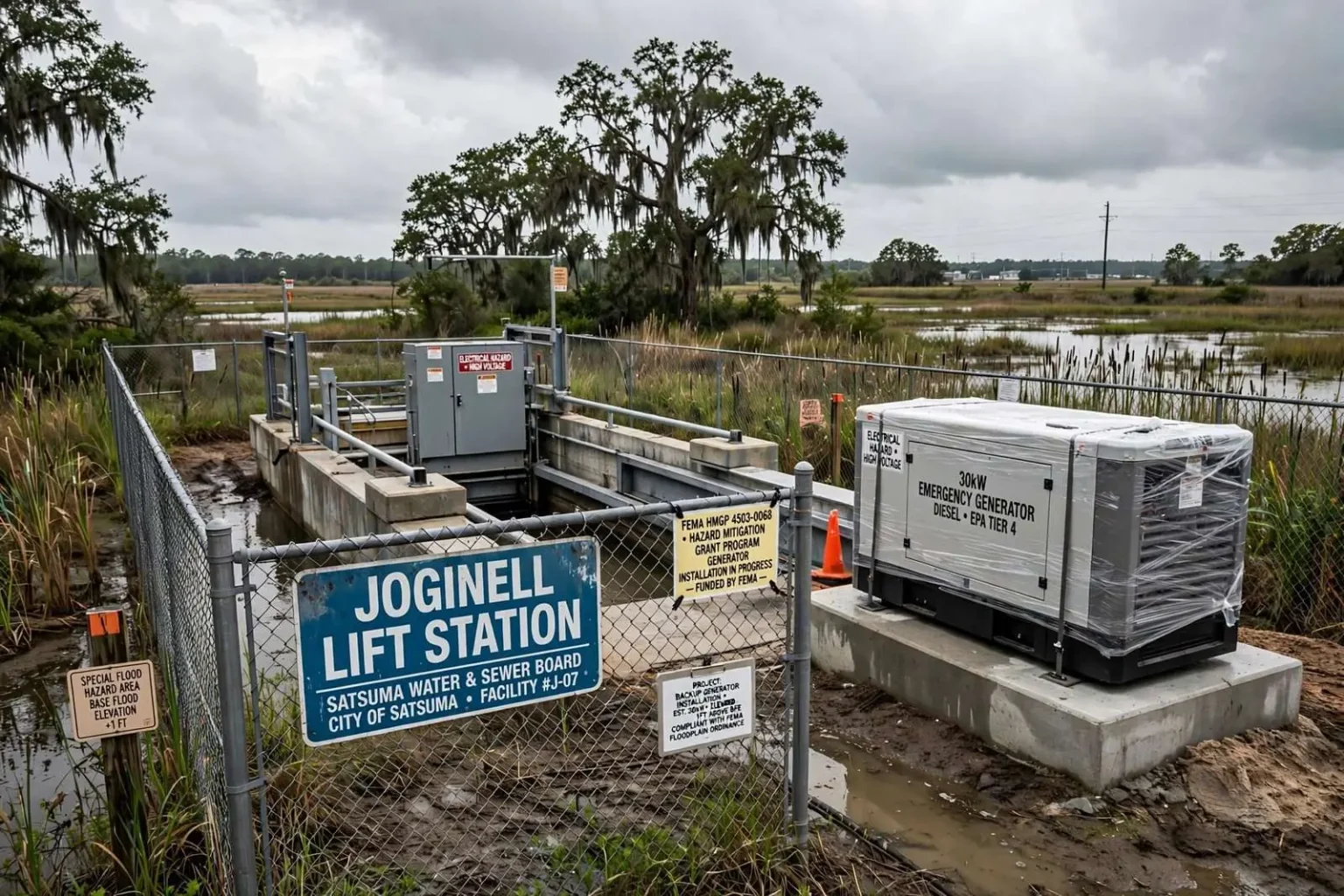
The City of Satsuma is set to receive federal funding to install a backup generator at its Joginell Lift Station, part of an ongoing effort to protect the city’s sewer infrastructure from power outages during hurricanes and other storms. The Federal Emergency Management Agency has issued a final public notice announcing its intent to fund the project through the Hazard Mitigation Grant Program.
The project is small in dollar terms but large in what it protects: a single piece of equipment that keeps a small city’s sewage moving when the lights go out. For Gulf Coast utilities, generators at lift stations have become one of the clearest lessons of recent hurricane seasons, where outages lasting days are treated not as a possibility but as an expectation.
The subgrant application was submitted by the Satsuma Water and Sewer Board, and FEMA’s funding decision comes after a review process required under federal environmental law. Because the project site sits within a Special Flood Hazard Area, the review examined potential effects on floodplains and wetlands, along with social, economic, historic and safety considerations, before the agency issued its final notice.
What the project involves
The plan calls for installing a 30-kilowatt emergency generator adjacent to the Joginell Lift Station, located at GPS coordinates 30.841199, -88.073769. The generator will provide backup power to keep the lift station running during power interruptions caused by storms, ensuring that sewage continues to be pumped to the Satsuma Wastewater Treatment Plant even when the electrical grid goes down.
Lift stations are the unglamorous workhorses of any sewer system. Because sewage flows downhill and the land between a city’s homes and its treatment plant rarely cooperates, utilities install below-grade collection points where pumps lift the wastewater over the high ground in between. Those pumps run on electricity, which means every lift station is a point of vulnerability: when the grid fails, the pumps stop, and the sewage keeps arriving with nowhere to go.
To meet local floodplain standards, the generator will be installed one foot above the base flood elevation, in accordance with the City of Satsuma’s floodplain ordinance. The site falls within a regulatory floodway and is located within or adjacent to wetlands, which is why the project required the additional layer of federal environmental review before funding could be finalized.
The elevation requirement reflects the irony built into the project: protecting a flood-prone asset with equipment that is itself vulnerable to flooding. Raising a generator above base flood elevation — the height water is statistically expected to reach in a given flood — is standard practice under local ordinances, which communities adopt as a condition of participation in the National Flood Insurance Program. Satsuma’s ordinance, like those of its neighbors, is what allows Satsuma residents and business owners to buy federal flood coverage at all.
Why a generator, and why here
FEMA’s notice lays out why officials determined that installing the generator in place, rather than relocating the lift station, is the most practicable option. Moving the sewer infrastructure out of the floodplain entirely would require rerouting sewer main lines, a process that could disrupt public access to nearby properties and require acquiring land from property owners along a new route. Given that the damage typically caused by flooding at the site is limited in scope, FEMA concluded the cost of relocating the facility would likely outweigh the cost of simply protecting it in place.
The cost-benefit comparison is the heart of any hazard mitigation decision. Rerouting sewer mains through a developed area means easements, engineering, construction disruption and the risk of new problems on a new alignment — all to move a facility whose historical flood damage has been manageable. Hardening the existing site, by contrast, is surgical: raise the equipment, wire it to switch over automatically, and the facility’s chief vulnerability is addressed for a fraction of the alternative’s price.
Doing nothing was also ruled out as an alternative. Lift stations like the one at Joginell rely on continuous power to move sewage toward treatment; without backup power, an outage during a storm could lead to sewage backups or overflows at a time when residents are already dealing with storm damage. FEMA’s notice describes the generator as necessary to keep the system functioning when the power grid fails.
The consequences of a dark lift station are not hypothetical on the Gulf Coast. Extended outages during and after hurricanes have repeatedly produced overflows and backups in communities across south Alabama, sending untreated sewage into neighborhoods, ditches and waterways precisely when residents cannot easily respond. Public health officials treat post-storm sewage releases as a secondary disaster — one that can linger in standing water and contaminate the same areas residents are trying to clean up.
Part of a broader federal effort
The Joginell Lift Station project is being funded under a broader disaster declaration tied to the COVID-19 pandemic, with an initial public notice for the disaster having been published in March 2020. Projects funded under the Hazard Mitigation Grant Program are also subject to a series of executive orders dating back decades, including orders requiring FEMA to evaluate impacts on floodplains and wetlands and to provide opportunities for public participation, particularly in communities with environmental justice concerns.
The funding pathway is worth explaining for taxpayers watching federal dollars arrive in a small Mobile County city. The Hazard Mitigation Grant Program is the federal government’s principal mechanism for funding projects that reduce future disaster losses, made available to states and localities following a presidential disaster declaration. Mitigation money is premised on a simple fiscal argument: every dollar spent preventing damage saves multiples in avoided response and repair costs after the next storm.
That a sewer generator is being funded under a pandemic-era declaration may seem incongruous, but the mechanics of federal disaster funding work that way — declarations open funding windows, and states prioritize mitigation projects across their hazard mitigation plans, whatever the original disaster. Satsuma’s utility seized the window for a project that has presumably been on its needs list for years.
FEMA noted that more recent executive orders signed in January 2021 renewed the federal government’s focus on environmental justice, directing agencies to work with communities and local groups to identify environmental justice concerns early in the application process. The review of the Joginell project was conducted with those requirements in mind, alongside standard requirements under the National Historic Preservation Act and the National Flood Insurance Program.
The layering of requirements — floodplain orders, wetlands orders, historic preservation consultation, environmental justice directives — is typical of federally funded construction, even modest construction. Each review exists because of a specific chapter in federal history, and together they mean that even a 30-kilowatt generator beside a small-town lift station passes through a regulatory gauntlet before the first concrete is poured.
How residents can weigh in
FEMA’s notice is considered final, but the agency is still accepting public comment on the project. Residents with questions, or anyone who wants a map of the specific project area, can write to FEMA Region 4 at 3005 Chamblee-Tucker Road, Atlanta, Georgia 30341, referencing “HMGP 4503-0068 Satsuma Water and Sewer” in the subject line. Comments must be submitted within 15 days of the notice’s posting date.
The comment window is narrow by design in a final notice, but it remains a real opportunity. Residents closest to the Joginell site — whose properties back up to the lift station or the wetlands near it — are the ones positioned to flag concerns the federal review might have missed, from drainage patterns they have watched for years to construction access questions that affect their own driveways. Public comments become part of the project record and can shape how, and when, work on the site proceeds.
The notice was posted at the Satsuma Water and Sewer office and on the utility’s website. Once the comment period closes, the notice will be removed from public view, and the project will move forward as part of the city’s continued efforts to harden its infrastructure against future storms.
What it means for Satsuma
Satsuma sits along the Mobile River delta’s northern reaches in Mobile County, in a landscape of low ground, creek bottoms and wetlands where drainage and flooding are permanent facts of civic life. Its water and sewer utility serves a small, close-knit city whose tax base is modest — which is precisely why federal mitigation grants matter: the projects that a larger city might fund from reserves are, in a town of Satsuma’s size, dependent on grants, applications and the patience to see a federal review through.
The generator project also fits into a wider pattern across south Alabama’s small municipalities, which have spent recent years hardening water, sewer and drainage systems against the hurricanes the Gulf Coast now treats as routine. Lift stations, well houses and treatment plants are the infrastructure residents notice least — until a storm knocks them out and the consequences surface in the yard, the ditch or the kitchen sink. Every generator installed, every pump elevated, is a small wager that the next storm’s damage can be contained rather than repeated.
For Satsuma residents, the practical effect will be invisible until it is needed. When the next major storm crosses the Gulf and the power fails across Mobile County, the Joginell Lift Station will keep pumping, sewage will keep moving to the treatment plant, and the backups and overflows that plague outaged systems will be one fewer problem the city has to manage. In disaster terms, that is exactly the kind of quiet, unphotographed outcome the Hazard Mitigation Grant Program exists to buy.