Satsuma Woman Killed in I-65 Northbound Crash Near Chickasaw
A 63-year-old Satsuma woman was killed in a two-vehicle crash on I-65 northbound near Chickasaw, troopers said. The wreck snarled traffic in Prichard.
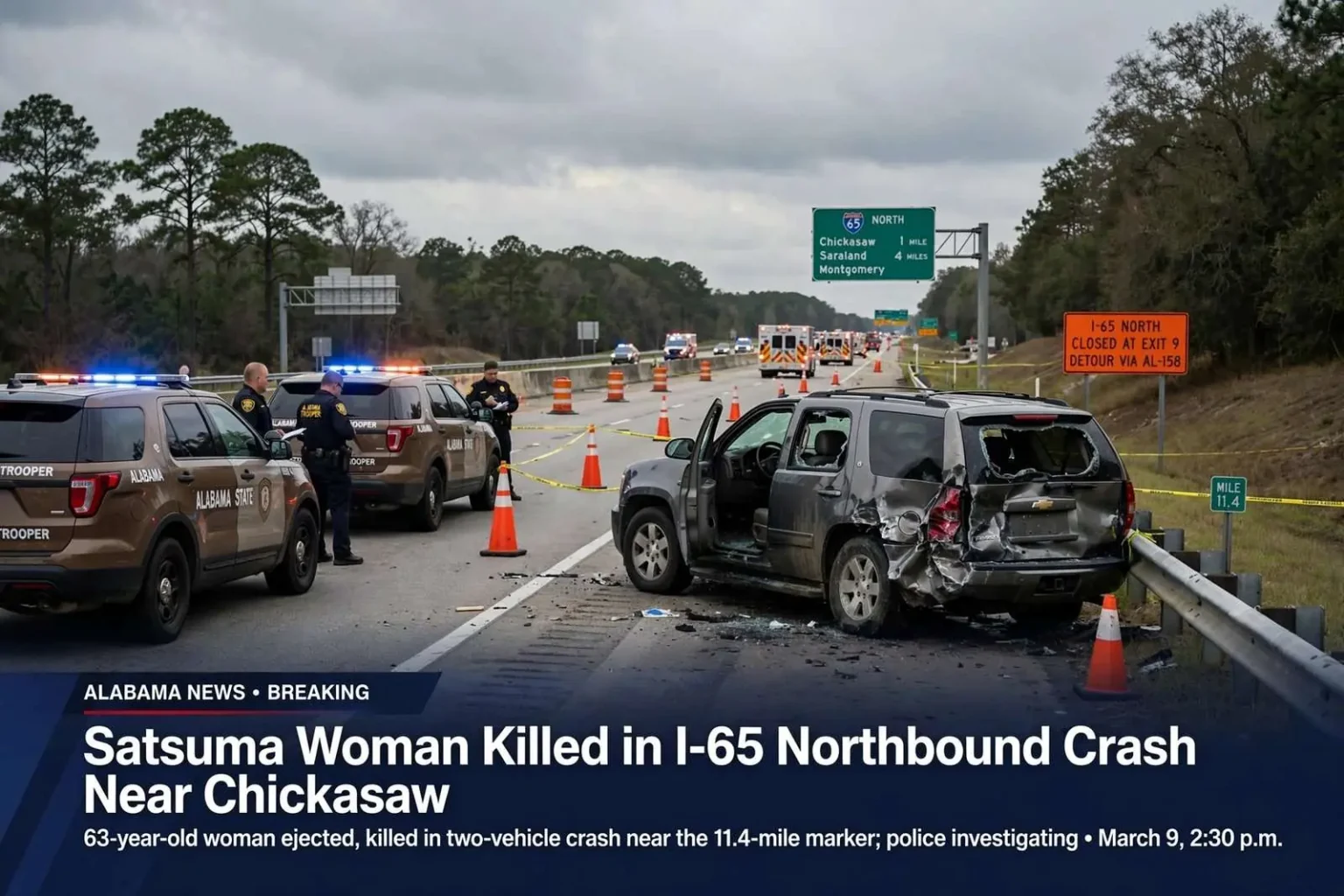
A 63-year-old Satsuma woman died Monday afternoon in a two-vehicle crash on Interstate 65 northbound near Chickasaw, according to Alabama state troopers.
Troopers with the Alabama Law Enforcement Agency said the collision happened around 2:30 p.m. on March 9 at the 11.4-mile marker. Investigators determined that a 2010 Infiniti G35 driven by Brandon Mann, 29, of Saraland, struck the rear of a 2003 Chevrolet Avalanche.
The victim
The Avalanche’s driver, Clarissa Murphy, 63, of Satsuma, was ejected from the sport utility vehicle and was pronounced dead at the scene. Troopers said she was not wearing a seat belt. Mann was not injured.
Ejection from a vehicle is among the deadliest outcomes in highway crashes, and it is the outcome seat belts exist to prevent. Federal and state safety data have shown for decades that occupants who are ejected in a crash are far more likely to be killed than those who remain inside the vehicle, and troopers throughout Alabama document belt use in every fatal crash investigation in part because of how often the absence of a belt distinguishes the fatality from the survivors. The 2003 Avalanche, a full-size pickup-based SUV, offers its occupants substantial structure in a rear-end collision — but that structure protects only those who stay inside it.
Where it happened
The 11.4-mile marker on Interstate 65 sits in the corridor between Mobile’s northern suburbs and the junction where the interstate splits traffic toward Montgomery and Huntsville. Northbound, the stretch carries commuters leaving Mobile, freight traffic and the steady flow of vehicles connecting through the Saraland and Chickasaw interchanges. Chickasaw itself sits just east of the interstate, one of the small cities that ring north Mobile, with Satsuma farther north along the same corridor — meaning the crash occurred practically in the middle of the route Murphy traveled regularly as a resident of that town.
Rear-end collisions on interstate mainlines most often occur in the flow of traffic where speeds are high and the difference between vehicles’ velocities — one car slowing, another approaching at speed — leaves little margin. Investigators document the sequence with the same care applied to any fatal crash: vehicle damage, roadway marks, final rest positions and the statements of witnesses who saw the G35 and the Avalanche in the moments before impact.
Traffic impact across north Mobile
The crash backed up northbound traffic for miles, with congestion reported near Exit 9 and Interstate 165 in Prichard as crews worked the scene. Authorities closed the roadway between Lee Street and Alabama 158 while investigators documented the wreck — a closure that swallowed the main route north out of Mobile for a Monday afternoon and pushed drivers onto parallel roads ill-suited for the volume.
The geography explains the scale of the delays. Interstate 165 branches off I-65 near Exit 9 and carries traffic into downtown Mobile and Prichard, and Alabama 158 and U.S. 43 serve the Saraland and Satsuma corridor to the north. With the interstate closed between those points, every northbound driver had to find another way around, and the overflow turned the arterial network of Prichard, Chickasaw and Saraland into a slow-moving detour for the duration of the investigation.
How fatal interstate crashes are worked
The closure between Lee Street and Alabama 158 reflected the demands of a fatal crash investigation. Troopers do not simply clear a wreck in which someone has died: the scene is treated as evidence, photographed and measured in detail, the vehicles examined for mechanical condition and damage patterns, and the roadway itself documented before anything is moved. In serious cases, ALEA’s specialized units assist with reconstruction, and the coroner responds to handle the deceased. Only after all of that can the wreckage be removed and the lanes reopened — a process that routinely takes hours, as Monday’s closure did.
Troopers said the investigation remained ongoing and no additional details were immediately available. The completed investigation will establish what the final report says about speeds, following distance and the chain of events that put the Infiniti into the rear of the Avalanche, and it will inform any enforcement decisions that follow.
The corridor’s crash record
The I-65 corridor through Mobile County is one of the busiest stretches of highway in Alabama, carrying commuter, commercial and through traffic between the Gulf Coast and the interior Southeast. Its interchanges with I-10 and I-165 in Mobile and Prichard rank among the region’s most congested junctions, and the mainline north of the city alternates between dense commuter flow and open-road speeds that invite the kind of rear-end collisions troopers investigate weekly. Crashes at midday, away from the rush hours, still find plenty of company on a mainline that carries tens of thousands of vehicles a day through north Mobile County.
For emergency crews, the corridor’s design shapes every response. Median barriers limit cross-over access, exit spacing runs in miles rather than blocks, and a closed segment strands traffic between interchanges — which is why a closure between Lee Street and Alabama 158 backed vehicles up through two interchanges and into the I-165 junction within a short time.
Satsuma and the surrounding towns
Murphy’s hometown of Satsuma sits north of Chickasaw along the U.S. 43 corridor, a small city of residential neighborhoods and schools whose residents commute south into Mobile or north toward Saraland each day. I-65 is the faster option, and the 11.4-mile marker sits along the route a Satsuma driver would take toward Mobile or the interstate’s northbound destinations. The news of a fatal crash close to home traveled quickly through the town’s networks, as it does in every small community when the victim is a familiar name.
The surrounding communities — Chickasaw, Prichard, Saraland and Creola among them — share the corridor and the risks that come with it. Local law enforcement and fire departments train for interstate responses, and Monday afternoon’s closure was handled by the agencies whose districts meet along that stretch: state troopers working the investigation, with local crews managing the traffic that the closure displaced.
Seat belts and ejection
The detail that Murphy was not wearing a seat belt will stand as the case’s starkest fact. Alabama’s seat belt law makes belt use mandatory for drivers and front-seat passengers, and troopers note belt status in every crash report because the correlation with survival is the clearest pattern in highway fatality data. In a rear-end collision, an unbelted occupant is thrown against the interior or, at higher closing speeds, through glass and sheet metal — and an occupant ejected onto an interstate roadway faces the impact twice, once with the vehicle and once with the pavement or oncoming traffic.
Safety officials use every fatal ejection to repeat the arithmetic: most crash survival comes down to staying inside the structure that engineers built to absorb the impact. The Avalanche’s occupant compartment was designed to protect a belted driver in exactly the kind of collision that occurred at the 11.4-mile marker; without a belt, that engineering never came into play.
The afternoon’s disruptions
For the drivers caught behind the closure, the crash turned a routine Monday into a detour. Congestion near Exit 9 and the I-165 junction in Prichard built quickly as northbound volume met a closed mainline, and the parallel routes through Prichard, Chickasaw and Saraland absorbed traffic for which they were never designed. Commercial freight, school transportation and evening commuters all shifted to the secondary network, and the delays persisted for as long as troopers needed the roadway.
This is the standard pattern for fatal interstate investigations in the Mobile area, and local drivers have learned to check traffic reports when a mainline closure is reported — the alternative is sitting in a parking lot of vehicles with no exit available between the closure points.
Seconds that decide the outcome
Reconstruction of a rear-end fatal typically comes down to a few seconds of motion. The Infiniti and the Avalanche were both moving north on the same mainline in midafternoon traffic when the gap between them closed to nothing, and everything the investigation will eventually say about the crash lives in the evidence of that closing: how long the skid or absence of skid marks runs, where the debris field starts, how far the vehicles traveled after impact, and where each came to rest relative to the lanes. Those measurements, taken before the wreck is moved, are the raw material of the final report.
The closure between Lee Street and Alabama 158 gave troopers the time and space to take those measurements properly. Investigators work behind traffic cones and closure vehicles on a live interstate, documenting a scene that remains under the control of the Highway Patrol Division until the evidence work is complete — the reason fatal crashes close highways even when the wreckage could physically be cleared much sooner.
What remains to be determined
Troopers said the investigation remained ongoing, and the questions a completed report will answer are the standard ones for a rear-end fatal: how fast the Infiniti was traveling, whether braking or evasive action preceded the impact, what slowed or stopped the Avalanche, and whether factors such as distraction or impairment contributed. The answers determine citations, insurance findings and, for the families involved, the account of what happened in the seconds before 2:30 p.m. on March 9.
What the initial report establishes is the outcome: a 63-year-old Satsuma woman, Clarissa Murphy, dead at the scene after being ejected from her Chevrolet Avalanche on I-65 northbound near Chickasaw, the driver of the Infiniti uninjured, the highway closed for hours between Lee Street and Alabama 158, and the investigation continuing.