Schedule Change at the Crescent: ‘Conviction’ Opens Friday
Hilary Swank's true-story legal drama 'Conviction' opens Dec. 3 at Mobile's Crescent Theater as 'Hornet's Nest' ends its run; 'Four Lions' follows Dec. 10.
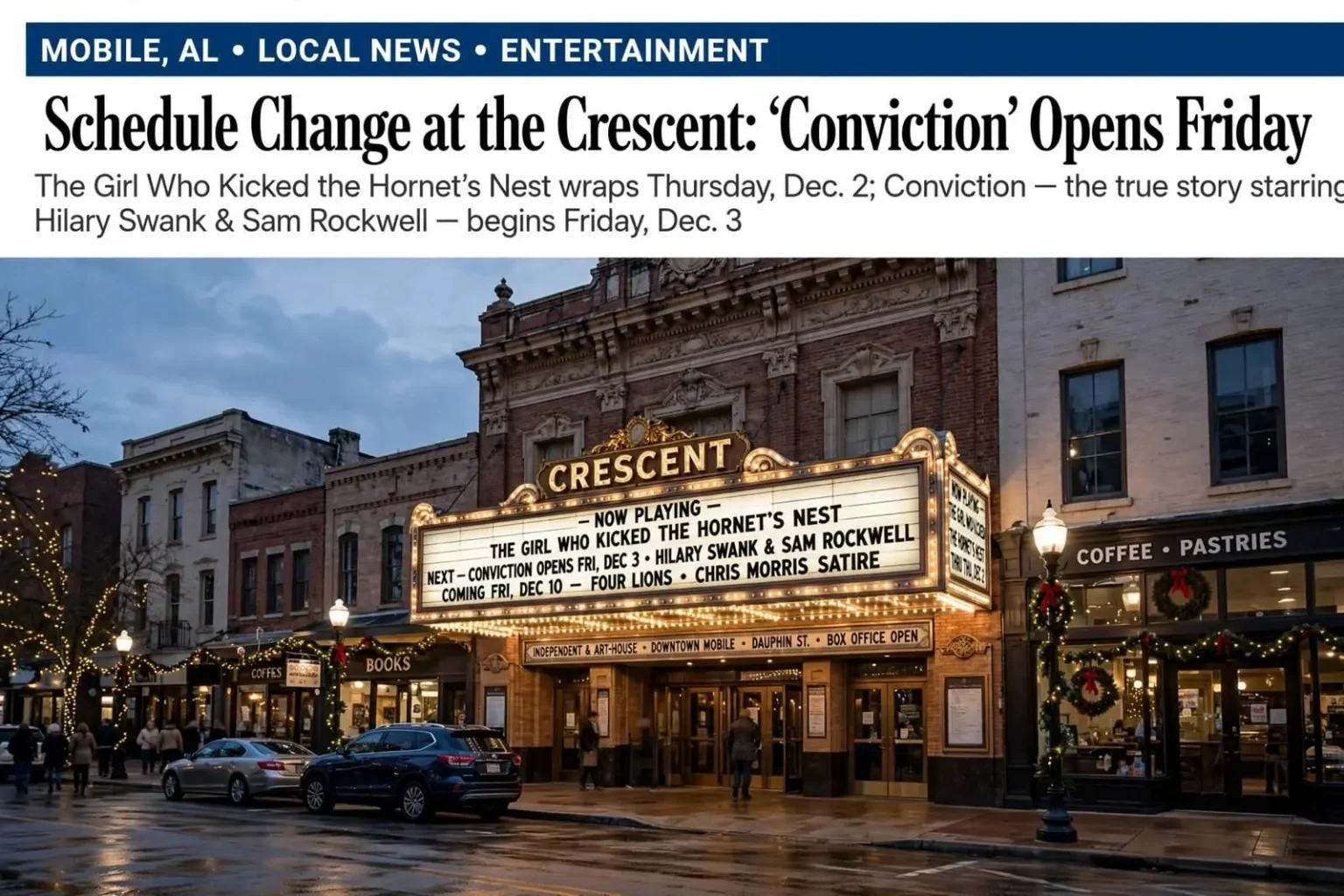
Downtown Mobile’s Crescent Theater is changing marquee this week, and the timing gives moviegoers back-to-back reasons to keep heading to Dauphin Street as the holiday season gets underway. The Girl Who Kicked the Hornet’s Nest, the Swedish thriller that has anchored the theater’s schedule in recent weeks, wraps its run this Thursday, December 2. Starting Friday, December 3, the Crescent screens Conviction, the inspirational true story of a sister’s unwavering devotion to her brother and her long fight to overturn his wrongful murder conviction. Hilary Swank and Sam Rockwell star.
For a single-screen house that has built its reputation on a fast-moving rotation of independent and art-house titles, the swap is business as usual — and a sign that the theater intends to stay busy straight through December. The plan does not stop with Conviction. Following that, Chris Morris’ satire Four Lions opens Friday, December 10, keeping the theater’s rotation of new independent releases moving through the holiday season.
The departures and arrivals trace a familiar pattern for the Crescent. The theater, tucked into downtown Mobile’s entertainment district, has long specialized in films that play the national art-house circuit but often skip the Gulf Coast’s larger multiplexes. A title like The Girl Who Kicked the Hornet’s Nest — the third and final chapter of Stieg Larsson’s Millennium trilogy — is exactly the kind of booking the Crescent exists to bring to local audiences, and the same goes for what is coming next.
Wrapping up the Millennium trilogy
The Girl Who Kicked the Hornet’s Nest closes out the screen adaptation of Larsson’s best-selling trilogy, which began with The Girl with the Dragon Tattoo and continued through The Girl Who Played with Fire. The films follow the punk-hacker Lisbeth Salander and journalist Mikael Blomkvist as they tangle with corruption, violence and institutional cover-ups in Sweden. The final installment picks up in the immediate aftermath of its predecessor’s cliffhanger, sending Salander into an intensive-care unit and a courtroom showdown that puts her entire history on trial.
Thursday, December 2, marks the last local chance to see it on the Crescent’s screen. Patrons who have followed the trilogy in Mobile — where the theater has carried the earlier chapters as they moved through their runs — will want to catch the conclusion before the projector moves on. The theater’s schedule runs in these short, sharp windows, and a missed week usually means waiting for home video.
The exit of the Millennium trilogy also clears the deck for a very different kind of film. Where the Larsson adaptations are dark, adult Scandinavian thrillers, the incoming headliner is an American courtroom drama with an emotional core drawn from real events. It is a programmed contrast, and for audiences the effect is a chance to see two of the fall’s most talked-about independent releases within a single two-week stretch.
Conviction: a sister’s twenty-year fight
Conviction tells the story of Kenny Waters, a Massachusetts man convicted of a 1980 murder he always insisted he did not commit, and his sister Betty Anne Waters, who spent nearly two decades — including years of night classes, a college degree and a law degree — working to win his freedom. Hilary Swank, a two-time Academy Award winner for Boys Don’t Cry and Million Dollar Baby, plays Betty Anne. Sam Rockwell plays Kenny, in a performance that moves between the character’s rough-edged charm and the quiet despair of a man watching decades pass behind bars.
The film dramatizes the machinery of exoneration: the appeal filings, the skeptical investigators, the search for old evidence and the DNA testing that eventually became the case’s decisive turn. For Mobile audiences, the subject lands with particular resonance. Innocence work and post-conviction litigation have been recurring stories in Alabama’s courts, and a film that shows what it actually takes to reopen a decades-old murder case — persistence measured in years, not news cycles — gives moviegoers a grounded look at a process most know only from headlines.
Swank’s involvement was a draw for the film’s distributor, and her presence signals the kind of prestige title the Crescent has made a habit of landing during awards season. December is when the industry’s year-end contenders begin arriving on screens nationwide, and a theater that commits to them gives downtown audiences a seat at the table without a drive to New Orleans or Pensacola.
Sam Rockwell’s breakout year
For Sam Rockwell, Conviction arrived in the middle of a remarkable run. The New York-born actor had spent years building a reputation as one of American film’s most watchable character performers, with roles ranging from ensemble comedies to the lone astronaut of the indie favorite Moon. His work as Kenny Waters put that range to a different test, asking him to play a real man whose life was suspended by a wrongful conviction and whose freedom depended on his sister’s stubborn refusal to accept the verdict.
Rockwell’s casting opposite Swank gave the film its emotional engine. The siblings’ relationship — volatile, funny, deeply loyal — is the story’s spine, and the actors’ scenes together carry the weight of the real family’s history. The script follows Betty Anne from her working-class life through her improbable climb into the legal profession, a journey that took more than a decade of night school before the courtroom strategy could even begin.
The true story behind the film has become a staple of wrongful-conviction discussions in the years since its release. It stands alongside other real-world exoneration cases that have shaped how the public understands the appeals process, DNA evidence and the fallibility of eyewitness testimony. For a community like Mobile, where local coverage of trials and post-conviction motions is a steady part of the news calendar, the film offers a dramatized but faithful map of that terrain.
Four Lions brings the satire
The next Friday brings a harder left turn. Four Lions, which opens at the Crescent on Friday, December 10, is the feature debut of British satirist Chris Morris, a writer and director whose television work made him one of the most celebrated and controversial comedy minds in the United Kingdom. The film premiered at Sundance and earned attention on both sides of the Atlantic for its audacious premise: a comedy about a cell of hapless would-be terrorists in Sheffield, England, whose incompetence rivals their fanaticism.
Morris built the film on years of research into real extremism cases, and the result is a satire that laughs at radicalization while refusing to trivialize its dangers. Critics were divided on the taste of the enterprise but largely admiring of the execution, and the film has since settled into a reputation as one of the sharpest political comedies of its era. Its arrival on the Gulf Coast was the kind of booking only a theater like the Crescent could be counted on to make — a foreign-financed satire with no multiplex marketing machine behind it.
The pairing of Conviction and Four Lions across consecutive Fridays shows the range the Crescent works to maintain. One week the screen holds a sincere, fact-based courtroom drama; the next, a dark British comedy that turns its lens on the war on terror. Both are the kind of titles that depend on word of mouth, and both depend on exactly the audience downtown Mobile has cultivated: moviegoers who check the marquee weekly and take a chance on something new.
What it means for the holiday schedule
For residents who plan their week around the theater’s listings, the message is simple. The Girl Who Kicked the Hornet’s Nest finishes Thursday, December 2. Conviction takes over Friday, December 3, and plays through the following week. Four Lions arrives Friday, December 10, keeping the rotation of new independent releases moving through the holiday season.
The theater’s steady turnover matters beyond convenience. A single screen that changes films weekly can carry far more titles per year than a multiplex auditorium that holds a blockbuster for a month, which means more of the year’s independent films actually reach Mobile. Each Friday swap is, in effect, a small referendum on whether local audiences will support non-studio cinema — and the theater’s continued operation suggests that they have.
Downtown’s moviegoing options have narrowed and recovered over the years as the city’s center has redeveloped, and the Crescent has been a consistent part of that story, sharing the calendar with the restored historic houses and the festival screenings that pass through Mobile each season. A December slate that moves from a Swedish crime saga to a true-life exoneration drama to a British satire is a fair snapshot of what the theater is for.
Moviegoers can expect the pattern to continue after Four Lions as well. The holiday weeks traditionally bring a wave of year-end releases — awards contenders, festival favorites and the small dramas that studios position for the season — and the Crescent’s December bookings position it to carry its share of them. For now, the immediate schedule is set: one last night with Lisbeth Salander, then two weeks of American true crime and British satire, all within walking distance of Dauphin Street’s restaurants and bars.