Schillinger Road Crash: Truck Driver Critically Hurt After 30-Minute Rescue in West Mobile
A collision between an 18-wheeler and another vehicle near 35 Schillinger Road North left a man trapped for about 30 minutes and hospitalized in critical condition Thursday, Mobile Police said.
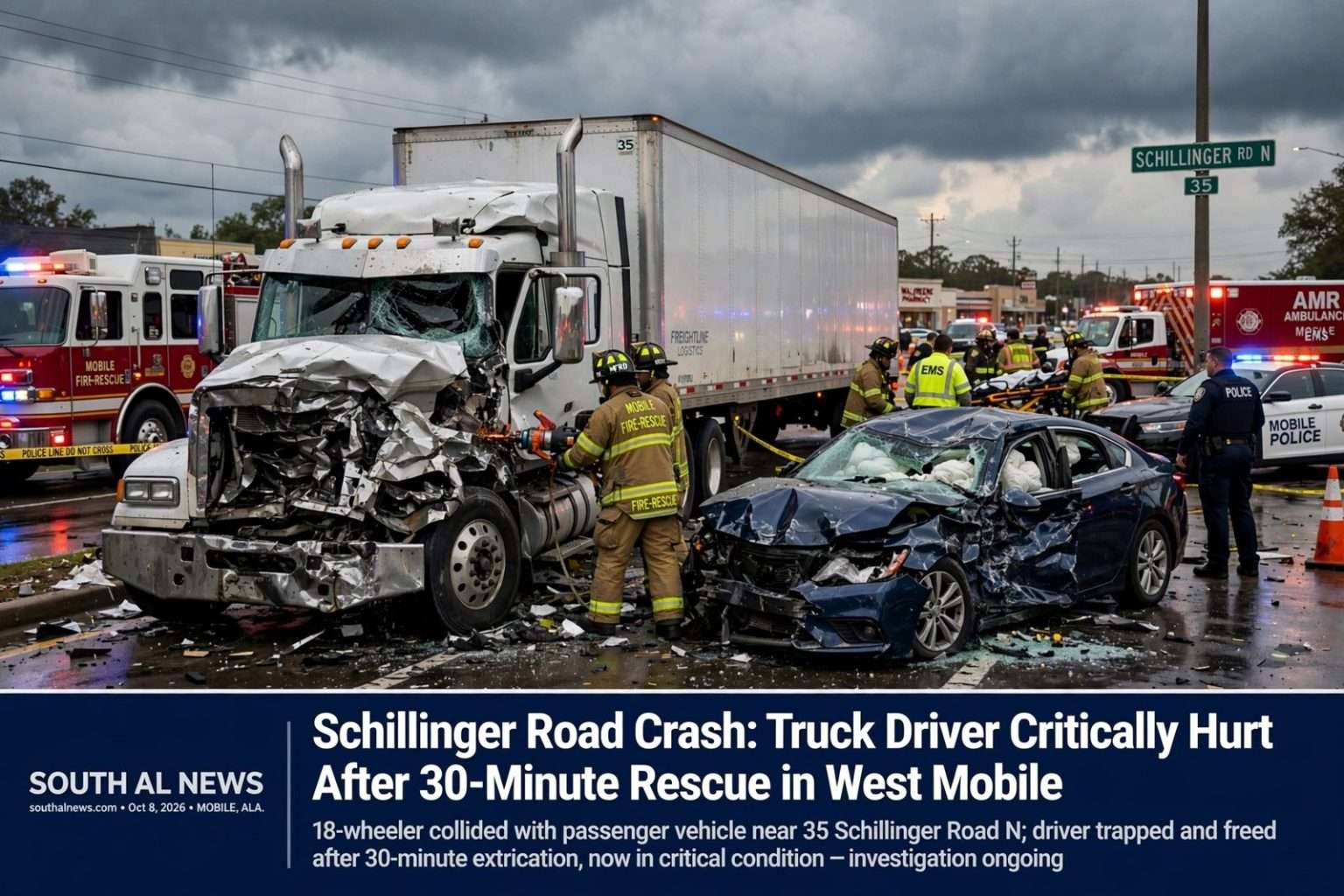
MOBILE, Ala. — A Schillinger Road crash between an 18-wheeler and another vehicle late Thursday afternoon, Oct. 8, left a man trapped for about half an hour before firefighters could free him, and he was hospitalized in critical condition, according to Mobile Police.
The crash happened at about 5:10 p.m. near 35 Schillinger Road North, police said. Mobile Fire-Rescue Department crews and emergency medical services responded, and firefighters carried out what police described as an approximately 30-minute extrication to free a male victim from the vehicle.
The man, who initial reports indicated was driving the commercial truck, was taken to a local hospital with life-threatening injuries. There was no word on the condition of the driver of the passenger vehicle.
Mobile Police are investigating the collision. Police did not immediately release the names of either driver, what caused the crash, or whether any charges or citations are being considered.
What police have said
According to a police spokesperson, the collision involved an 18-wheeler and one other vehicle. Officers described the incident as a traffic collision with entrapment, meaning at least one person was pinned inside a vehicle and could not get out without help from rescuers.
The key facts released so far:
- When: About 5:10 p.m. Thursday, Oct. 8, 2026.
- Where: Near 35 Schillinger Road North in Mobile.
- Vehicles: An 18-wheeler and a passenger vehicle.
- Rescue: Mobile Fire-Rescue crews worked for roughly 30 minutes to free a male victim.
- Injuries: The man who was freed was hospitalized with life-threatening injuries and was listed in critical condition. The other driver’s condition was not released.
- Investigation: Mobile Police are handling the investigation.
Police have not said which direction either vehicle was traveling, how the two vehicles came together, or whether anyone else was in either vehicle.
A busy west Mobile corridor
Schillinger Road is one of the main north-south roads in west Mobile, linking neighborhoods, shopping centers, restaurants and businesses on the city’s growing western side. It carries a heavy mix of commuter traffic, delivery vehicles and commercial trucks throughout the day, and late afternoon, when this crash occurred, is typically one of the busiest periods as people head home from work.
The crash came as residents across Mobile and Baldwin counties were preparing for Hurricane Isaias, which made landfall on the Gulf Coast the following day, Oct. 9. Pre-storm errands, supply runs and deliveries often add traffic to commercial corridors in the hours before a storm arrives.
What an extrication involves
When a driver or passenger is trapped after a crash, firefighters must often remove parts of the vehicle around the person rather than simply opening a door. Crews commonly use hydraulic rescue tools, often referred to by the brand name “Jaws of Life,” to spread, cut and pull apart metal, and they may stabilize the vehicle first so it does not shift while rescuers work.
Extrications involving large trucks can be especially difficult. A tractor-trailer cab sits high off the ground, is built of heavy materials, and may be damaged in ways that make it hard to reach the driver. At the same time, medics try to begin treatment as soon as they can reach the patient, because serious injuries are time-sensitive. A rescue that lasts about 30 minutes, as this one did, reflects the complexity crews can face.
Once the patient is freed, EMS crews take over care and transport the person to a hospital. In the Mobile area, patients with the most severe injuries are often taken to hospitals equipped to handle major trauma.
How crash investigations work
Crashes on city streets in Mobile are investigated by the Mobile Police Department. In serious-injury crashes, officers typically document the scene, take measurements and photographs, examine the vehicles, interview drivers and witnesses, and review any available video. Investigators may also look at road conditions, lighting, weather and vehicle damage to determine how a collision happened.
Crashes involving commercial vehicles can add further steps. Large trucks may carry electronic data recorders and electronic logging devices that track speed, braking and hours of service, information that can help investigators reconstruct a crash. Commercial drivers and the companies that operate their trucks are subject to federal safety rules, including limits on driving hours, vehicle inspection requirements and drug and alcohol testing after certain crashes.
Findings about the cause of a crash are often released later, after the investigation is complete, and are not always made public. Police have not indicated that anyone has been charged in connection with Thursday’s collision.
Sharing the road with large trucks
Safety officials regularly remind drivers that tractor-trailers handle very differently from passenger cars. A fully loaded 18-wheeler can weigh up to 80,000 pounds under federal limits for interstate highways, many times the weight of a typical car, which means it needs far more distance to stop and has far less ability to swerve.
Tips commonly offered to drivers include:
- Avoid the blind spots. Large trucks have significant blind spots, sometimes called “no zones,” directly in front, directly behind and along both sides, especially the right side. If you cannot see the truck driver’s mirrors, the driver likely cannot see you.
- Don’t cut in close. Pulling in front of a truck and slowing down leaves the truck driver little room to stop.
- Give wide turns room. Tractor-trailers often swing wide to make right turns. Avoid squeezing between a turning truck and the curb.
- Pass with care. Pass on the left when possible, do so steadily, and do not linger alongside the trailer.
- Stay alert. Put phones away, watch for brake lights and turn signals, and allow extra following distance in heavy traffic.
When you come upon a crash
Drivers who approach an active crash scene should slow down, follow directions from police and firefighters, and give emergency crews as much room as possible. Alabama’s Move Over law requires drivers to move over or slow down when passing stopped emergency vehicles with flashing lights. Anyone who witnesses a crash should call 911 and give as precise a location as possible, such as a street address or nearby business.
People who are not trained should generally avoid moving an injured person unless there is an immediate danger, such as a fire, because movement can worsen spinal and other injuries.
What happens next
Mobile Police are continuing to investigate the crash. Authorities have not released the names of the drivers, an update on the injured man’s condition, or the condition of the driver of the passenger vehicle. Anyone who saw the collision or has information that could help investigators can contact the Mobile Police Department.
South AL News will update this story if police release more information.