
Search continues for missing Washington County woman Terri Gale Sullivan
Investigators continue searching for Terri Gale Sullivan, 45, reported missing from Tibbie in Washington County, Alabama, with the SBI assisting.
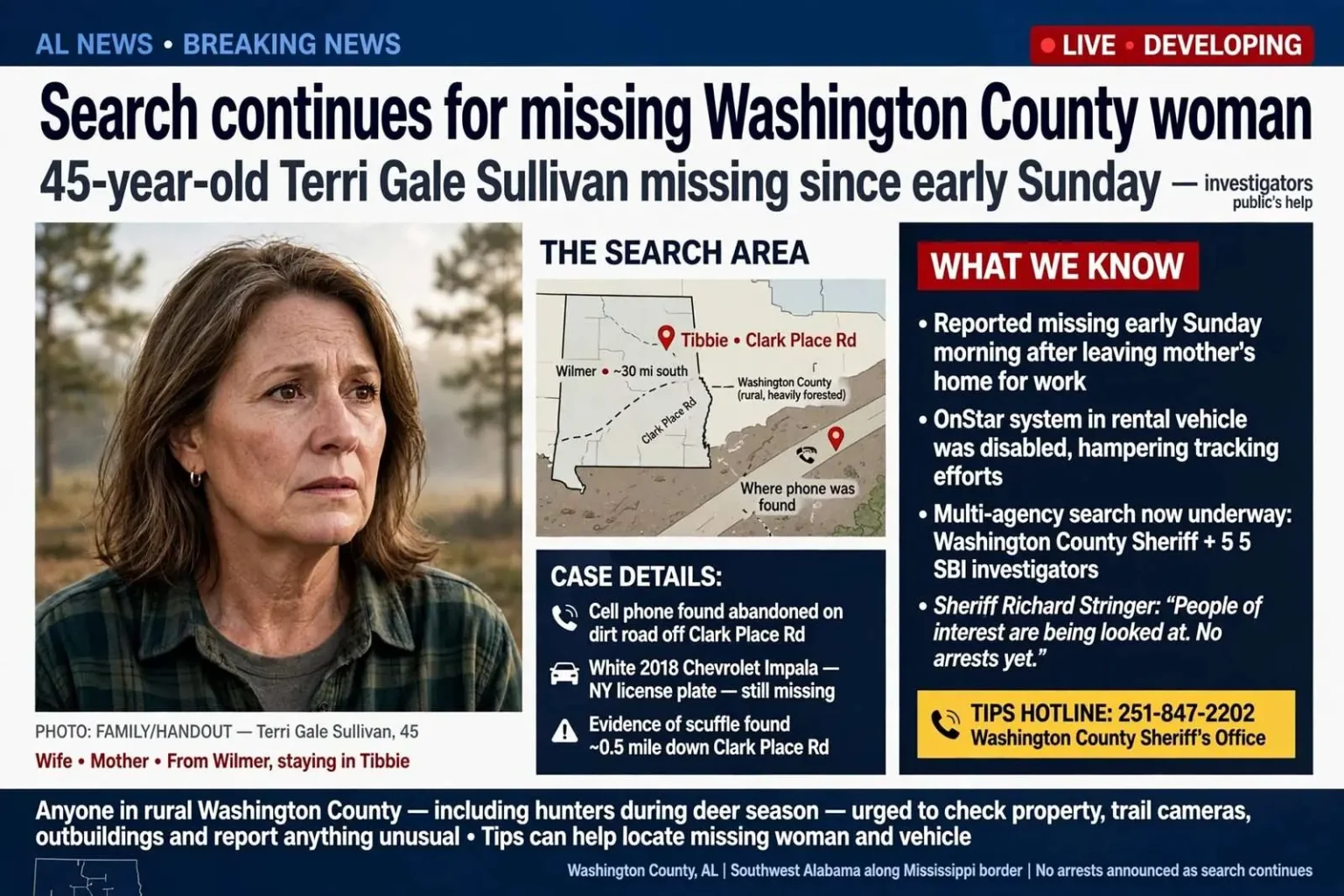
Investigators in Washington County are continuing to search for 45-year-old Terri Gale Sullivan, who was reported missing early Sunday morning and has not been seen since. The case, unfolding in one of Alabama’s most rural counties, has combined local deputies, state investigators, and tips from the public in an effort to piece together what happened after Sullivan left her mother’s home for work.
Sullivan’s cell phone was found on a dirt road shortly after she left for work. The discovery of the phone — abandoned along the route she would have traveled — raised immediate concerns for investigators, because a missing phone is rarely consistent with an adult simply deciding to leave town without telling anyone.
Her rental vehicle, a white 2018 Chevrolet Impala with a New York tag, also has not been located. Investigators said the car’s OnStar system had been disabled. OnStar, General Motors’ connected-vehicle service, can normally be used to locate a vehicle remotely, and authorities said the system’s deactivation added a layer of difficulty to the search and suggested deliberate action rather than chance.
About a half-mile down Clark Place Road in Tibbie, authorities said they found evidence of a scuffle. The discovery gave investigators a focal point for their search and deepened fears for Sullivan’s safety, turning a missing-person report into what Sheriff’s officials have treated as a potential crime investigation.
Who Terri Gale Sullivan Is
Sullivan, who is from Wilmer but had been staying with her mother in Tibbie, is described as a wife and mother. Her disappearance has rippled through two communities — Wilmer, in western Mobile County near the Mississippi line, and Tibbie, a small crossroads community in southern Washington County — as family and neighbors await news.
The circumstances of her disappearance, including the route she took from her mother’s home toward work, have been central to the investigation. The rural roads of Washington County are sparsely traveled, particularly in the early morning hours, which limits the pool of potential witnesses but also means anything unusual along the roadway tends to stand out to those who live there.
Washington County Sheriff Richard Stringer said investigators have people of interest they are looking at. The sheriff’s acknowledgment that individuals have drawn investigative attention signals that detectives are working a direction in the case, though no arrests have been announced and officials have not described the nature of the interest.
Stringer also urged anyone in the remote area — including hunters still in the woods during deer season — to report anything unusual. The timing of the disappearance falls in the heart of Alabama’s deer season, when hundreds of hunters fan out across private and public land in Washington County with binoculars, game cameras, and an eye for anything out of place. Hunters, the sheriff noted, are uniquely positioned to spot disturbances in areas few other people ever enter.
A Multi-Agency Search
Five investigators with the Alabama State Bureau of Investigation are assisting in the case. The SBI, the investigative arm of the Alabama Law Enforcement Agency, regularly lends detectives to county sheriff’s offices in cases that exceed local capacity or require specialized resources. For a county the size of Washington — with a sheriff’s office numbering only a handful of investigators — the state’s help multiplies the manpower available for canvassing, interviews, and evidence work.
Searches in rural Washington County present their own challenges. The county is among Alabama’s most heavily forested, a landscape of pine plantations, hardwood bottoms, creeks, and unpaved roads where visibility is short and terrain can hide evidence from anything but a close, methodical look. Ground searches in such country move slowly and depend heavily on local knowledge of old tracks, hunt camps, and cleared plots.
Residents of Tibbie and surrounding communities have been asked to check their own property — outbuildings, gates, game cameras — for anything that might bear on the case. Trail cameras that hunters use to pattern deer have proven valuable in other missing-person cases, sometimes capturing images of vehicles or people at hours when no one expected traffic.
How the Investigation Is Working
The investigation’s early phases have focused on the physical evidence along Clark Place Road and the timeline of Sullivan’s morning. Investigators typically work backward from the last confirmed sighting, mapping each location where a trace of the missing person or her vehicle has appeared — the home she left, the spot where her phone was found, the scene of the scuffle — and interviewing anyone who passed through those points.
The disabled OnStar system is a detail investigators will press on. The service can be disabled through the vehicle itself or through account actions, and determining how and when it was turned off — and by whom — could narrow the field of suspects. Rental vehicles also carry their own paper trail, from the rental agreement to GPS data held by the rental company, all of which can be obtained through legal process.
The white 2018 Impala with its New York tag is the most visible element of the search, and deputies have asked residents across south Alabama and southeast Mississippi to watch for it. A New York plate on a car in rural Washington County would have been distinctive, and officials are counting on the possibility that someone remembers seeing it parked, driven, or abandoned anywhere in the region.
People of interest, if any are charged, would move through the Washington County court system, but serious charges in a case like this could also involve state or federal prosecutors depending on what the evidence shows. Investigators have released few details about the scuffle scene, consistent with the practice of withholding evidence specifics that only the person responsible would know.
Missing Persons in Rural Alabama
Washington County sits along the Mississippi border in southwest Alabama, a county of small towns — Chatom, Millry, McIntosh, Vinegar Bend — spread across hundreds of square miles of forest and farmland. Its law enforcement resources are modest, and cases that touch on violent crime routinely draw state assistance. The sheriff’s office has emphasized that tips from residents remain the investigation’s most valuable resource.
Sheriff’s officials asked anyone with information to call the Washington County Sheriff’s Office at 251-847-2202.
For families of missing adults, the first days are decisive. Investigators know that the odds of locating a missing person alive and unharmed decline with each passing week, and they structure their work accordingly — fast mobilization, wide canvassing, and aggressive pursuit of every lead while memories are fresh and physical evidence is intact.
The case has drawn attention from communities across southwest Alabama, where news of a scuffle scene and an abandoned phone travels quickly through church networks, social media groups, and rural word of mouth. Area residents have been asked to share official information rather than speculation, since inaccurate rumors can misdirect search efforts and burden investigators with false leads.
As the search continues, investigators are holding to a simple principle: someone knows something. A vehicle on a rural road, a stranger at a hunting camp, a car parked where it should not have been — any of these could be the detail that breaks the case, and the sheriff’s office has made clear that no tip is too small.
The geography of the case matters to how it unfolds. Tibbie lies along Washington County’s southern reaches, where Clark Place Road and similar dirt roads thread between planted pines and creek bottoms, and Wilmer sits roughly thirty miles to the south in Mobile County along U.S. 45. Any movement between the two communities crosses territory where gas stations, churches, and crossroads stores are the only reliable landmarks — and where the people who staff them remember the cars that pass.
Investigators with the SBI bring forensic capabilities that small sheriff’s offices rarely have in-house, including crime scene processing and access to state laboratory analysis. Evidence recovered from the Clark Place Road scene will be examined for anything that can identify who was there and what happened, and the results of that analysis typically shape whether the case advances toward arrests.
Deputies have also continued their own line of work: sitting down with the people who knew Sullivan’s routine, her work schedule, her relationships, and her plans. In missing-person cases that become criminal investigations, that background work is what allows detectives to evaluate the people of interest Stringer referenced and to test each one’s account against the physical evidence.
Community members who want to help have options beyond calling in tips. Keeping the family in their prayers, sharing official releases so they reach hunters and drivers in surrounding counties, and refraining from spreading unverified rumors all serve the investigation. Officials have stressed that the family deserves accurate information and that speculation can cause real harm while the search is active.
Until investigators announce otherwise, the white 2018 Impala with New York plates remains unaccounted for, the phone found on the dirt road remains a key piece of evidence, and the scuffle scene on Clark Place Road remains the case’s center of gravity. Deputies, state investigators, and the family of Terri Gale Sullivan are all waiting on the same thing: a credible sighting, a recovered vehicle, or a tip that explains what happened on the road to work.