Second Annual Charity Contest at MaGhee’s Grill on the Hill Raises Thousands for Wilmer Hall
Mobile's second annual charity contest at MaGhee's Grill on the Hill raised thousands of dollars for Wilmer Hall Children's Home.
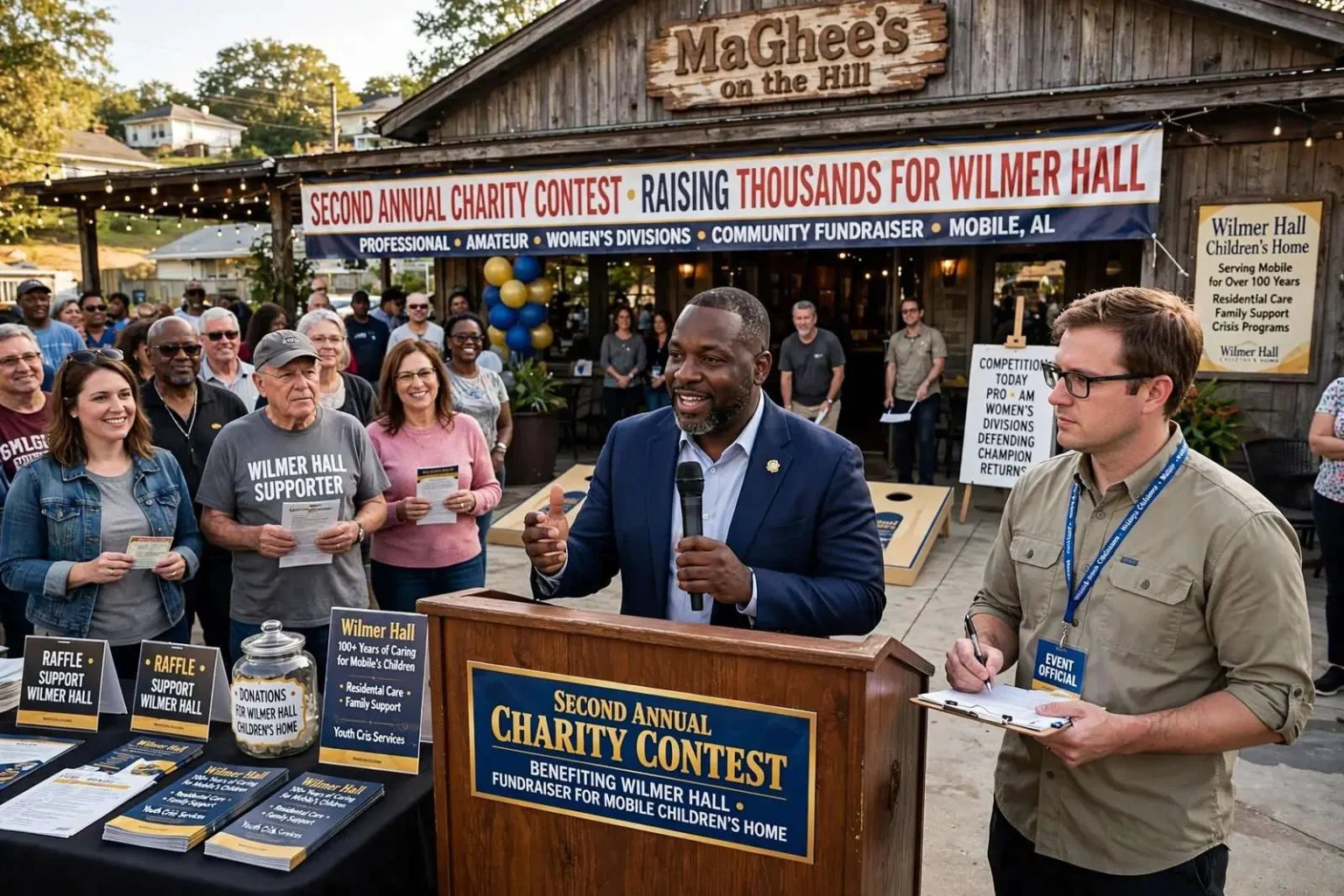
Mobile’s second annual charity contest returned to MaGhee’s Grill on the Hill this weekend, drawing a crowd of competitors and spectators for an event that organizers said raised thousands of dollars for Wilmer Hall, the Mobile children’s home.
The lighthearted competition began the previous year as a fundraiser organized by friends looking for a fun way to raise money for a good cause, and it has since grown into an annual tradition benefiting Wilmer Hall’s programs for children in need of care. What started as a one-off gathering among acquaintances now has the feel of a fixture — the kind of neighborhood event that regulars mark on the calendar and newcomers hear about by word of mouth.
A community turnout
Mobile City Councilman Reggie Copeland took part in the opening ceremony to kick off the competition, and J. Geil served as the event’s official. The presence of a sitting councilman at the opening underscored the event’s growing profile in the community, while the official kept the proceedings moving for a full field of entrants.
Local residents competed across professional, amateur and women’s divisions, giving entrants of every skill level a competitive lane. The division structure did more than organize the brackets: it broadened the base of people willing to sign up, since first-time participants were not facing seasoned veterans head-to-head, and each additional entry fee added to the fundraising total.
The defending professional champion returned to defend his title against a field of new challengers. Organizers said this year’s contest drew a competitive field, with several entrants pushing the reigning champion for the top spot — a sign that the event’s first year had attracted serious repeat competitors rather than a purely casual crowd.
Final results were still being tallied as the event wrapped up, but organizers confirmed the fundraiser brought in several thousand dollars for Wilmer Hall. For a second-year event built from scratch by a group of friends, that total represents meaningful support for the children’s home — and a base to grow from in years ahead.
About Wilmer Hall
Wilmer Hall Children’s Home has served Mobile-area children for more than a century, providing residential care, family support services and other programs for youth in crisis. Its longevity alone sets it apart in Mobile’s nonprofit landscape: an institution that has cared for children across more than a hundred years of the city’s history has adapted through generations of changing needs, from its founding era through the present day.
The home’s work today spans several forms of support. Residential care provides a stable living environment for children who cannot remain at home, while family support services aim to help families stay together or reunify where possible. Programs for youth in crisis extend the mission to young people facing emergencies and disruptions that fall outside the traditional residential model. Together, those services depend on a funding mix that never stands still.
Community fundraisers like the MaGhee’s contest make up a portion of the nonprofit’s annual support, supplementing grants and individual donations. That mix matters operationally. Grants are restricted to specific programs and reporting requirements; large donations can be transformative but unpredictable. Money raised by neighborhood events arrives with no strings attached and, just as important, with a community behind it — dozens or hundreds of local residents who now know the home’s name, its mission and its needs.
For a century-old institution, that visibility is a form of support in its own right. Children’s homes do their work largely out of public view, and the families they serve often arrive quietly. Events like this one introduce the organization to Mobile residents who might never otherwise encounter it, planting the seeds for future donors, volunteers and board members.
The power of the neighborhood fundraiser
The MaGhee’s contest is part of a broader tradition along the Gulf Coast: small businesses anchoring grassroots fundraisers for local causes. Bars, restaurants and neighborhood grills host charity events year-round, and the format works because it asks little of participants — show up, have fun, spend a little — while giving a cause a crowd it could never assemble on its own.
The second year of any such event is the telling one. First-year fundraisers run on novelty and the enthusiasm of the organizing friends; second-year events test whether the tradition can stand on its own. By that measure, the MaGhee’s contest passed comfortably: a returning defending champion, deeper competition across three divisions, an opening ceremony that drew a city councilman, and a fundraising total organizers described as several thousand dollars.
Organizers said they plan to continue the event in future years as a recurring fundraiser for the children’s home. If year two’s momentum holds, the contest is positioned to become one of those Mobile traditions that outgrows its origins — an annual date on the Spring Hill calendar where neighbors gather, compete and raise money for one of the city’s oldest charitable institutions.
What the money supports
Several thousand dollars raised at a one-day neighborhood contest will not balance a children’s home’s budget on its own, but unrestricted gifts of that size have a way of covering exactly the needs that other funding streams cannot: emergency expenses for a child arriving with nothing, program supplies, the small but real costs of daily care that grants rarely reach.
The fundraising total also sets a benchmark for year three. Organizers now know what the event generates at its current size, and every element — division entries, spectators, raffles and event-day spending at the host venue — offers room to grow. Community fundraisers tend to compound: each year’s participants recruit the next year’s, and the cause itself builds loyalty among the regulars who make the event an annual habit.
For Wilmer Hall, the weekend added another name to a long list of community partners, and for MaGhee’s Grill on the Hill, it reinforced the role neighborhood establishments play in Mobile’s civic life. The contest’s organizers set out two years ago to raise money for a good cause in a fun way, and on the evidence of this year’s turnout, the deep competitive field and the several thousand dollars raised, they have built something that will be back — bigger, they hope, with every annual edition on the calendar.
A century of caring for Mobile’s children
To understand what a neighborhood contest’s donation means to Wilmer Hall, it helps to understand the institution receiving it. A children’s home that has operated in Mobile for more than a hundred years has witnessed the city’s entire modern history — depressions, wars, storms and the changing shape of the families who need help. Through all of it, the mission has remained constant: providing a safe place for children whose circumstances have left them without one.
The model of care has evolved considerably over that span. Modern children’s homes are less likely to resemble the orphanages of a century ago and more likely to operate as flexible networks of residential care, family support and crisis services — meeting children where they are, and working to strengthen families rather than simply substitute for them. Wilmer Hall’s present-day programs reflect that evolution, combining residential care with family support services and outreach to youth in crisis across the Mobile area.
Funding that mission is a year-round undertaking. Residential care is expensive by nature — housing, food, education support, counseling and staffing continue whether or not donations arrive — and state contracts and grants, while essential, rarely cover the full cost of care. That gap is where community fundraising comes in, and why events like the MaGhee’s contest, modest as any single one may be, matter to the home’s operations.
How the weekend fit together
The contest’s success rested on a familiar combination. A willing host venue gave the event a home base where competitors and spectators could gather before, during and after their turns. A full slate of divisions kept the schedule moving and the crowd engaged. A city councilman’s presence at the opening ceremony lent the occasion civic weight. And an official keeping order, a returning champion defending his title and a field of hungry challengers supplied the competitive drama that turns a fundraiser into entertainment.
Organizers confirmed the several-thousand-dollar total even as final results were still being tallied, and they described the atmosphere as the best yet in the event’s short history. With plans already set to bring the contest back as a recurring fundraiser for Wilmer Hall, the second annual edition closes with the event’s future secure — and with Mobile’s children’s home a little better supported because a group of friends decided two years ago to have some fun for a good cause.
Entries, spectating and giving will all be on offer again next year, when the contest returns to the Hill for its third run in support of the children’s home.